Ischemic Heart Disease
The association between viral infection (cytomegalovirus or HIV-1 itself) and coronary artery lesions is not clear. HIV-1 sequences have been detected by in situ hybridization in the coronary vessels of an HIV-infected patient who died from acute myocardial infarction (Fig.
3) [7]. Potential mechanisms through which HIV-1 may damage coronary arteries include activation of cytokines and cell-adhesion molecules and alteration of major histocompatibility complex class I molecules on the surface of smooth muscle cells [7]. It is possible also that HIV-1-associated protein gp 120 may induce smooth muscle cell apoptosis through a mitochondrion-controlled pathway by activation of inflammatory cytokines (e.g., TNF-α) [8]. The incidence of ischemic heart disease is apparently increasing among HIV-infected patients receiving protease inhibitor-based highly active antiretroviral therapy (HAART), especially in those who develop HAART-associated meta-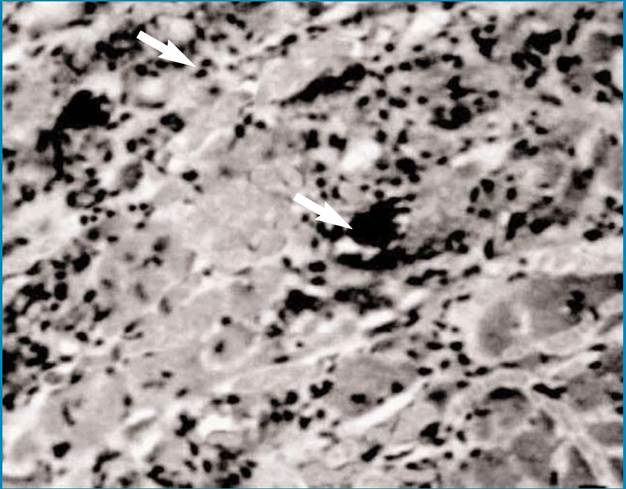
Fig. 2 In situ hybridization from an endomyocardial biopsy sample in an HIV-infected subject with echocardiographic diagnosis of dilated cardiomyopathy (left ventricular ejection fraction: 28%) and histologic diagnosis of active myocarditis. It is possible to observe two myocytes showing a positive signal for nucleic sequences of HIV-1 (arrows). H&E, x20
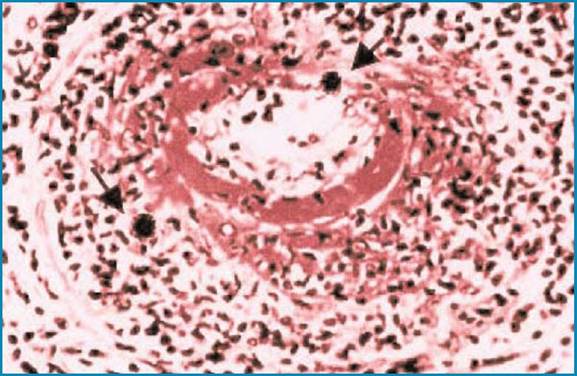
Fig. 3 In situ hybridization of an HIV-1 RNA probe in a transverse section of a branch of the anterior descending coronary artery. Intense staining indicating the presence of HIV-1 sequences within the intima and the media (arrows). There is a dense lymphocyte infiltrate within the media and necrosis of the intima, which is covered with swollen endothelial cells. (From [7], Copyright© 2001 Massachusetts Medical Society. All right reserved). H&E, x280
bolic syndrome during therapy [9]. However, studies on the risk of coronary heart disease in this subset of patients remain controversial [10-14].
Pathologic examination of coronary arteries generally reveals eccentric fibroatheromatous plaques with variable degrees of chronic inflammatory infiltrates. Lesions with morphologic features similar to accelerated arteriosclerosis have been described at autopsy of young HIV-infected patients [2, 3]. The pathology of coronary and peripheral vessels in HIV infection is described in detail by A. Tabib and R. Loire in a separate chapter in this volume.
More on the topic Ischemic Heart Disease:
- Ischemic Heart Disease
- Coronary Heart Disease
- Macrovascular Complications of Diabetes Mellitus
- CONGENITAL HEART DISEASE
- Common HIV Therapies and the Heart
- Barbaro Giuseppe, Boccara Franc (eds.). Cardiovascular Disease in AIDS. 2nd edition. — Springer,2009. — 169 p., 2009
- Ventricular Tachyarrhythmias
- Preoperative Cardiac Evaluation
- Heart Failure
- Fundamentals of healthy lifestyle