Team Formations
Team formation questions are another question type which are commonly seen in most exams. The questions consist typically of a group of people/objects that have to be put together in teams— albeit with a set of ConstraintsZconditions about certain people who need to be put together/ cannot be put together in a team.
The key skills involved in solving team formation questions would involve the following:
(i) The ability to visualise the structure of the teams to be formed including the number of people/objects in each team
(ii) The ability to order the clues in the correct order of usage (as explained in the theory of logical reasoning)
(iii) The ability to create symbolic representations of the various clues provided so that you can bring together each of the relevant clues while creating the teams
(iv) The ability to wait for and reach the appropriate time in the problem solving situation from where the indirect clues provided in the question can be used.
Illustrated below are the solutions to a few typical questions on team formations. We would urge you to first have a look at the questions and try to solve the same on your own before looking at the solutions.
Example 1
Directions for Questions 1 and 2: Read the information given below and answer the questions.
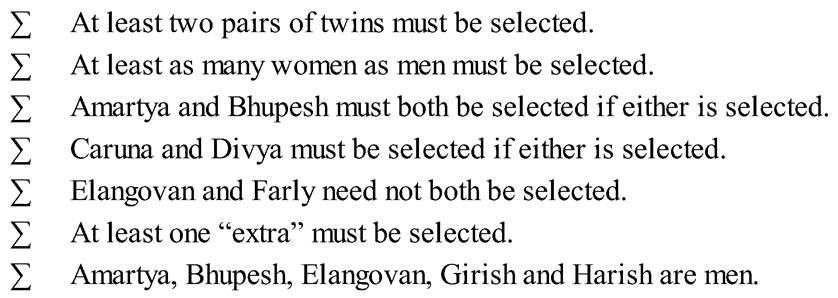
A director is casting a movie about twins.Selection must be made from among nine people—Amartya, Bhupesh, Caruna, Divya, Elangovan, Farly, Girish, Harish, and Isha. Amartya is Bhupesh’s twin, Caruna is Divya’s twin, and Elangovan is Farly’s twin.
Girish, Harish and Isha may each be selected only as “extras.”
1. Which of the following is an acceptable cast for the movie?
(a) Amartya, Bhupesh, Elangovan, Farly, Isha
(b) Caruna, Divya, Farly, Girish, Harish, Isha
(c) Bhupesh, Caruna, Divya, Elangovan, Harish, Isha
(d) Caruna, Divya, Elangovan, Farly, Girish, Harish, Isha
2.
Which of the following people must be included in the cast?(a) Divya (b) Isha
(c) Farly (d) Harish
Solution:
To solve this we will create a diagram where men will be denoted by upper case letter and women with lower case letters and we will list the extras separately to avoid confusion. Here given that Caruna and Divya must both be selected because if they were not selected then Amartya and Bhupesh or Elangovan and Farly (three of whom are men) would all be selected; as a result only two women Farly and Isha at most will be selected. However according to the constraints at least as many women as men must be selected, thus Caruna and Divya must both be selected.
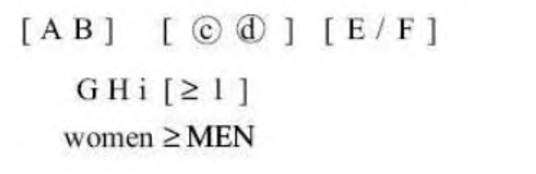
1) Eliminate each options using the clues given in the information. Only option (d) suffices. Hence option (d) is the correct answer.
2) Caruna and Divya must both be selected. Hence option (a) is the correct answer. Example 2 Vijayshree wants to take four courses this trimester. There are only seven
courses in which she is interested: three marketing courses - Distribution, Advertising and PR; and four Finance courses— International Finance, Accounting, Corporate Finance and Financial Services. To meet college requirements she must take two marketing courses. There are some scheduling problems: International Finance overlaps both Advertising and Corporate Finance but she can choose Advertising and Corporate Finance as two different courses. Distribution is given at the same time as Accounting.
1. IfVijayshree decides she will take International Finance, what will her other three courses be?
(a) Distribution, PR and Advertising
(b) Distribution, PR and Financial Services
(c) Distribution, PR and Accounting
(d) PR, Advertising and Financial Services
2. If Vijayshree takes four courses this trimester, then which of the following statement is not possible?
I. She takes Accounting and does not take Advertising.
II. She takes Corporate Finance and does not take Advertising.
III. She takes International Finance and does not take PR.
(a) I only (b) II only
(c) III only (d) I and III only
3. Which of the following must always be true?
I. Vijayshree must take PR if she takes Corporate Finance.
II. Vijayshree must take Advertising if she takes Accounting.
III. Vijayshree must take Accounting if she takes Advertising.
(a) I, II, and III (b) II, and III only
(c) I and II only (d) II only
Solution:
(1) It can be seen that if she takes International Finance, she would not be able to take the Advertising and Corporate Finance course. This means that she has to choose Distribution and PR as her two marketing courses and because Distribution overlaps with Accounting, her second finance course must be Financial Services. Option (b) is correct.
(2) Statement I is definitely not possible because if she takes Accounting she cannot
take Distribution and she must have to take Advertising.
Statement II is possible, while statement III can be seen to not be possible as if she takes International Finance she has to take PR as Advertising would not be available to her.
Option (d) is correct.
(3) Statement I is not necessarily true as if she takes Corporate Finance she can take up Distribution and Advertising and skip PR. i.e. PR is not necessary if she has taken Corporate Finance.
Statement II is mandatorily true because if she takes Accounting, she cannot take Distribution and hence she would be forced to take up Advertising as one of her two compulsory marketing courses. Statement III is not necessarily true. Thus option (d) is correct.
Example 3
Directions for Questions 1 to 3: Answer the questions based on the following information.
At Semco, Ricardo Serdar has perfected the art of employee motivation. Due to this, his staff works 7 days a week. However, he has given them the leeway that in every week they are allowed to work for the company on any 4 days and for the remaining 3 days of the week every employee is allowed to work on his own entrepreneurial project.
On a particular day, Mr. Serdar was looking closely at the functioning of 3 of his most trusted executives and found out a few facts about their weekly schedule.Each of them work for the company ody 4 days a week and work on their own projects for 3 days every week.
All the three executives work together (for the company) ody once in a week.
None of them works for the company for 3 consecutive days.
Ardt works on his project on Tuesdays, Thursdays and Sundays.
Birdesh works on his own project on Saturday.
Chetan does not work for the company on Fridays and Sundays.
No two executives have an own project work day on the same day more than once a week.
At least 1 person works for the company everyday of the week.
1. On which day of the week do all the three executives work together?
(a) Monday (b) Wednesday
Solution:
The following table emerges from the given conditions: (P denotes working on own project)
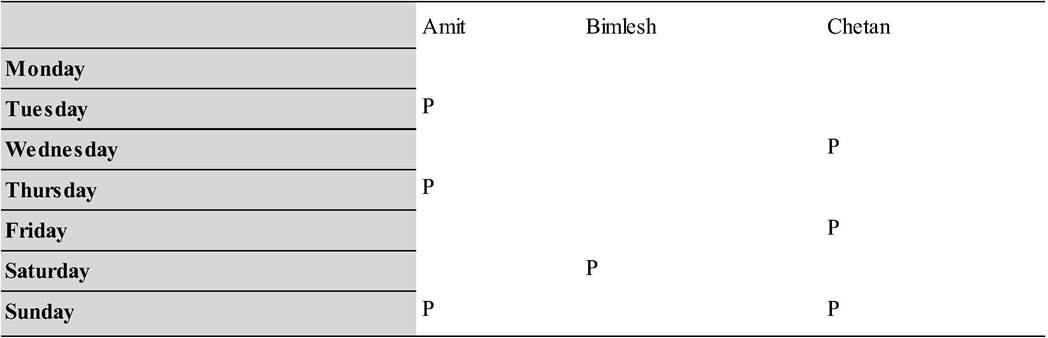
Note: Chetan’s third P is on Wednesday because it cannot be on Tuesday or Thursday (as in that case Chetan and Amit would be working on their projects together on two days of the week.) Also, Chetan’s third P cannot be on Monday in which case Chetan would be working continuously for the company for 3 days.
Thus, the answers are:
1. Option (a) (Monday)
2. Option (c) (Wednesday)
3. Sunday is necessarily a company working day for Bimlesh. Option (c) is correct.
Example 4 Study the following information carefully and answer the questions given below:
7 friends A, B, C, D, L, M and Z are going to a new year’s party on mobikes in Goa. Since it is late at night they do not anticipate any police presence and hence have taken only 3 bikes - an Enfield, a Honda and a TVS, with at least 2 of them sitting on each bike (hence there is triple riding on at least 1 bike).
There is exactly one male on each bike. Amongst the group there are two executives, two designers and three psychologists among them.(i) Cisa lady designer and she does not travel with the pair of sisters, A and M.
(ii) B, a male executive, travels with only Z, a psychologist on an Enfield bike.
(iii) D is a male designer.
(iv) Two persons belonging to the same profession do not travel on the same bike.
(v) Ais not an executive and travels on the Honda.
1. What is M’s profession?
(a) Executive (b) Psychologist
(c) Designer (d) Data inadequate
2. On which bike does C travel?
(a) Enfield (b) Honda
(c) TVS (d) Either Honda or TVS
3. Which of the following represents the three psychologists?
(a) ZLM (b) ZLA
(c) ZLM or ZLA (d) None of these
Solution:
We start from clue (ii) and get the following table:

(Note we can conclude that Z is a female because there is exactly 1 male on each bike). We denote females in our figures with an underline.
We further know that A and M are sisters and Cisa lady designer. Since 2 persons with the same profession cannot travel together, D and C must be traveling on different bikes. Thus, D should be clubbed with A & M. Also, since A is on a Honda, the Honda should have 3 people A, M and D. 
From this point in the solution, we need to concentrate only on the professions of A, M and L. We also know that we are yet to identify 1 executive and 2 psycholoigsts. Further, according to the constraint of clue (iv) both A and M cannot be psychologists. Thus, L must be a psychologist. Also, since, we know that A is not an executive we can conclude that A must be a psychologist and the final table emerges as follows:

The answers are:
1.
Executive. Option (a) is correct.2. On the TVS. Option (c) is correct.
3. Z, L and A represent the three psychologists. Option (b) is correct.
Example 5
Direction for Questions 1 to 3: Study the following information carefully to answer the questions given below:
Examinations of eight papers were conducted in a week, from Monday to Saturday. The papers were: Advertising, Biology, Chemistry, Distribution, Quantitative Techniques, Finance, Marketing and Heuristics. Not more than two papers were organised in a day. Only one of the days, during Monday to Saturday, was the rest day. The paper on Distribution was held just before the Finance paper, but immediately after the Heuristics paper. It is also known that there was no rest day between any two of these three papers. The tests were split equally between the days before the rest day and the days after the rest day, i.e., tests of four papers were held before the rest day whereas four papers were held after the rest day. Thursday was not the rest day. Quantitative Techniques and Finance were held on the same day. The paper on Heuristics was not held either on Thursday or on Friday. The papers on Marketing and Biology were held just before Advertising and Chemistry respectively. The paper on Advertising was held just before the paper on Biology.
1. Examinations of which papers were held on Monday?
(a) Heuristics and Distribution
(b) Distribution and Finance
(c) Marketing and Advertising
(d) Can’t be determined
2. Which of the following days was the rest day?
(a) Tuesday (b) Wednesday
(c) Thursday (d) Can’t be determined
3. Examinations) of which of the following papers was /were held on Friday?
I. Marketing
II. Advertising
III. Biology
IV. Chemistry
(a) Only II
(b) Only III
(c) Either II or III or both II and III
(d) Both II and III
Solution:
The thinking in this question would go as follows:
From the statements “Examinations of eight papers were conducted in a week, from Monday to Saturday. Not more than two papers were organised in a day & only one of the days, during Monday to Saturday, was the rest day.” We realise:
8 papers are conducted in 5 days with not more than 2 papers on any single day. This means that there must be exactly 3 days when 2 papers each are conducted.
Further when we read “Tests of four papers were held before the rest day whereas four papers were held after the rest day”, we realise that there must be at least 2 days before the rest day and 2 days after the rest day. This obviously means that the rest day must be either on Wednesday or on Thursday.
Also as we go further down the problem we realise: “Thursday was not the rest day.” We realise that the rest day must be on Wednesday. Thus, both Monday and Tuesday must have had 2 exams each.
From the statements: “The papers on Marketing and Biology were held just before Advertising and Chemistry respectively. The paper on Advertising was held just before the paper on Biology.” We get that Marketing-Advertising-Biology-Cheinistry must be the order for these 4 subjects and also that there must not be any other paper between these 4 papers.
At this point we know the following structure of the respective days and the papers on each day:

In the above figure we also know that between Thursday to Saturday exactly one day has 2 papers. Thus, there could be 2 papers on any one of the days viz: Thursday, Friday or Saturday.
Further using the statements “The paper on Distribution was held just before the Finance paper, but immediately after the Heuristics paper. It is also known that there was no rest day between any two of these three papers & Quantitative Techniques and Finance were held on the same day. The paper on Heuristics was not held either on Thursday or on Friday.” We get:
Heuristics-Distribution-Finance-Quantitative Techniques as one order of papers which can either be placed before the rest day or after. However, if we were to try to place these 4 papers after the rest day, we would need to put Heuristics on Thursday which contradicts the conditions of the problem. Thus, these 4 papers can only be assigned to Monday and Tuesday (2 papers each). This also means that: Marketing- Advertismg-Biology-Chemistry must be after the rest day.
Based on these conclusions there are 3 possible ways in which the exams can be structured (depending on which day we use for putting 2 papers after Wednesday). These are
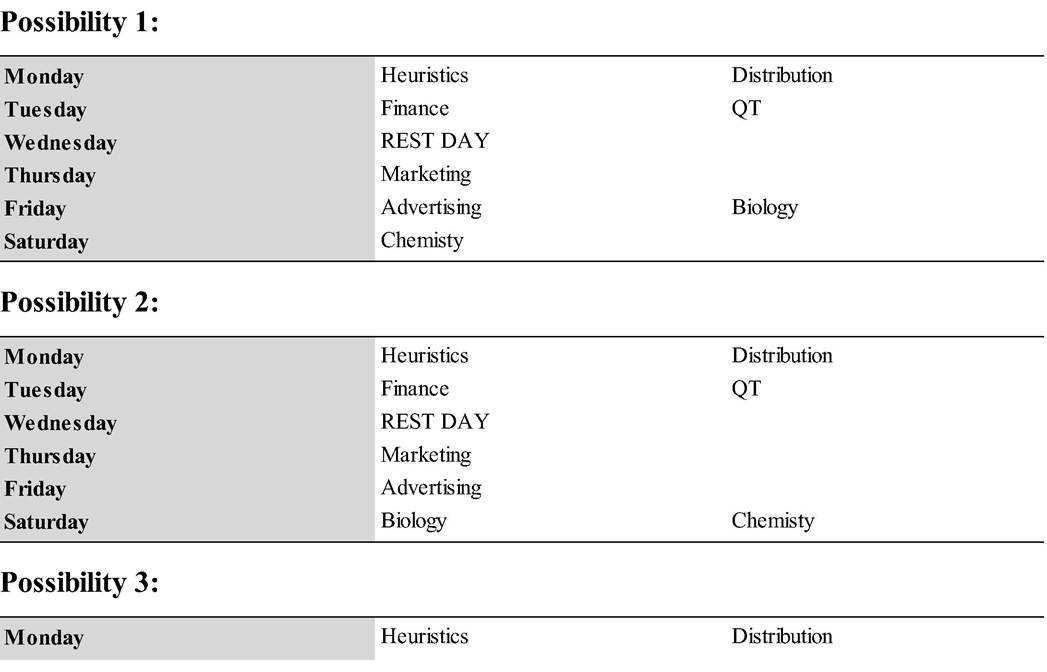

The answers can be read off from the tables (based on what is correct for each of these possibilities):
1. Heuristics and distribution are always on Monday. Option (a) is correct.
2. Wednesday is the rest day in all possibilities. Option (b) is correct.
3. It could be either Biology (possibility 3) or Advertising (possibility 2) or both (possibility 1). Option (c) is correct.
More on the topic Team Formations:
- INTRODUCTION TO REASONING IN THE SNAP EXAM
- Notes
- THE INTERNET AS A COMPLEX ADAPTIVE SYSTEM
- Eruptions of collective popular violence punctuated the entire earlymodern period of European history and assumed three chief forms.
- When does social capital matter?
- Oxygen concentrations vary with elevation, diffusion, and consumption
- FARMS AND FARMERS
- Acting Together in the Midst of Disaster
- Quantum-wave nature of the social phenomenon
- CHAPTER 6 From Bedpans to Bulldogs: Lottie: Gallipoli Nurse and the Pitfalls of Presenting War to the Young*