Growth with Expanding Product Varieties
Finally, I now brief the present the equivalent model in which growth is driven by product innovations, that is, by expanding product varieties rather than expanding varieties of inputs.
The economy is in continuous time and has constant population L. It admits a representative household with preferences given by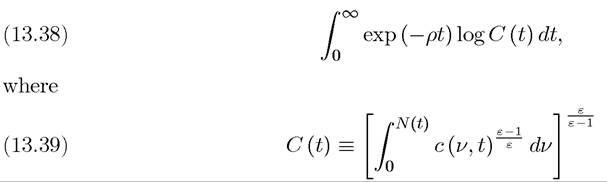
is the consumption index, which is a CES aggregate of the consumption of different varieties. Here c (ν, t) denotes the consumption of product ν at time t, while N (t) is the total measure of products. I assume throughout that ε > 1. Therefore, expanding input varieties have been replaced with expanding product varieties. The log specification in this utility function is for simplicity, and can be replaced by a CRRA utility function.
The patent to produce each product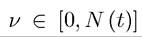 belongs to a monopolist, and the
monopolist who invents the blueprints for a new product receives a fully enforced perpetual 496
patent on this product. Each product can be produced with the technology
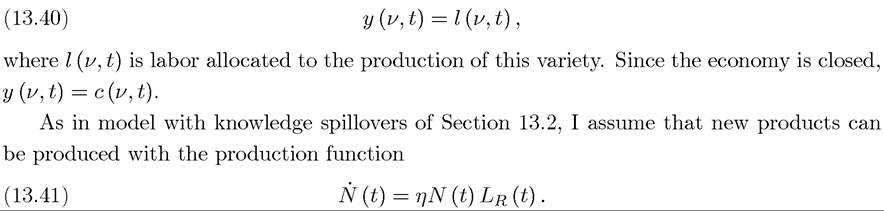
The reader will notice that there is a very close connection between the model here and the models of expanding input variety studied so far, especially the model with knowledge spillovers in Section 13.2. For instance, if у (ν, t)s were interpreted as intermediate goods or inputs instead of products and if C (t) in (13.39) were interpreted as the production function for the final good rather than part of the utility function of the representative household, the two models would be essentially identical. The only difference would be that, with this interpretation, labor would now be used in the production of the inputs, while in Section 13.2 it is used in the final good sector.
This similarity emphasizes that the distinction between process and product innovations is fairly minor in theory, though this distinction might still be useful in mapping these models to reality.An equilibrium and a BGP are defined similarly to before. The representative household now determines both the allocation of its expenditure on different varieties and the time path of consumption expenditures. Since the economy is closed and there is no capital, all output must be consumed. Nevertheless, the consumer Euler equation will apply to determine the equilibrium interest rate. Labor market clearing requires that

Let us start with expenditure decisions. Since the representative household has Dixit- Stiglitz preferences, the following consumer demands can be derived (see Exercise 13.24):

where px (ν, t) is the price of product variety ν at time t, and C (t) is defined in (13.39). The term in the denominator is the ideal price index raised to the power —ε. It is most convenient to set this ideal price index as the numeraire, so that the price of output at every instant is normalized to 1, that is,
With this choice of numeraire, the consumer Euler equation is (see Exercise 13.25): 
With similar arguments to before, the net present discounted value of the monopolist owning the patent for product ν can be written as

where w (t) c(ν, t) is the total expenditure of the firm to produce a total quantity of c(ν, t) (given the production function (13.40) and the wage rate at time t equal to w (t)), while px(ν, t)c(ν, t) is its revenue, consistent with the demand function (13.43).
The maximization of the net present discounted value again requires profit maximization at every instant. Since each monopolist faces the isoelastic demand curve given in (13.43), the profit-maximizing monopoly price is
Since all firms charge the same price, they will all produce the same amount and employ the same amount of labor. At time t, there are N (t) products, so the labor market clearing condition (13.42) implies that

where Le (t) = L — Lr (t). The instantaneous profits of each monopolist at time t can then be written as

Since prices, sales and profits are equal for all monopolists, we can simplify notation by letting
V (t) = V (ν, t) for all ν and t.
In addition, since c(ν, t) = c (t) for all ν,

where the second equality uses (13.46).
Labor demand comes from the research sector as well as from the final good producers. Labor demand from research can again be determined using the free-entry condition. Assuming that there is positive research, so that the free-entry condition holds as an equality, this takes the form
(13.49) ηN (t) V (t) = w (t).
Combining this equation with (13.47) yields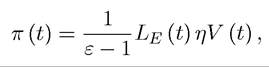
where we use π (t) to denote the profits of all monopolists at time t. In BGP, where the fraction of the workforce working in research is constant, this implies that profits and the net present discounted value of monopolists must grow at the same rate. Let us denote the 498
BGP growth rate of the number of products, N (t), by gN, the growth rate of profit and values by gv, and the growth rate of wages by gw.
Moreover, given the choice of numeraire, the consumption growth rate in this economy, g*, must equal the wage growth rate, gw. The free-entry condition, (13.49), then implies that g* = gN + gv. Given these constant growth rates and the constant BGP interest rate r*, (13.47) implies that in BGP:
Intuitively, at time t, profits are equal to π (t). Subsequently, because of product expansion, the number of employees per product decreases at the rate gw, reducing profits, and wages increase at the rate g*, increasing profits. Taking into account discounting at the rate r* yields (13.50). Now combining (13.49) with (13.50) implies that 
with L*r denoting the BGP size of the research sector. The R&D employment level of L*r combined with the R&D sector production function, (13.41) then implies
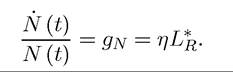
However, we also know from the consumer Euler equation, (13.45) that in BGP g* = r* — ρ. Combining this with the previous two equations, the steady-state size of the research sector is obtained as

I assume that L*r > 0, so that there is positive growth (otherwise, the free-entry condition would hold is inequality and there would be zero growth). Moreover, from (13.48) g* = gw I (ε — 1), therefore
Since r* > g*, the relevant transversality condition is always satisfied.
PROPOSITION 13.6. In the above-described expanding product variety model, provided that ηL > (ε - 1) ρ, there exists a unique BGP, in which aggregate consumption expenditure, C (t), and the wage rate, w (t), grow at the rate g* given by (13.52).
A couple of features are worth noting. First, in this equilibrium, there is growth of “real income,” even though the production function of each good remains unchanged. This is because, while there is no process innovation reducing costs or improving quality, the number of products available to consumers expands because of product innovations. Since the utility function of the representative household, (13.38), exhibits love-for-variety, the expanding variety of products increases utility. What happens to income depends on what we choose as the numeraire. The natural numeraire is the one setting the ideal price index, (13.44), equal to 1, which amounts to measuring incomes in similar units at different dates. With this 499
choice of numeraire, real incomes grow at the same rate as C (t), at the rate g*. Second, even though the equilibrium was characterized in a somewhat different manner than our baseline expanding input variety model, there is a close parallel between expanding product varieties and expanding input varieties. This can be seen, for example, in Exercise 13.23, which looks at an economy with expanding input varieties produced by labor. It can be verified that the structure of the equilibrium is very similar to the one studied here. Third, Exercise 13.26 will show that as in other models of endogenous technological progress in this chapter, there are no transitional dynamics and the equilibrium is again Pareto suboptimal. Moreover, log preferences now ensure that the transversality condition is always satisfied. Finally, it can be verified that there is again a scale effect here. This discussion then reveals that whether one wishes to use the expanding input variety or the expanding product model is mostly a matter of taste, and perhaps one of context. Both models lead to a similar structure of equilibria, to similar equilibrium growth rates and to similar welfare properties.
13.5.
More on the topic Growth with Expanding Product Varieties:
- Step-by-Step Innovations*
- ECONOMIC DIMENSIONS OF EXPANSION
- Chapter 65 An Empirical Investigation on Credit Card Adoption in Indi
- 16 EXPANDING FLORA’S EMPIRE
- The European Union
- The Impact in Africa
- Fligstein Neil. The Banks Did It: An Anatomy of the Financial Crisis. Harvard University Press,2021. — 334 p., 2021
- CHALLENGES TO TCP/IP
- THE ECONOMIC PROBLEM
- Deindustrialization