GROSS EXPOSURE
A single gross credit exposure GE (t) at Point in Time (PIT) t is the maximum amount that the institution may lose in the event of the counterparty's default or downgrading, named counterparty risk.
The former type of event, default, is considered when the exposure is held to maturity, whereas both events are considered when the exposures are traded at any time up to the maturity date.The amount of gross credit exposure is measured simply by the value of all assets outstanding against the counterparty status linked to this exposure. The value therefore plays an important role in exposure calculations. Thus, the valuation rule(s) and the discount factors, e.g., risk-free rates, yields and spreads, must be well defined. At the time when the contract starts, the net present value may be used to measure the exposure, whereas at default or downgrading time mark-to-market valuation may be sufficient.
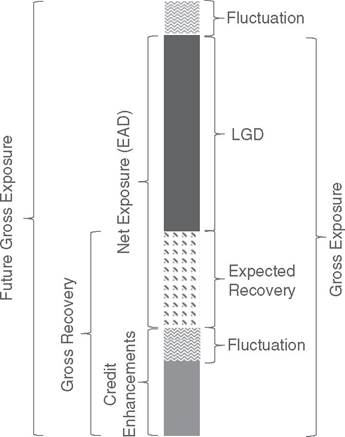
FIGURE 9.1 Defining credit exposures
9.2
More on the topic GROSS EXPOSURE:
- CONCLUDING REMARKS
- CONCLUSION
- A simplified approach to evolution
- Small intestine (duodenum, jejunum, and ileum)
- CHAPTER 38 ASPERGILLOSIS
- Diagnosis of Bovine Tuberculosis in Zambia
- HERPESVIRUS INFECTIONS IN WILD BIRDS
- INFORMING INTERVIEW
- Salmonella enterica Infection: Salmonellosis
- 47 Cancer of the Uterine Corpus