A simplified approach to evolution
Most of the work on the evolution of competitors discussed here uses the approach now generally known as Adaptive Dynamics'. It is an extension of the older ‘fitness maximization' approach used in Lawlor and Maynard Smith (1976) and Abrams (1986a).
The extension of this approach to situations in which fitness is frequency dependent was pioneered by Eshel (1983), Matsuda (1985), and Wilson and Turelli (1986), and was extended and formalized in Geritz et al. (1998). Frequency dependence arises when the relative fitness of a given phenotype depends on the set of other phenotypes present and their abundances. In the simplest case of a population with a very narrow distribution of trait values, an individual's fitness may be expressed as a function of its own trait value and the mean trait value in the population. The narrow range of variation allows the selection coefficient to be expressed as the derivative of the individual's fitness with respect to its own trait value, evaluated at the population mean. This approach is covered extensively in Dercole and Rinaldi (2008). Frequency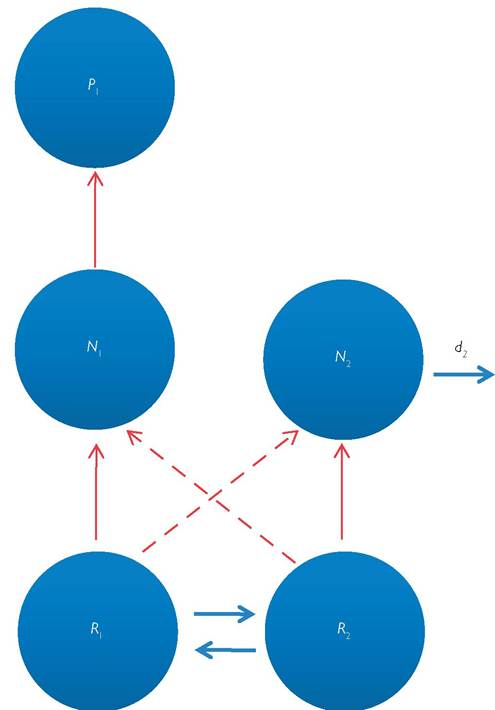
Fig. Il.l A food web in which one of two competing consumer species (N1) is controlled by a specialist predator while sharing two resources with the other competitor (N2). The text discusses the impact of altering the mortality of consumer 2.
dependence requires that the fitness of an individual with a given trait be expressed as a function of that individual’s trait and of the mean trait value in the population. The fitness gradient with respect to the individual’s trait is what determines the direction and strength of selection, but the sign of this gradient depends on the mean trait value. More generally, the distribution of trait values in the population may be required to determine individual fitness and the fitness gradient. However, dynamics based solely on the mean value can be sufficient if the range of variation is relatively narrow. This framework is often a good approximation in other situations with moderate variance (Abrams 2001d). While more elaborate models maybe required to understand evolution in many scenarios, the simple approximation of Adaptive Dynamics is surprisingly robust, and it at least provides a minimal set of potential evolutionary outcomes.
11.4
More on the topic A simplified approach to evolution:
- In 1848, commenting on the quashing of the Viennese popular uprising against the Austro-Hungarian Empire, Karl Marx predicted the only way the ‘bloody birth throes of the new society can be shortened, simplified and concentrated, [would be through] revolutionary terror'.1
- The evolution of the biosphere
- Evolution is descent with modification
- EVOLUTION OF THE GROSS AND NET EXPOSURES
- Warfare and Human Evolution
- In the most general sense, biological evolution is change in organisms over time.
- 11.l Evolution’s many effects on interspecific competition
- Evolution and coexistence: current theory and the future
- THE HEURISTIC APPROACH
- An Academic Approach to the Study of Religions
- Evolution of apparent competitors
- The Evolution of National Values in Diplomacy
- Evolution with both exploitative and interference competition
- Adaptive evolution can occur rapidly
- Methodological approach to comprehension of the social organism
- A unified theory of the evolution of international incomes
- What Is Evolution?
- Evolution can influence plant-herbivore interactions
- LOOKING OUTSIDE THE PM STANDARDS WORLD: THE LOGICAL FRAMEWORK APPROACH