Evolution is descent with modification
In many parts of this book, when we refer to evolution, we will be referring to allele frequency change over time. But evolution can also be defined more broadly as descent with modification.
At the heart of this definition is the observation that populations accumulate differences over time, and hence, when a new species forms, it differs from its ancestors. However, although a new species differs from its ancestors in some ways, it also resembles its ancestors and continues to share many characteristics with them. Hence, when evolution occurs, both descent (shared ancestry, resulting in shared characteristics) and modification (the accumulation of differences) can be observed, as seen in the fossil fish in FIGURE 6.3.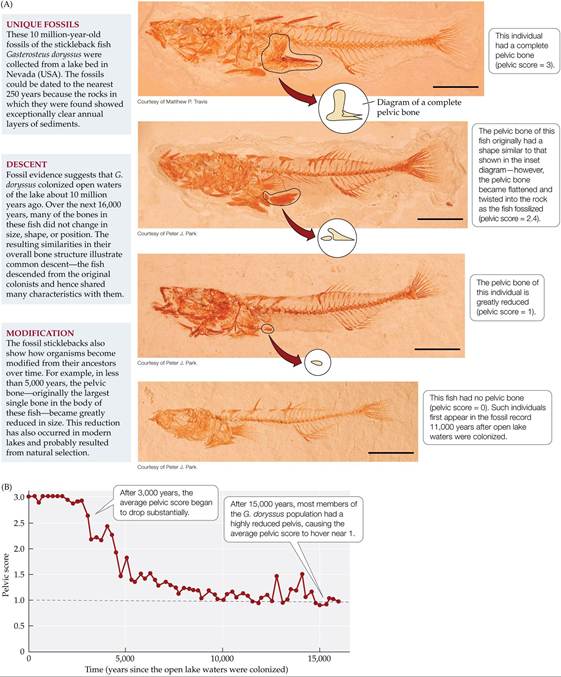
FIGURE 6.3 Descent with Modification Michael Bell and colleagues have analyzed thousands of 10-million-year-old fossils of the stickleback fish Gasterosteus doryssus. Their specimens are unique in that the lake bed in which they were found is so finely layered that the ages of the fossils can be determined to the nearest 250-year interval. (A) Representative G. doryssus fossils, showing how the pelvic bone became reduced over time; the scale bar for each fossil is 1 cm. (B) The average pelvic score at different times. Fossil pelvic bones were scored by size according to a scale that ranged from 3 (complete bone) to 0 (no bone). (B after M. A. Bell et al. 2006. Paleobiology 32: 562-577.) View larger image
Charles Darwin (1859) used the phrase “descent with modification” to summarize the evolutionary process in his book The Origin of Species. Darwin proposed that populations accumulate differences over time primarily by natural selection, the process by which individuals with certain genetically determined characteristics survive and reproduce more successfully than other individuals because of those characteristics. We've already seen several examples of selection at work in this chapter's Case Study.
In bighorn sheep populations, trophy hunting has selected for rams with small horns, while in the cod fishery, harvesting practices have selected for individuals that mature at a younger age and a smaller size.How can natural selection explain the accumulation of differences between populations? Darwin argued that if two populations experience different environmental conditions, individuals with one set of characteristics may be favored by natural selection in one population, while individuals with a different set of characteristics may be favored in the other population (FIGURE 6.4). By favoring individuals with different heritable characteristics in different populations, natural selection can cause populations to diverge genetically from one another over time; that is, each population will accumulate more and more genetic differences. Thus, natural selection can be responsible for the modification part of “descent with modification.”
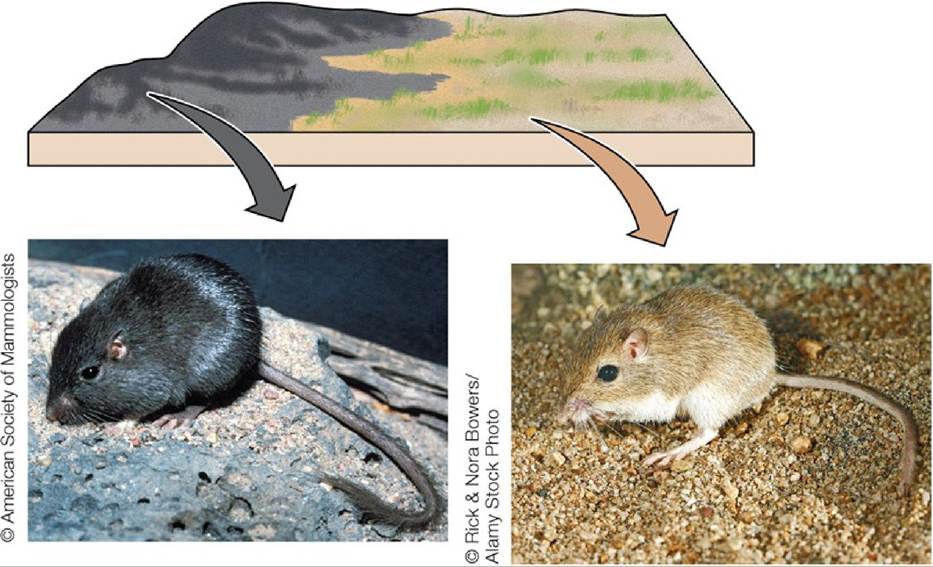
FIGURE 6.4 Natural Selection Can Result in Differences between Populations
Populations of rock pocket mice (Chaetodipus intermedius) that live on dark lava formations in Arizona and New Mexico have dark coats, while nearby populations that live on light-colored rocks have light coats. In each population, natural selection has favored individuals whose coat colors match their surroundings, making them less visible to predators. View larger image
More on the topic Evolution is descent with modification:
- CONCEPT 6.1 Evolution can be viewed as genetic change over time or as a process of descent with modification.
- Relations with Peoples of African Descent
- Today over 2.5 million people of Ukrainian descent live outside the borders of the Soviet Union.
- Chapter 10 Revisiting the Dynamics Between Two Ancient Japanese Descent Groups: What Happened from the Jomon to the Yayoi Periods in Japan
- In the most general sense, biological evolution is change in organisms over time.
- The evolution of the biosphere
- EVOLUTION OF THE GROSS AND NET EXPOSURES
- 11.l Evolution’s many effects on interspecific competition
- Evolution and coexistence: current theory and the future
- A simplified approach to evolution
- Evolution of apparent competitors
- Warfare and Human Evolution
- The Evolution of National Values in Diplomacy
- Evolution with both exploitative and interference competition
- Adaptive evolution can occur rapidly
- A unified theory of the evolution of international incomes
- What Is Evolution?
- Evolution can influence plant-herbivore interactions