Genomic Epidemiology of MAP
6.3.1 Host preference
There appear to be epidemiological trends associated with MAP-C and MAP-S strains with respect to transmission, host preference and susceptibility to infection.
However, the results of many past epidemiological studies need to be interpreted with caution since they often employed media that would not support growth of all MAP strains. This could easily result in a microbiological bias in these reports, in particular an underrepresentation of MAP-S strains. Furthermore, many studies did not use molecular typing techniques that differentiated all MAP sub-lineages or strains.MAP-S strains have been isolated predominantly, but not exclusively, from sheep and goats, suggesting a preference for these host species. Genetically distinct Type III MAP-S isolates have also been found in Arabian camels, though only a limited number of isolates have been genetically characterized to date (Ghosh etal., 2012). Reports of the occurrence of MAP-S strains in wildlife are relatively uncommon. One MAP-S isolate was obtained from a fallow deer (Dama dama) (Machackova et al., 2004) and another from a house mouse (Mus musculus) (Florou et al., 2008). MAP-S isolates were also recovered from tissue samples of kangaroos (Macropus fuliginosus fuligi- nosus) and wallabies (Macropus eugenii decres) grazing with infected sheep on Kangaroo Island, though faecal shedding of MAP by the macropods was not observed (Cleland et al., 2010).
MAP-C isolates have a broad host range and are commonly isolated from both domesticated and wildlife species, including nonruminants (Table 15.1 Fox et al., Chapter 15, this volume), although clinical disease has only been observed in ruminants, camelids, rabbits and hares. MAP-C is by far the most common MAP lineage isolated from cattle. MAP isolates from human Crohn's disease patients that have been typed have all been classified as MAP-C (Whittington et al., 2000; Bull et al., 2003; Ghadiali et al., 2004; Wu et al., 2006; Griffiths et al., 2008; Paustian et al., 2008; Singh et al., 2009; Wynne et al., 2011; Bannantine et al., 2014; Timms et al., 2015) and appear to be most closely related to isolates from cattle or bison in the same geographical region (Bryant et al., 2016).
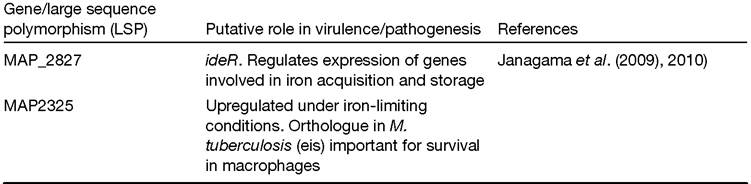
As with the other types, Type B isolates do not show specificity for bison (Bison bison) and have also been isolated from cattle, sheep, goat, buffalo, bison, hog deer, rabbits, blue bull and humans in India (Sohal et al., 2013), and bison and dairy cattle in the USA and Canada (Bryant et al., 2016; Ahlstrom et al., 2016b). This again brings into question the suitability of nomenclature based on host species provenance.Table 6.3. Mycobacterium avium subsp. paratuberculosis (MAP) strain-specific gene clusters that may be associated with differences in virulence and pathogenic traits.
| Gene/large sequence polymorphism (LSP) | Putative role in virulence/pathogenesis | References |
| MAV_1993 (LSPa4-II) | HspR protein. Global regulator of heat shock gene expression. Represses acr2 involved in virulence and pathogenesis of Mycobacterium tuberculosis | Stewart et al. (2003, 2005) |
| MAV_1998 MAV_2006 (LSPa4-II) | PPE family proteins. Elicit increased humoral and cell-mediated response in infected host | Tundup et al. (2008) |
| MAV_2005 (LSPa4-II) | PapA2 protein. Essential for biosynthesis of M. tuberculosis virulence factor sulfolipid-1 | Kumar et al. (2007) |
| MAV_3258-MAV_3270 | Glycopeptidolipids. Promote | Schorey and Sweet (2008); |
| (GPL) | macrophage activation in a TLR2- and | Alexander et al. (2009); Mobius |
| MAPS_17680-17710 | MyD88-dependent manner. Complex cluster with three configurations | et al. (2015) |
| MAV_2984 (MAV-14) | Cytochrome P450. Possible involvement in basic cellular processes and virulence | McLean et al. (2006) |
| MAV_2989 (MAV-14) | Aryl-sulfatase. May modulate pathogen-host interactions | Mougous et al. (2002) |
| MAP_1728 c-MAP_1744 | MmpL proteins: involved in fatty acid transport, associated with cell surface characteristics, biofilm formation and virulence. MmpS proteins: involved in intracellular survival and in vivo growth | Recht and Kolter (2001); Domenech et al. (2005); Lamichhane et al. (2005); Marsh and Whittington (2005) |
| MAP_1740 c (Del-2) | DevS protein. Essential for in vivo growth of M. tuberculosis and induced during hypoxia | Sherman et al. (2001); Sassetti and Rubin (2003) |
| MAP_1741 c (Del-2) | Upregulated during responses to heat shock and hypoxia in M. tuberculosis | Sherman et al. (2001); Stewart et al. (2002) |
| MAP_1743 c (Del-2) | Acg. Associated with detoxification of nitroaromatic compounds in macrophages and granulomas in M. tuberculosis | Sherman et al. (2001); Purkayastha et al. (2002) |
| MAP_2704 (INDEL11) | Deleted in pigmented S strains. Haemolysin III homologue. Virulence factor for systemic infections of humans with isolates of M. avium complex | Maslow et al. (1999); Castellanos et al. (2009) |
| MAV_4125 | mce genes involved in initiation | Gioffre et al. (2005); Senaratne |
| MAV_4126 (INDEL12) | of infection through cell entry and | et al. (2008); Castellanos et al. |
| MAPS_39450-39500 | granuloma formation | (2009); Mobius et al. (2015) |
| MACPPE43 | Possible human-associated PPE. Protein found only in human-associated strain of MAP, M. avium complex and M. tuberculosis. | Timms et al. (2015) |
Continued
6.3.2 Transmission
Cross-species transmission of MAP-S strains has been observed in natural settings. There are some reports of cattle naturally infected with MAP-S strains, including a pigmented MAP strain (Watt, 1954), and these infections have typically been associated with bullfighting breeds (de Juan et al., 2006) or cases where there has been direct or indirect contact of calves with sheep infected with MAP-S strains (Whittington et al., 2001b). The most convincing demonstration of natural cross-species transmission of MAP-S strains between sheep and cattle occurred in Iceland. Paratuberculosis was introduced in 1938 via infected Karakul sheep from Germany and in 1944 spread to the local cattle population, in which it subsequently became endemic (Fridriksdottir et al., 2000). The Icelandic strains were classified retrospectively as MAP-S (Whittington et al., 2001b). MAP-S strains have also been isolated from farmed red deer in New Zealand (de Lisle et al., 1993), but such isolations appear to be rare (Verdugo et al., 2014) and experimental infection of deer calves has suggested that deer are less susceptible to MAP-S than to MAP-C strains (O'Brien et al., 2006). Calves experimentally infected with either pigmented or Icelandic ovine strains developed clinical paratuberculosis (Taylor, 1953) and the pigmented strain isolated from cattle by Watt (1954) also could be transmitted experimentally to sheep.
However, experimental infections typically involve high doses of MAP and may not accurately reflect in vivo transmission of the different strains.Data are accumulating regarding the geographical distribution of MAP strains, which has probably been influenced by many factors, including animal movements, strain virulence and farm management systems. MAP-S strains are prevalent in Australian sheep and, despite the fact that MAP-C strains have been isolated from Australian cattle, they are rarely, if ever, isolated from Australian sheep (Whittington et al., 2000; Windsor, 2015). This is in contrast to Europe and New Zealand, where both MAP-S and C strains are isolated from sheep (Stevenson et al., 2009; Verdugo et al., 2014). This difference is possibly linked to differences in management practices between some parts of Europe and Australia, the scale of the farming practices, and relative proportions of sheep and cattle co- or sequentially grazing. MAP-S pigmented isolates have been isolated most commonly from animals in the UK and the Faroe Islands (Taylor, 1951; Stevenson etal., 2002). Pigmented strains have also been reported in Spain (Sevilla et al., 2007) and Morocco (Benazzi et al., 1996) but are relatively uncommon in these settings. The first confirmed MAP-C pigmented strain (C4A4) was recently isolated from goat faeces in Azores, Portugal (Barbosa et al., 2017). In North India, Type B MAP isolates are most commonly isolated, though there are some regional differences, with non-Type B isolates more common in New Delhi and Agra (Singh et al., 2009).
Within- and cross-species transmission of specific MAP strains is difficult to conclusively determine in non-experimental settings. Even with the highest resolution molecular typing tools, epidemiological data are needed to support inference regarding transmission events. This is exemplified by the low mean nucleotide substitution rate in the MAP genome, which was estimated to be below 0.25 substitutions per genome per year, with an upper 95% confidence limit of less than 0.5 substitutions per genome per year (Bryant et al., 2016).
It is important to consider this low substitution rate when inferring epidemiological connections based on genomic data alone, as just a small number of SNP differences could represent more than a decade of divergence. Nevertheless, closely related isolates are likely epidemiologically linked in the somewhat recent past and supporting epidemiological data could help unravel transmission dynamics.WGS has been particularly useful in identifying the relative number of SNP differences between isolates to derive epidemiological inferences at different spatial scales (Ahlstrom et al., 2016a; Bryant et al., 2016). Sequencing of 141 diverse MAP isolates revealed the global diversity, though the authors found no evidence of strong geographical clustering (Bryant et al., 2016). At a national and provincial scale, WGS of 182 MAP isolates from Canada indicated that Canadian isolates represented a subset of the known global diversity, and similarly demonstrated weak evidence of geographical clustering within Canada (Ahlstrom et al., 2016a). However, a polymerase chain reaction (PCR) assay designed to target five SNPs that differentiated isolates into four strains relevant to Canadian dairy herds was used to screen 602 MAP isolates from Canada (Ahlstrom et al., 2016b) and indicated that some strains appeared to be overrepresented in certain provinces. Comprehensive within-herd level SNP diversity has not been reported to date, though sequencing of multiple isolates per herd has confirmed the co-occurrence of genetically unrelated MAP isolates as well as clonal isolates within a single herd and between herds (Ahlstrom et al., 2015; Davidson et al., 2016).
Human-origin MAP isolates, isolated from patients with Crohn's disease, ulcerative colitis and non-inflammatory bowel disease controls, were found to show high genomic similarity to each other as well as to an isolate from a bovine host with clinical paratuberculosis from the same region in Australia (Wynne et al., 2011). A SNP genotyping approach targeting SNPs unique to isolates derived from human, bovine and ovine hosts was used to screen 52 isolates predominantly from Australia (Wynne et al., 2014). The authors found that some humanorigin MAP isolates were highly similar to those derived from bovine hosts, whereas others were more divergent. These studies provide evidence for potential zoonotic transmission of MAP.
The endemic nature of MAP in many countries challenges efforts aimed at understanding transmission dynamics, as multiple strains co-circulate in most regions. Molecular targets previously used to estimate the diversity and genetic relationship of MAP isolates are often not discriminatory enough, not biologically relevant or insufficiently stable. Indeed, the reliability of traditionally used genotyping schemes to accurately reflect genetic similarity and phylogenetic relationships of MAP strains has been assessed using WGS (Ahlstrom et al., 2015; Bryant et al., 2016). For example, MIRU-VNTR typing and IS 1311 typing were each found to have limitations in their ability to differentiate strains. As such, the limitations of genotyping tools should be considered when interpreting studies based on those tools, and further comparison using WGS is warranted to determine if currently used molecular markers are appropriate to differentiate strains on an epidemiologically relevant scale.
Molecular tools have nevertheless been, and continue to be, instrumental in supplementing epidemiological data to infer inter- and intraspecies transmission of MAP among domestic ruminants (Verdugo et al., 2014; Marquetoux et al., 2016), between domestic ruminants and both ruminant and non-ruminant wildlife (Stevenson et al., 2009; Fritsch et al., 2012) and among wildlife (Forde et al., 2012). Within a herd, short-sequence repeat (SSR) typing of MAP indicated that supershedders may play an important role in spreading MAP to herd mates (Pradhan et al., 2011). Within an individual animal, SSR typing has suggested mixed infection within an individual cow, which was later confirmed by WGS (Davidson et al., 2016). For more complete descriptions on the molecular epidemiology of MAP, see reviews (Stevenson, 2015; Li et al., 2016; Fawzy et al., 2018).
6.4
More on the topic Genomic Epidemiology of MAP:
- Genomic Comparison of MAP Strains
- Comparative Genomics and Genomic Epidemiology of Mycobacterium avium subsp. paratuberculosis Strains
- GENOMIC AND RAPID RESPONSE PATHWAY TO VITAMIN D
- GENOMIC CONSIDERATIONS FOR THE PATHOLOGIST
- GENOMIC BASIS OF CD8-MEDIATED PROTECTION: CLUES FROM THE WHOLE HUMAN GENOME MICROARRAY STUDIES
- Study of MAP Proteins
- Enumeration of MAP
- Epidemiology
- Cultural Requirements of Different Strains of MAP
- Survival of MAP During Dairy Processing
- Comparison of the Virulence and Pathogenicity of MAP Strains
- Innate Response to MAP Infection
- MAP Antigens
- General Principles for the Cultivation of MAP
- MAP Drug Susceptibility Testing: Where Are We in 2019?
- Resuscitation of MAP and Growth Stimulation