LEPTOSPIROSIS
Like IBR, leptospirosis can cause quite a wide range of clinical signs. These are:
• a mild and transient increase in temperature (pyrexia), which may well pass unnoticed, particularly in heifers
• mastitis and milk drop
• abortion
• reduced conception rates
It has been estimated that around one-third of all abortions in the UK are caused by leptospirosis (other causes are given in Chapter 8 and Appendix 2).
The strain involved in cattle is Leptospira interrogans var hardjo. By measuring antibody levels in the blood it has been shown that 60% of herds in the British Isles have been exposed to infection, although the actual clinical disease is much less commonly diagnosed. Cows are infected by urine splashing into their eyes, mouth or cuts in their skin.The first stage of the disease is simply a raised temperature and a slight reduction in appetite, when the leptospires are multiplying in the liver. Such mild clinical signs may not be noticed in maiden heifers, many of which recover in one or two days without treatment. In higher-yielding dairy cows, however, the clinical signs can be much more pronounced and they are characterised by a sharp fall in milk production. The udder becomes flaccid, the milk is thick, almost like colostrum, and at first you may think that your cow has mastitis in all four quarters, but without any swelling, heat or hardness. This is why leptospirosis is sometimes referred to as ‘milk drop’ or ‘flabby bag’ syndrome.
The third clinical sign caused by leptospirosis is abortion. This usually occurs six to twelve weeks after the initial infection and temperature rise and is especially common if the cow is in the final third of pregnancy. It is quite possible that the earlier infection did not cause a significant milk drop and that abortion is the only clinical sign seen. There are two major problems in the diagnosis of leptospirosis from abortions:
• The organism does not live very long and it is difficult to grow in culture.
The best method of diagnosis is to take a freshly aborted foetus (within 12 hours) straight to the laboratory to check its liver and kidneys for leptospires. Fluorescent antibody tests are also used.• Antibody levels in the blood persist for only a short while. (Often called titres, antibody levels are a measure of the concentration of antibodies in the blood. See Chapter 1 for a full explanation.) Two weeks after the initial infection (and the ‘milk drop’, if seen), antibody titres will be high, for example 1:1600. However, they fall very rapidly, so that six to twelve weeks later (the time when abortion occurs), titres may be low (1:100) or (in approximately 30% of cows) no longer detectable. If you think leptospirosis is a possibility in your herd, it is useful to blood sample 15-20 cows at random. Even then, I know of one case in which seven cows aborting over a short period all blood sampled negative for leptospirosis, a further 18 bloods at random were also negative and yet leptospirosis was eventually confirmed in a freshly aborted foetus! An alternative approach is to measure leptospira antibodies in bulk milk. This gives a useful estimate of the proportion of the herd infected.
The fourth clinical sign is reduced conception rates. Leptospirosis organisms can live in the reproductive tract for a considerable period of time, leading to both regular and irregular returns to service, the latter being due to early embryonic death. For example, in a survey of 529 animals in five infected herds, cows with blood titres of 1:100 or greater had a conception rate of 34%, whereas cows which were negative on blood test had a conception rate of almost 53%. Similarly, in another trial involving known infected herds, 200 cows which were vaccinated had a conception rate of 51%, whereas 215 unvaccinated cows only achieved 34%.
Treatment and control
If left untreated, affected cows will slowly recover on their own, although they will probably never regain their full milk potential for the present lactation.
Antibiotics and vaccination can be used.Antibiotics The use of antibiotics, especially streptomycin, will speed recovery. Following infection, some cows rid themselves of Leptospira and develop an immunity. However this lasts only one to two years, after which they are susceptible to further attacks. Other cows remain carriers with a focus of Leptospira infection in their kidneys which periodically bursts out and leads to intermittent excretion in the urine, and some of these animals will not even show a reaction (antibody titre) in their blood. This combination of carrier cows and waning immunity leads to repeated outbreaks of disease, even in a closed herd.
Vaccination There is a good killed vaccine available for cows and heifers. Two doses are given, four weeks apart, and a booster is needed each year. Most outbreaks of disease seem to occur during the grazing period, especially during a wet spell. This is because L. hardjo can survive for longer on pasture during warm, damp weather. The best time to vaccinate is therefore just before turnout in the spring, to prevent such outbreaks. Some people recommend only vaccinating heifers prior to their entry into the main herd and they rely on the normal spread of infection within the herd to provide immunity. Although this is clearly much cheaper, an on-farm vaccination trial suggested that it may not be correct. Four hundred and sixty-four heifers were monitored serologically (via the blood) for leptospirosis after they were introduced into 14 known infected herds. Half the heifers entering each herd were vaccinated and half were not. Vaccination reduced the incidence of abortion from 5% to 0.85%. The results are shown in Table 13.3. Overall
the vaccinated cattle also produced 50 litres more milk per lactation than the non-vaccinates, although where there was clear serological evidence of infection, vaccinated heifers showed an advantage of 785 litres. This is despite the fact that no obvious cases of milk drop had been seen in either group.
It is well known that cases of ‘milk drop’ are only sporadic and as such can easily pass unrecognised by the herdsman.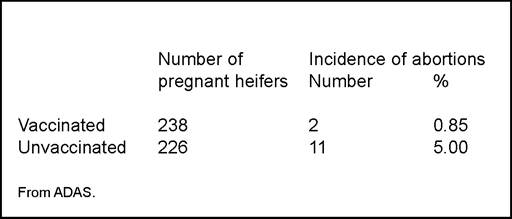
Unfortunately cows can still remain carriers of leptospirosis even after vaccination, so only if calves are vaccinated at six months old and then annually thereafter can you be fairly sure of avoiding the carrier status. In some countries the disease is considered to be so important that cows receive a booster vaccination every six months.
Table 13.3. Heifers were introduced into 14 known infected herds, half entering each farm being vaccinated against leptospirosis and half left unvaccinated. The reduction in abortions during the first lactation was dramatic in vaccinated heifers, and vaccinated heifers also produced more milk.
Prevention
Preventing the entry of leptospirosis into an otherwise clean herd can be best discussed by examining the risk factors, that is those factors which have been associated with an increased incidence of disease. These are:
• purchased cattle (including bulls). This doubles the risk of a closed herd
• the use of natural service rather than AI, especially if the bull is hired or shared. This increases the risk four times
• grazing sheep with cattle. Because sheep carry leptospirosis, this increases the risk six times, unless the sheep are moved at least two months before the cattle graze. By then the majority of the leptospires will be dead
• access to water courses and streams (eight times risk), because Leptospira organisms excreted from one farm can be carried downstream to the next. Leptospires have been shown to survive for up to four months in fresh water and six months in urine-saturated soil. (Note that these are maximum persistence times.)
If purchased cattle or hire bulls are to enter a clean herd, they should ideally be injected on arrival with both antibiotic and vaccine and again three to four weeks later.
Some outbreaks of disease can be dramatic, for example causing up to 30% reduction in total milk sales. However, it is more common for infection to pass through the herd fairly slowly and in such cases leptospirosis is more difficult to recognise and diagnose. Herds with a chronically high abortion rate, for example 6-8% per year, should consider vaccination, and programmes are available for eradication following vaccination.
Leptospirosis in man
Although cattle are the main hosts of L. hardjo, other animals can become infected, including man. Anyone working in a milking parlour is especially at risk, because it is so easy to get splashed with urine from an infected cow. The symptoms in man include headaches, fever and aching joints, very similar to a severe attack of influenza, and occasional cases of meningitis. Cattle vaccination hence reduces the human health risk. L. hardjo is different from L. icterohaemorrhagiae. The latter is the classic Weil’s disease, which causes liver failure and jaundice. It is spread from rats to man and is quite rare.
More on the topic LEPTOSPIROSIS:
- LEPTOSPIROSIS
- Leptospira spp. Infection: Leptospirosis
- CHAPTER 33 LEPTOSPIRA INFECTIONS
- Staphylococcal TS
- Zoonoses
- Leptospira spp. Infection
- SUBJECT INDEX
- Boon Andrew. The Ethics and Conduct of Lawyers in England and Wales. Hart Publishing,1999. — 808 p., 1999
- Griffiths-Baker Janine. Serving Two Masters: Conflicts of Interest in the Modern Law Firm. Hart Publishing,2002. — 227 p., 2002
- Grisso T.. Evaluating Competencies: Forensic Assessments and Instruments. 2nd edition. — Springer,2002. — 564 p., 2002
- Luban David. Legal Ethics and Human Dignity. Cambridge University Press,2007. — 350 p., 2007
- Ayupova Z.K.. Theory of state and law: textbook. - Almaty: Kazakh University,2015. - 192 pages., 2015
- Allen Danielle, Benkler Yochai et al. (eds.). A Political Economy of Justice. The University of Chicago Press,2022. — 416 p., 2022
- Barnes Rudolph C.. Military Legitimacy: Might and Right in the New Millennium.Frank Cass,1996. — 198 p., 1996
- Bedner Adriaan (ed.).. Real Legal Certainty and its Relevance: Essays in Honor of Jan Michiel Otto. Leiden University Press,2018. — 261 p., 2018
- Fridson M., Alvarez F.. Financial Statement Analysis. John Wiley & Sons, Inc.,2002. — 413 p, 2002
- Banking, Finance, and Accounting: Concepts, Methodologies, Tools, and Applications. IGI Global,2014. — 1593 p., 2014
- Hare C., Neo D. (eds.). Trade Finance: Technology, Innovation and Documentary Credit. Oxford University Press,2021. — 417 p., 2021
- Fligstein Neil. The Banks Did It: An Anatomy of the Financial Crisis. Harvard University Press,2021. — 334 p., 2021
- Cline W.. The Right Balance for Banks. Peterson Institute for International Economics,2017. — 281 p., 2017