MISCELLANEOUS CONDITIONS
Listeriosis
This is an infection caused by the bacterium Listeria monocytogenes. In cattle it is mainly seen as a nervous disease, although it may also cause abortion or even sudden death.
In the typical case you will see one side of the animal’s face droop, due to paralysis of the facial muscles, and this leads to drooling (Plate 13.29). The ear and eyelids are also paralysed, leading to a dry eye surface and a glazed expression, with total blindness on the affected side only. Eating is difficult, appetite is depressed and weight loss occurs. There may also be nervous signs: initially walking around in circles, perhaps pushing the head against a wall, then in the terminal stages convulsions and eventually death. Listeriosis is the most common diagnosis in cows which are suspected of having BSE, but on slaughter are found to be negative. Provided that listeriosis is diagnosed early enough, very high levels of penicillin injection (probably twice daily), continued for seven to ten days, can produce a cure in a reasonable number of animals.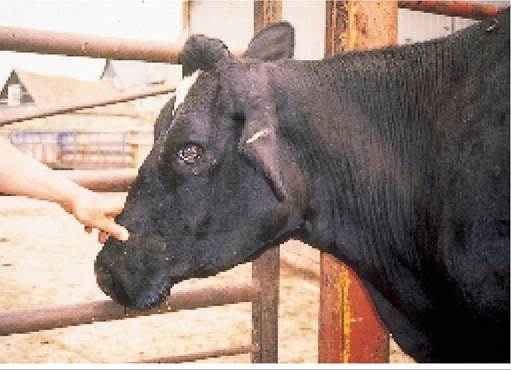
Plate 13.29. Listeriosis is a brain infection leading to paralysis of the muscles of the face (e.g. lips, eyelids and ears) on one side only.
Do not confuse listeriosis with middle ear disease (Plate 13.30). Because of the pain, an animal with middle ear infection stands with its head on one side and may walk around in circles, but it is not blind and is much brighter and more alert, usually continuing to feed. Most middle ear infections respond well to antibiotics.
Listeria is an interesting organism.
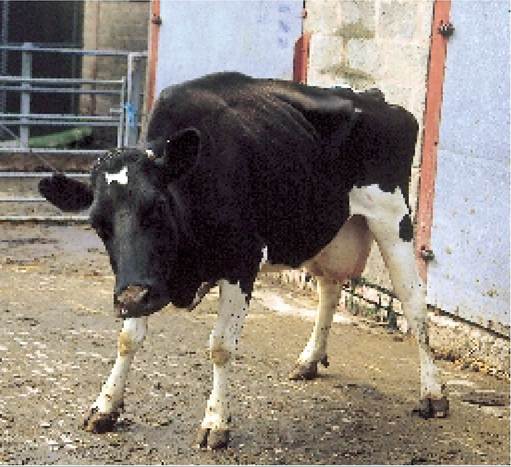
Plate 13.30. Although an animal with middle ear infection walks around in circles, similar to listeriosis, it will normally be more bright and alert and will not develop facial paralysis.
It can survive for many years in dung or soil, it is a common contaminant of silage and yet disease is relatively rare. Most cases occur in silage-fed cattle in late winter, and the stress of poor housing, unhygienic management and dietary changes increase the risk of disease. It has also been implicated as a possible cause of ‘silage eye’ or bovine iritis (Chapter 4). The organism is frequently found in man, and can occasionally cause food poisoning. High levels of human infection from sewage sludge can be a danger to animals.
Blindness
Blindness may be present at birth, when we say that the calf has a congenital defect (Plate 1.13), or it may occur later in life, possibly as a result of an improperly treated New Forest eye (Plate 4.13). Some cows suddenly go blind, however, with no symptoms, and this can be due to a localised blood clot or an abscess in the brain. Sudden onset blindness may also be due to hyphaema (Plate 4.23).
In calves the most common defect is a lens opacity or cataract (Plate 1.12). If you look at an eye with a cataract you see that the circle filling the centre of the pupil is blue-grey in colour and light cannot enter. This is thought to be caused by toxins or infections (e.g. BVD virus) acting on the cow in early pregnancy, at the stage when the eyes are being formed. Cataracts can be treated by making cuts on the surface of the lens with a very small ‘needling’ knife. The fluid of the eyeball (the aqueous humour) then dissolves away the lens. Sight is slowly restored over one to two months, but for distant vision only. Some cataracts are of genetic origin, and occasionally groups of calves are affected but no cause is found.
Blindness can also be a symptom of some other condition, for example lead poisoning, meningitis, CCN or vitamin A deficiency (a full list is given in Appendix 2). Some calves are born without eyes (anophthalmia) or with very small, non-functional eyes (microphthalmia).
Aujeszky’s Disease
This is a virus infection which occurs mainly in pigs, where it causes nervous disease, pneumonia and reproductive failure.
Cases in cattle are rare, but when they do occur there is excitement, drooling and intense itching. There is no treatment. Aujeszky’s disease is also called pseudorabies, because the symptoms are indistinguishable from a true rabies infection of cattle. It is a notifiable disease in the UK.The PPH Syndrome
This is a disease of cattle which can cause intense itching. The letters PPH stand for pruritus (itching), pyrexia (raised temperature), and haemorrhage (bleeding from various sites in the body). It is a rare condition, seen only in dairy cows. The early signs are intense irritation of raised patches of skin on the head, neck, tail and udder, and in mild cases this is all you will see. In more severe cases, however, the cow runs a high temperature, goes off her food, may develop haemorrhagic areas inside the nose and mouth, and sometimes passes fresh blood with the dung. These cases do not recover and the animal is best slaughtered.
The cause of PPH is unclear, although the fungal toxin citronin, which leads to kidney damage, has been implicated. Citronin, which is produced by Penicillium and Aspergillus moulds, has been found in a range of foods including citrus pulp, and mouldy citrus pulp, containing 30 ppm of citronin, was suggested as the cause of one outbreak. The original theory, namely that PPH was associated with feeding silage having a sulphuric acid additive, has now been largely discounted.
Bovine Immunodeficiency Virus (BIV)
BIV belongs to a family known as lentiviruses. Lentiviruses cause definite disease syndromes in many animals, for example equine infectious anaemia, maedi-visna in sheep, feline immunodeficiency virus (FIV) and the well-known human immunodeficiency virus (HIV), the cause of AIDS. Monitoring of antibody levels in blood samples has shown that the bovine form of the virus, BIV, is present in many countries in the world, but the evidence on whether it causes disease is much less conclusive. Those who believe that BIV causes disease say that it produces general ill-thrift, for example seen as cows which develop a high temperature and lose weight after calving, and calves which fail to grow.
Skin lesions have also been reported. Numerous other secondary infections can be found (as happens with AIDS in man) but the underlying problem could be BIV, leading to an increased susceptibility to infection.BIV is considered a definite disease entity by some in North America, with one of the classic features being enlargement of the lymph glands under the skin, identical to the skin TB lesions shown in Plate 10.18. However, skin TB is so widespread in the UK that if it is caused by BIV, then BIV is also widespread - and probably does not cause disease. The only herd in the UK suspected of having disease caused by BIV was in Cheshire in 1993/94 and even this was disputed by some investigators.
Lightning Stroke and Electrocution
Death from electrocution and lightning is more common in cattle than in any other species, partly because of an inherent susceptibility, partly because their four feet placed firmly on the ground make a good earth and partly because they are often in milking parlours and other housing where free electricity can occur.
Lightning stroke
It is unlikely that you will see anything except a dead animal, or possibly a group of cattle lying together, although sometimes there are also one or two staggering around with concussion. Perhaps you will be able to see other evidence to substantiate your diagnosis, such as scorch marks on adjacent trees, broken branches, marks along the ground or burns on the animal itself, as in Plate 13.31. This is not necessarily the case, however. If lightning strikes damp ground, or if an overloaded power cable falls into a pool of water, there may be sufficient ground current to be fatal and there are then no marks to be seen on the carcase.
Electrocution
Waterpumps, vacuum pumps and milking machines are the most common sources of free electricity and so milking cows are commonly affected.
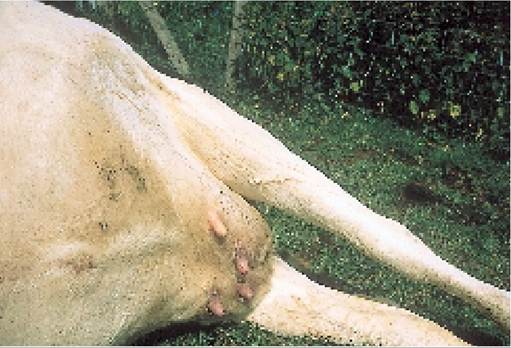
Plate 13.31.
This late pregnant heifer was standing in a field, well away from trees or electricity, when she was struck by lightning. The scorch marks running down her legs confirm the diagnosis.I have seen a case where four cows dropped dead during milking and, after they were released, others staggered around aimlessly, suffering from electrical concussion. They recovered eventually. In this instance there was a fault in the water heater, and the element had an earth which passed through the milking equipment. On another occasion the farmer thought that his cows had a low-grade grass staggers because they were unusually nervous and jumpy in the parlour. The problem was eventually traced to a fault on the lift pump which gave the cows a shock as it switched on. The farmer felt nothing himself because he was wearing rubber boots.
Beef cattle can also be affected, and electrocution of animals inside a metal-framed building where the stanchions are standing in a damp area is not uncommon. I can remember seeing five from a group of ten finished beef cattle found dead from electrocution between two metal stanchions. The cause was traced to a short from a three-phase electric cable onto a metal pole some 20 metres away. The cattle had been killed by ground current: the electric cable blew against the metal pole and sent pulses of electricity along the ground to the cattle in the building.
If you wish to pursue an insurance claim for lightening or electrocution, it is most important that you do not move the cattle until your vet has arrived. He will want to see them in situ, looking for scorch marks and other electrical damage. He will also want to clear them for anthrax before carrying out a post-mortem examination to eliminate other causes of death.
Bovine Influenza A
Many dairy herds have cows which experience a sudden drop in milk yield, an increase in temperature and show some respiratory signs such as drooling, increased respiratory rate, and coughing. In some cases there may also be a low-grade diarrhoea. Although there is a wide variety of causes, an influenza virus is known to be one possible factor. Being a virus infection there is no specific treatment, although if the cow is very sick, antibiotic cover will prevent secondary bacterial infection, and use of anti-inflammatory drugs such as flunixin will help to bring the temperature down and should hasten recovery. Diagnosis is based on blood sampling.
More on the topic MISCELLANEOUS CONDITIONS:
- Chapter 13 MISCELLANEOUS DIGESTIVE, RESPIRATORY AND OTHER CONDITIONS
- Miscellaneous
- Miscellaneous
- Miscellaneous Complications
- MISCELLANEOUS DISORDERS
- MISCELLANEOUS DISORDERS
- Miscellaneous Liver Disorders
- MISCELLANEOUS LUNG DISORDERS
- 6 Miscellaneous Regulations of Expression
- 4 Miscellaneous statutory rights
- AGING AND MISCELLANEOUS DISORDERS
- AGING, DEGENERATIVE, AND MISCELLANEOUS DISORDERS
- BIBLIOGRAPHY FOR AGING, DEGENERATIVE, AND MISCELLANEOUS DISORDERS
- BIBLIOGRAPHY FOR AGE-, MISCELLANEOUS-, ENVIRONMENTAL- AND DRUG-RELATED DISORDERS
- FOOT CONDITIONS CAUSING LAMENESS