Leptospira spp. Infection
Leptospirosis in humans is the most widespread zoonotic disease throughout the world, and wild rats and mice play an important role as maintenance hosts for pathogenic Leptospira.
Among the 13 recognized species of pathogenic Leptospira, there are numerous serogroups and serovars, but neither serogroup nor serovar is predictive of species (see Mouse Chapter 1, “Leptospira spp. infection” for a discussion of nomenclature). Rats are clinically silent chronic carriers of Leptospira, and both pet rats and laboratory rats have also been found to carry pathogenic Leptospira and be sources of human infection. Pathology in rats is minimal, consisting of mild nonsuppurative interstitial nephritis. Leptospires populate the proximal tubules (Fig. 2.40) in large numbers, and are shed through urine. They can be visualized in tissue sections with Warthin-Starry or other silver stains, and cultured from kidney tissue. Speciation is accomplished through DNA hybridization analysis.Mycoplasma haemomuris Infection
Formerly known as Hemobartonella muris, Mycoplasma haemomuris is now classified as a member of the genus Mycoplasma. It is a hemotropic Mycoplasma that infects wild rats and other rodents and at one time was common in laboratory rats. It is transmitted primarily by Polyplax
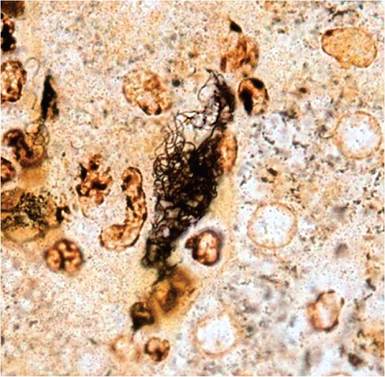
FIG. 2.40. Colonization of a renal tubular lumen with Leptospira sp. in an infected rat (Warthin-Starry stain). (Source: Tucunduva de Faria et al. 2007. Reproduced with permission from Elsevier.)
spinulosa and can also be transmitted in utero, but apparently inefficiently, since cesarean section is usually successful at eliminating the organism. Mycoplasma hae- momuris can contaminate biological products derived from infected rodents and is infectious in both rats and mice. Natural infections are invariably inapparent, with mild transient bacteremia, splenomegaly, and erythrocytic reticulocytosis. The reticuloendothelial system, especially the spleen, is critical for clearing the bacteremia. Splenectomy of carrier rats may result in hemolytic anemia with hemoglobinuria and death. Immunosuppression with corticosteroids is ineffective in activating a subclinical infection. Diagnosis can now be achieved by PCR of blood from infected rodents.
More on the topic Leptospira spp. Infection:
- Leptospira spp. Infection: Leptospirosis
- Malassezia spp. Infection: Malasseziasis
- Bacterial Enteric Infections Brachyspira spp. Infection
- Aspergillus spp. Infection: Aspergillosis
- Actinobacillus spp. Infection
- Actinomyces spp. Infection
- Brucella spp. Infection: Brucellosis
- Chlamydophlla spp. Infection
- Helicobacter spp. Infection
- Mycobacterium spp. Infection: Tuberculosis, Paratuberculosis
- Enterococcus spp. Infection: Enterococcal Enteropathy
- Salmonella spp. Infection: Salmonellosis
- Klebsiella spp. Infection