Salmonella spp. Infection: Salmonellosis
Although once common in the early 1900s, salmonellosis is relatively rare in domestic rabbits housed in wellmanaged facilities. Infection with Salmonella enterica serotypes Typhimurium and Enteritidis, as well as other serotypes, can result in explosive epizootics of septicemia, abortion, and rapid death.
Diarrhea is inconsistently present. Salmonellosis has been identified in specific-pathogen-free rabbits infected with S. enterica serotype Mbandaka following experimental surgery and irradiation. Pathologic changes included polyserositis, focal hepatic necrosis, splenomegaly, acute enteritis with fibrinous exudation, and suppurative metritis. In view of the public health aspects, and the dangers of interspecies spread, the diagnosis of salmonellosis warrants thorough investigation and eradication.Staphylococcus aureus Infections: Staphylococcosis
Staphylococcus aureus is a common cause of subcutaneous abscesses, dermatitis, mastitis, pododermatitis, and septicemia in rabbits. Genital and respiratory tract infections may also occur. Within a population of rabbits, 2 patterns of infection are apparent. A low level of sporadic lesions is associated with low-virulence strains of S. aureus, whereas high-virulence strains may cause epizootic outbreaks with high morbidity. Following the initial epizootic, high-virulence S. aureus subsequently becomes enzootically entrenched within the herd, with chronic decline in production. Low- and high-virulence strains of S. aureus can be somewhat differentiated by biotyping (culture and beta hemolysin characteristics), but other typing methods have included phage typing, and more recently genotyping. Low-virulence strains typically belong to the poultry or human biotype, whereas high-virulence strains have a different biotype-phage type known as “mixed CV-C-3A/3C/55/ 71.” Genetic analysis suggests that there was a single clonal origin of the most common high-virulence strain, which has become widespread in many European countries.
High-density commercial production has contributed to the spread of this strain.Epizootiology and Pathogenesis
Transmission of S. aureus can occur through environmental contamination, direct and indirect contact, from does to kits, among littermates and cagemates, and through semen. Introduction of new breeding stock to the herd has been a major source of contamination with high-virulence strains. Traumatic lesions through wire cage floors and fighting, as well as the neonatal umbilicus are important conduits of S. aureus. In some outbreaks, the same phage type isolated from the rabbits has been isolated from the nares of human contacts. Virulent strains of the organism may be harbored as an inapparent infection in the upper respiratory tract. Such infections may spread by direct contact, but the organism has also been recovered from the air in contaminated facilities. Neonatal staphylococcal infections are a recognized cause of neonatal mortality in domestic rabbits in Europe, the United States, and Canada. In France, it is considered to be an important cause of mortality in suckling rabbits in commercial rabbitries. Disseminated staphylococcal infections have also been observed in wild rabbits and hares.
Pathology
In mature animals, chronic suppurative lesions may occur in the skin, mammary glands, genital tract, conjunctiva, footpads (see "Pododermatitis: Sore Hocks”), and upper and lower respiratory tract. In neonatal infections, lesions may be confined to the skin and manifest as multiple raised suppurative lesions a few millimeters in diameter. These may involve a variety of areas, including the extremities, head, back, and sides (Fig. 6.49). The acute septicemic form of the disease usually occurs only in suckling kits during the first week of life, frequently with high mortality in affected litters. At necropsy, multifocal suppurative lesions may be present in the subcutaneous tissue and in viscera, including lung, kidney, spleen, heart, and liver (Fig.
6.50). Occasionally, systemic staphylococcosis with focal suppurative lesions occurs in adult rabbits (Fig. 6.51). Microscopically, focal suppurative lesions are present in affected organs. Gram-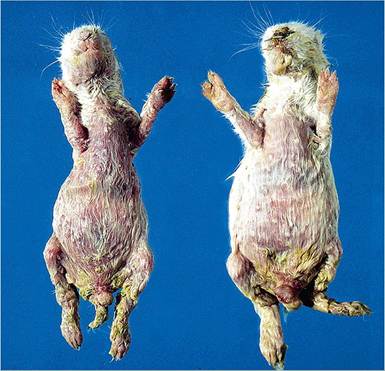
FIG. 6.49. Pyoderma in rabbit kits associated with Staphylococcus aureus infection.
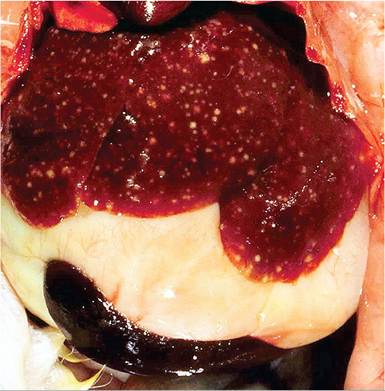
FIG. 6.50. Multifocal suppurative hepatitis in a 10-day-old rabbit kit with fatal Staphylococcus aureus septicemia.
positive bacterial colonies are typically associated with the lesions. In staphylococcal mastitis, affected glands may vary in appearance from swollen, red areas with induration of the overlying skin to chronic abscessation. Lesions in the respiratory tract, when present, vary from mucopurulent rhinitis to localized bronchopneumonia and/or abscessation of the lung. Differential diagnoses include pasteurellosis, Tyzzer's disease, and listeriosis.
Streptococcus spp. Infection
Septicemic infections of young rabbits were once associated with Streptococcus spp., but such infections appear to be rare among contemporary rabbit populations. Recently, an outbreak of disease with high mortality was reported in China among young commercially raised rabbits. Rabbits presented with acute respiratory distress, fever, paddling and convulsions. Necropsy revealed congestion and hemorrhage in multiple organs, particularly the lungs. Lesions consistent with diffuse intravascular coagulation were widespread. Gram-positive cocci were present in multiple tissues, and culture revealed S. agalactiae, which was confirmed by sequence analysis. The disease resembled streptococcal toxic shock
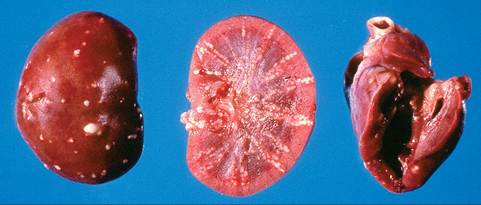
FIG. 6.51. Multifocal suppurative nephritis and myocarditis in an adult New Zealand White rabbit with systemic Staphylococcus aureus infection. Source: D. Imai, University of California, Davis, CA. Reproduced with permission from D. Imai.
syndrome. Differential diagnosis must rule out rabbit hemorrhagic disease, which presents with similar gross and microscopic lesions.
More on the topic Salmonella spp. Infection: Salmonellosis:
- Actinomyces spp. Infection
- Salmonella enterica Infection: Salmonellosis
- BACTERIAL INFECTIONS
- Enterococcus spp. Infection: Enterococcal Enteropathy
- Aspergillus spp. Infection: Aspergillosis
- BIBLIOGRAPHY FOR BACTERIAL INFECTIONS
- Malassezia spp. Infection: Malasseziasis
- BIBLIOGRAPHY FOR BACTERIAL INFECTIONS