DISORDERS OF MALE REPRODUCTION
Three of the more common male disorders, namely tumours on the penis (fibropapilloma, Chapter 10), hermaphrodite/intersex (Chapter 5) and obstruction of the penis (urolithiasis, Chapter 3), have been described already.
Damage to the Prepuce
Posthitis means inflammation of the prepuce and in most cases this is caused by physical injury followed by infection. The prepuce becomes swollen and hangs down from the belly. This further increases the risk of injury and infection. A typical example is seen in the Charolais bull in Plate 13.27. If the damaged prepuce is pushed back into the sheath and held in position with sutures, many cases heal without further problems. The sutures need to be left in place for at least three to four weeks to allow sufficient time for healing, and of course there must be a large enough gap to permit urine flow. Allow at least six weeks’ rest from work, penning the bull well away from cows on heat. In non-responsive cases part of the prepuce has to be removed surgically.
Balanoposthitis
This is an inflammation of the prepuce and penis. It occurs with IBR and is the male form of infective pustular vulvovaginitis, IPV.
Orchitis and Testicular Swellings
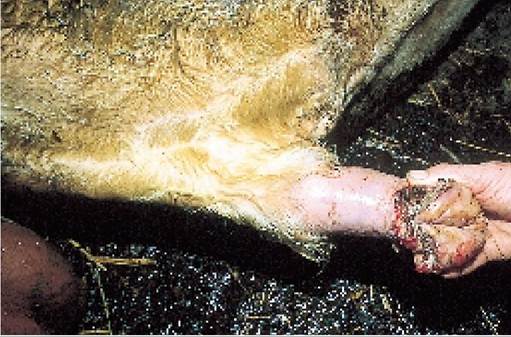
Plate 13.27. Prolapse and eversion of the prepuce (posthitis). Because the damaged prepuce hangs down from the belly, further damage is likely.
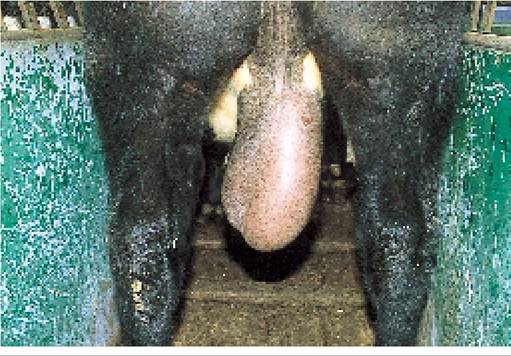
Plate 13.28. Most scrotal swellings are haematomas and can be left to resolve on their own.
Orchitis means inflammation of the testicle itself and can be caused by a range of bacterial infections including tuberculosis and brucellosis. The testicle(s) will be swollen and painful
and the animal may be off-colour.
However, simple bruises and haematomas are more common. Although the swelling may look gross (Plate 13.28), most animals are unaffected by bruising and slowly recover or, as in Plate 13.28, may be sent for slaughter when fit. Necrosis of the scrotum may occur as a result of improper use of the Burdizzo bloodless castrator (page 438).Fracture of the Penis
Despite its name, the condition is not a true fracture but rather a rupture of the outer casing of the penis leading to a haematoma (blood blister) under the sheath. It occurs when a cow or heifer moves during service, or if the bull slips or is pushed off. A swelling beneath the skin is seen halfway between the scrotum and prepuce. Provided that the bull is rested for two to three months, many cases recover without treatment. Surgery can also be used.
Corkscrew Penis (Spiral Deviation of the Penis)
In some bulls the penis deflects to one side or the other as it extrudes when they are attempting to serve, or goes so low that it is unable to enter the cow. This is usually associated with damage to the ligaments or the outer wall of the penis, for example as caused by warts (Plate 10.16). As some cases are inherited, they are best not treated.
More on the topic DISORDERS OF MALE REPRODUCTION:
- Male-Male Rape in Qing Law
- Male Honor as Metaphor for Male Power
- This chapter focuses on homicide and serious interpersonal violence, male on male, in early modern Europe within a global context,
- MEDICALLY ASSISTED REPRODUCTION
- Mode of reproduction is a basic life history trait
- There are trade-offs between current reproduction and other life history traits
- Male Aggression
- Males and females differ in their sexual organs and in other ways that are directly related to reproduction.
- Populations grow geometrically when reproduction occurs at regular time intervals
- P Keerthi Kundana, Mona Gajre, Alpana Kondekar, Mukesh AgrawalNeurological disorders account for ~15-20% of hospitalizations, which may be divided into three major categories: (a) central nervous system disorders, involving brain and spinal cord, (b) neuromuscular disorders involving peripheral nerves and muscles, and rare disorders of autonomic nervous system.
- Sexuality: male, female, third gender