Liver Disorders
A progressive increase in ploidy (polyploidy) occurs in hepatocyte nuclei with age. The number of chromosomes may increase to ploidy values of 16 or 32. Thus, karyomegaly, anisokaryosis, polykarya, and cytomegaly are common incidental findings (Fig.
1.5). Intranuclear cytoplasmic invaginations are also common and can be recognized as delineated eosinophilic structures within the nucleus (Fig. 1.6). Eosinophilic cytoplasmic inclusions, composed of secretory material in dilated endoplasmic reticulum of hepatocytes, are also common, especially in B6 mice (Fig. 1.117). They are most frequently observed in hepatocytes of older mice and transgenic mice. A multitude of these features are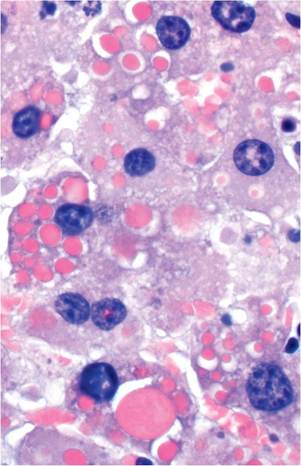
FIG. 1.117. Liver from an aged B6 mouse with eosinophilic cytoplasmic inclusions in hepatocytes.
present at all ages but increase with age and disease and may be particularly extreme in some GEMs (Fig. 1.118). Hepatocellular fatty change is a normal finding in BALB mice, and the livers of these mice are typically paler than in other strains. One or more foci of hepatic coagulation necrosis in the absence of an infectious agent may be observed as incidental findings in many strains of mice. They are probably ischemic in origin. Epithelial hyalinosis and crystals are a frequent incidental finding in the biliary and gall bladder epithelium of B6 and 129 mice. Bile ductular proliferation is a common incidental finding in all laboratory rodents and lagomorphs. Proliferation of Kupffer cells and Ito cells can occur under a variety of circumstances but should signal inquiry into the presence of Helicobacter.
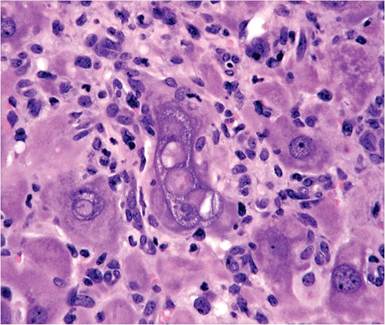
FIG. 1.118. Liver from an aged transgenic mouse with cytomegaly, polykarya, megalokarya, intranuclear cytoplasmic invagination, and oval cell hyperplasia.
More on the topic Liver Disorders:
- Liver disease
- Liver Transplantation
- Macrovascular Complications of Diabetes Mellitus
- 14 Hypoadrenocorticism in a dog
- 22 Hepatic lipidosis in a cat
- Chapter 8 Maternal medicine and infections
- Index
- Agrawal M.. Textbook of Pediatrics. 3rd ed. — CBS Publishers,2025. — 973 p., 2025
- I POLYCYSTIC OVARY SYNDROME ^273 ^567