Otitis externa is a common malady, occurring in 15% to 20% of dogs and 5% to 7% of cats seen in veterinary practice.
Otitis externa is also one of the most frustrating diseases for veterinarians and owners to treat effectively. Treatment regimens vary widely, and a myriad of products containing a variety of ingredients are available for the treatment of ear disease.
Effective treatment of otitis externa often varies from one patient to another; treatments successful in one patient may not help in the next. Each patient and each ear must be considered individually, and treatment regimens must be tailored to the specific case.
In addition, dermatologic conditions often affect the ear canal, making it susceptible to otitis externa. The ear canal is an invagination of epidermis forming a hollow skin tube inside the head; it begins at the eardrum. Pathologic mechanisms affecting the skin of the animal also affect the epithelial tube lining the ear canal. For example, a dog with atopy may also show inflammation of the ear canal, resulting in redness, swelling, heat, and pain (Figures 8-1 and 8-2). In a cylindrical tube such as
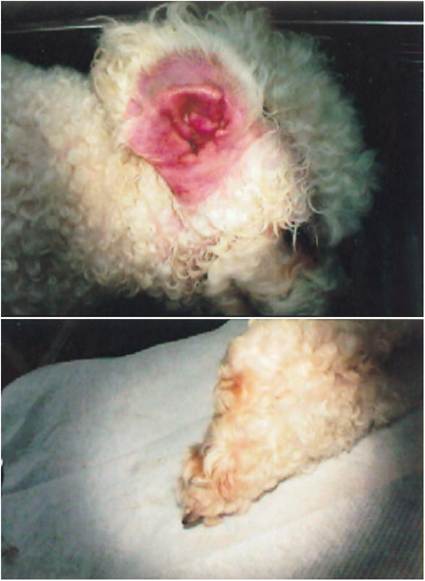
Figure 8-1
Top, Red, hot, itchy ear in a Miniature Poodle with otitis externa. Bottom, Salivary staining on the foot of the same dog indicates atopic dermatitis as the cause of the otitis. Often there is concomitant Malassezia dermatitis between the toes of these dogs.
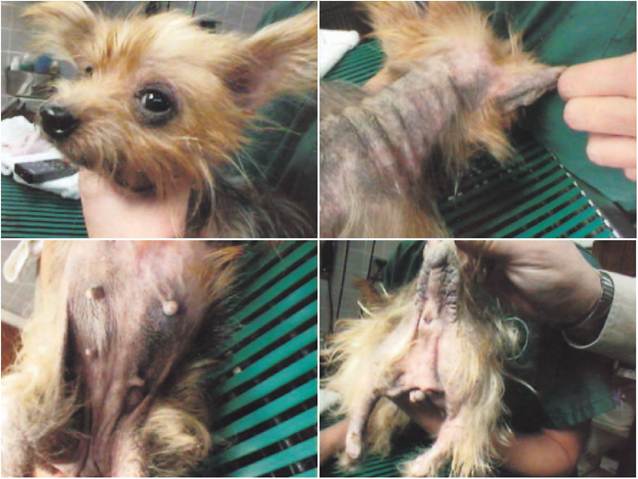
Figure 8-2
Underlying skin disease predisposes the ear to secondary bacterial or yeast infection. The patient, a 5-year-old Yorkshire Terrier with severe allergic skin disease complicated with Malassezia dermatitis, also had severe Malassezia otitis externa.
the ear canal, inflammation decreases the lumen diameter, tending to reduce both the ventilation and drying of the ear canal.
Without ventilation, the humidity level of the ear canal rises, a factor favorable for bacterial growth.Papules, pustules, crusts, ulcers, and alopecia that may occur on the skin of the trunk may also occur on the skin of the ear canal. Because the ear canal is L-shaped, exudates from these lesions tend to accumulate in the horizontal portion of the ear canal (Figure 8-3). In the treatment of skin disease, shampoo therapy, using a variety of compounds formulated for specific purposes, acts to remove irritating substances and improve healing. In the ear canal, ear flushing solutions containing a variety of ingredients are also used for adjunctive therapy of disease of the ear canal.
New approaches to the medical management of otitis externa in dogs and cats have now been introduced. They include (1) cytologic evaluation of exudates to identify disease processes and determine the type of disease organisms that may be present; (2) flushing products to remove exudates and to disinfect the canal epithelium; and (3) elucidations of pathophysiologic mechanisms showing that otitis externa is a secondary manifestation of underlying skin disease. New combinations of topical medications have been formulated to be effective against bacteria, fungi, and inflammation. The fluoroquinolone antibiotics, injectable ivermectin, and topical fipronil
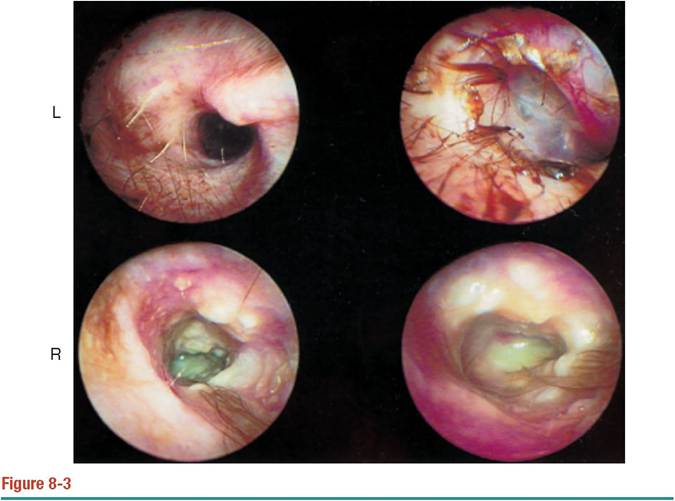
Left and right ear canals from a dog with atopic dermatitis. Top, The left ear canal (left) and eardrum (right) are normal. Bottom, The right ear canal (left) is severely inflamed and ulcerated and there is a thick exudate composed cytologically of rods and neutrophils. Culture revealed Pseudomonas. When the ear canal was flushed, there was no eardrum in that ear. Infection had moved through the eardrum into the tympanic bulla, resulting in secondary otitis media. Hyposensitization of this dog allowed complete resolution of this dog's otitis after 1 year.
for ear mite infestations have reduced the use of potentially ototoxic antibiotics, oils, and insecticides in the ear canal.
More on the topic Otitis externa is a common malady, occurring in 15% to 20% of dogs and 5% to 7% of cats seen in veterinary practice.:
- One of the most common ailments of dogs seen in a veterinary practice is ear disease.
- Common ear ailments of dogs and cats can be seen in up to 50% of patients in areas of humid climates during some or all of the patient’s life.
- Otitis media is a common disease process that often goes unrecognized in most veterinary practices.
- Primary Otitis Media in Cats
- Otitis Externa
- Reference ranges for haematology and serum chemistry values for adult cats and dogs
- Most cases of acute otitis externa are pruritic.
- Most skin diseases may affect the pinna in dogs and cats, but other parts of the body can also be involved.
- Secondary Otitis Media in Dogs
- Factors that Predispose the Ear to Otitis Externa
- Perpetuating Factors and Treatment of Otitis Externa
- Selecting the appropriateimaging method, correctly applying the technique selected, and accurately interpreting the examination are the key steps in imaging ear disorders in dogs and cats.
- Careful examination of a clean, dry ear canal in a dog or cat with otitis externa may reveal many conditions that affect the ear canal.
- By definition, otitis externa represents a spectrum of inflammatory changes that occur to the external acoustic canal in response to any insult to the ear canal epithelium.
- Otitis interna, or infection of the inner ear, is a relatively common disorder in the dog.
- Further thoughts on the rationality and sustainability of common law practice