TICK-BORNE DISEASES
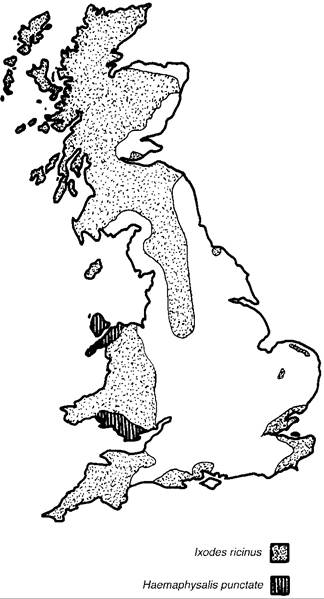
Figure 13.7. The distribution of cattle ticks in the
United Kingdom. From R. E.
Purnell (1982), Proc. Brit. Cattle Vet. Assoc., p. 103.There are two major species of cattle ticks in the British Isles, namely Ixodes ricinus and Haemaphysalis punctata. Ixodes is by far the most common and it is found throughout Scotland, Wales, north and south-west England and in a few areas of Dorset and the south-east. Tick areas are shown on the map in Figure 13.7. Haemaphysalis is found only in coastal areas of Wales. Ticks prefer coarse, uncultivated pasture, because the tufts of grass provide them with moisture and protection.
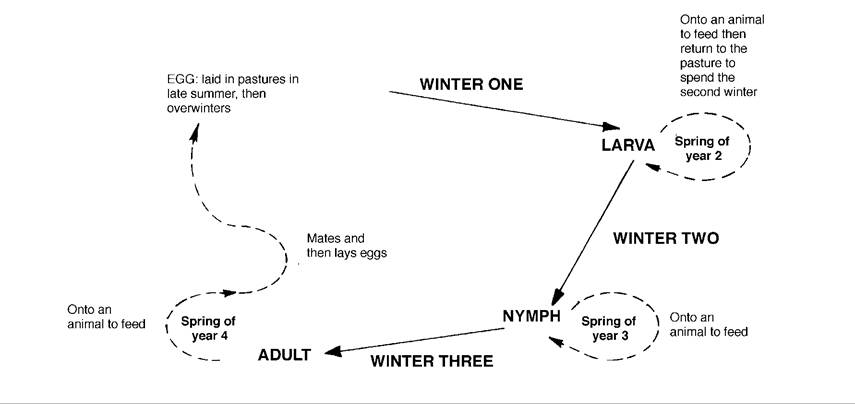
Figure 13.8. The three year life cycle of a springfeeding tick.
Ticks and tick diseases are much more important in warmer parts of the world, for example in central and southern Africa and America.
Life cycle of the tick
Different ticks may have different life cycles and local texts should be consulted. The life cycle of Ixodes ricinus is spread over three years, as shown in Figure 13.8. An egg laid in the grass in year one slowly develops over the following winter to hatch as a larva in the spring of year two. The tick larva climbs to the top of the grass or a small bush, and waits there until an animal brushes past, whereupon it attaches itself to the animal and then slowly engorges itself with blood. This takes four to six days. When full it drops onto the ground and remains there over the summer and the second winter until the spring of the third year, when it moults and emerges as a nymph. The feeding process is repeated and the nymph returns to the ground until the spring of the fourth year, when a further moult occurs, and it emerges as an adult.
The adults feed, then mating takes place, either on the animal or on the ground. The males die soon afterwards, but the females live slightly longer and lay their eggs into thick matted pasture.There are two phases of tick activity, one in the spring (May and June) and the other in the autumn (September). Ticks which hatch as larvae in the spring continue as spring-feeding nymphs and adults, whereas those hatching in the autumn
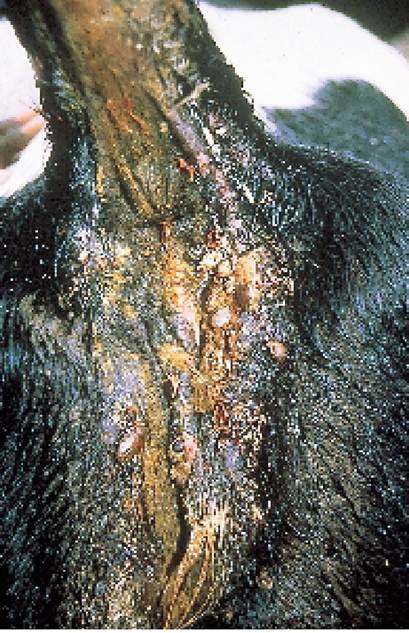
Plate 13.19. Ticks attach to an animal only to feed. The animal shown was from Zimbabwe. Whilst feeding, the ticks secreted a toxin which produced sweating sickness, which is not seen in the UK.
continue as autumn feeders. To feed, the tick inserts its mouthparts through the animal’s skin, squirts in saliva to act as an anticoagulant and then begins to fill itself with blood (Plate 13.19). When fully engorged it drops back onto the pasture, where it remains in cracks and crevices, to complete the moult which is the next stage of its development. It takes three years for a tick egg to become an adult, therefore, and during this time it will have fed only once each year. Most of the tick’s life is spent on the ground.
Ticks can feed on most animals including sheep, cattle, deer, rabbits, dogs and even man. However, although they may transmit sheep infections to cattle and vice versa, these infections only become established in the correct host species.
Disease caused by ticks is of two kinds, primary and secondary. Primary disease is related to the tick’s feeding activities and consists of irritation and anaemia due to extensive blood loss. It is rare that tick burdens are ever high enough to produce significant anaemia under British conditions, but this can be a problem in some countries. Secondary disease is far more common and is due to the effects of the parasites carried by the ticks. In the UK the two main conditions in cattle are redwater and tick-borne fever, both of which are carried by Ixodes.
Haemaphysalis carries a less important form of redwater and another blood parasite called Theileria. Ticks also carry the sheep disease louping-ill and cause tick pyaemia. Tick-transmitted diseases in southern Africa include heart water and gall sickness.Redwater
Redwater is caused by a small single-celled protozoan parasite called Babesia divergens. It is related to the parasite which causes malaria in man. Babesia is transmitted into cattle with the drop of saliva which is pushed down through the tick’s mouthparts as an anticoagulant at the start of feeding. Once in the bloodstream Babesia starts to multiply in the red blood cells. Waves of infection occur, with the new crop of Babesia rupturing the red blood cells as they are released. Haemoglobin pigment is also liberated from the ruptured cells. It passes out in the urine and hence the name of redwater. Other causes of red urine are given in Appendix 2.
Clinical signs
In the early stages of the disease the animal will be standing apart from the others and running a very high temperature (41°C). This is the multiplication phase of Babesia. Within 24 hours and possibly sooner, the urine turns a deep port-wine red colour (Plate 13.20) and froths as it lands on the floor. The animal’s pulse is very fast because of the anaemia associated with the rupturing of the red cells and often you can hear the very loud heartbeat if you stand quietly nearby. In the early stages, the dung is passed under pressure due to a spasm of the anus and this produces a ‘pipe-stem’ effect, almost as if the animal is scouring. As the effects of the anaemia develop, however, constipation sets in. If left untreated, death may occur. A proportion of animals will undoubtedly have less serious infections and some recover without treatment, possibly without having been noticeably ill.
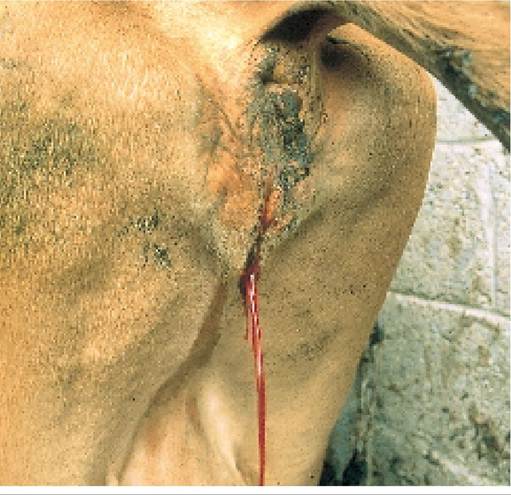
Plate 13.20. Redwater. Note the deep red urine.
There are other causes of red urine apart from Babesia.Treatment
Drugs such as imidocarb can specifically kill the Babesia. Quinuronium sulphate has also been used, although it must be given subcutaneously and not intramuscularly or intravenously. If the urine is still discoloured after 24 hours, a repeat treatment may be needed. Iron injections and vitamins will help re-form the red cells, although if the anaemia is severe a blood transfusion may be necessary.
Immunity
Young animals have an inherent immunity (sometimes called a premunity) against redwater, and the disease is unlikely to be seen in cattle less than nine months old. If they are then slowly exposed to low levels of infection they can build up their own true immunity.
However, as immunity is quite shortlived and as exposure to Babesia may be erratic, this may not be sufficient to give total protection. Babesia can persist in the pasture for prolonged periods, only occasionally infecting cattle because
• There are only two phases of tick activity each year, in spring and autumn, and cattle need to be grazing infested pasture during these periods to become exposed.
• By no means all parts of a farm will be tick infested.
• Babesia can survive inside the tick for three years as it passes from the egg through its larval, nymph and into the adult stages, despite the fact that the tick may not have fed on cattle blood over this period. It can even pass into the next generation of ticks via the ovary and tick egg. In this way pastures can remain infective for up to six years, even in the absence of cattle and certainly without cases of redwater being seen.
A vaccine, consisting of Babesia-infected blood which has been partly inactivated by radiation treatment, has been produced, and although it is not available in Great Britain it is used in other parts of the world where ticks are a much more serious problem.
Control
Prevention of redwater is based on reducing tick populations, promoting immunity (discussed above) and the strategic use of drugs.
Reducing tick population Ticks need thick cover and continuous moisture. If pastures are improved, for example by harvesting them very short, ploughing or tight grazing, this will reduce tick numbers. Ticks can feed on sheep, but they can only contract the redwater infection when they are feeding on cattle (or deer) during the active phase of Babesia multiplication. Consequently allowing dipped sheep to graze the pasture (dipping kills ticks) would help in tick control. Only if the land has been totally free of cattle and deer for six years or more will it be ‘redwater free’.
Strategic use of drugs Alarge dose of imidocarb diproprionate (at 2.5 times the normal rate) can be given to cattle when they first enter a tick area, or when an increase in tick activity is suspected. The drug gives total protection for 28 days, and then as its effect slowly fades, it is hoped that exposure to Babesia will occur and immunity will develop without disease. This drug is only available under special licence in the UK.
Tick-borne Fever
This is another important infection carried by ticks. It is caused by Cytoecetes phagocytophilia. This is a rickettsial parasite, an organism with size and characteristics partway between viruses and bacteria. Whereas Babesia attacks red blood cells, Cytoecetes destroys neutrophils, which are one of the types of white cells in the blood. Naturally, disease only occurs in tick areas and only during the periods of tick activity. Affected animals show stiffness in the joints, lethargy, a loss of appetite and they run a high temperature. Deaths are rare, although infection can cause weight loss or a drop in milk production, and the high temperature can often lead to abortion.
Treatment with the antibiotic oxytetracycline is usually very effective and a long-acting injection gives a four day cover. Infections are probably quite common, more so than with Babesia, but because the symptoms are mild and rather non-specific, the majority of attacks go unnoticed.
With up to 50% of its white blood cells destroyed, however, an animal suffering or recovering from tick fever will have lost some of its defence mechanisms and so it will be more susceptible to other diseases for the next one to two weeks.Louping ill
This is a virus infection carried by the tick Ixodes ricinus, and although it mainly affects sheep (causing nervous signs and abortions) it can occasionally affect cattle and even man. Most infections in cattle are asymptomatic, which means that no clinical signs are seen because infection does not reach the brain. The animal is then left with lifelong immunity. However, if the virus reaches the brain clinical signs include trembling, staggering and a very stiff gait. Fortunately most heifers recover, although some may be left with a permanent mild twitching.
A killed vaccine is available for use in areas where the disease is a problem. Annual boosters are required. Do not use in the last month of pregnancy.
More on the topic TICK-BORNE DISEASES:
- Tick-Borne Infections
- TICK-BORNE ENCEPHALITIS
- VECTOR-BORNE VIRAL DISEASES
- Rickettsiosis, anaplasmosis and ehrlichiosis are diseases of public health and veterinary importance that are acquired via tick bite.
- VECTOR-BORNE BACTERIA
- NATIONAL VECTOR BORNE DISEASE CONTROL PROGRAMME (NVBDCP)
- FIVE The Parasitic Insects, Mites, and Tick
- The various cardiovascular diseases observed in HIV-infected patients and widely described in the literature have been predominantly coronary and peripheral arterial diseases (PAD) and remain poorly known.
- Mosquito-Borne Infections
- BIBLIOGRAPHY FOR NONINFECTIOUS DISEASES
- INTERSTITIAL LUNG DISEASES
- THE CLOSTRIDIAL DISEASES