WHY STUDY WILDLIFE DISEASES
A focus on the health and well-being of wildlife themselves is of relatively recent origin. Historically, much of the initial interest in the health and diseases of wildlife stemmed from other concerns, particularly human health and the health of domestic animals (Friend 1976, Gulland 1995, Simpson 2002).
In time, more direct interest emerged in the wildlife themselves, with an effort to gain a more complete biological and ecological understanding of how diseases interact with host populations; this is exemplified by the emergence of wildlife health and conservation medicine as distinctive disciplines.More broadly, because parasitism is such a common mode of life, with parasites comprising the majority of species on earth (Zimmer 2000), there is considerable interest in understanding the basic biological relations parasitism entails, so as to better understand evolutionary history and ecological principles. In conventional Darwinian theory, natural selection adapts creatures to their immediate local environments through a process of specialization, operating to produce features that reduce organismal flexibility for future evolution; for example, specialization through simplification and loss of structures among helminth parasites often has been extreme (Gould 2002). Wildlife provide important models to better understand key host-parasite relationships.
In recent years, an increased sense of human responsibility toward the natural world, including a greater concern for wildlife, has emerged. Two examples of these concerns are the growing interest among the public in wildlife rehabilitation, as well as concerns over environmental issues such as oil spills and other forms of pollution. In recent years, increased tensions in global political relationships and a desire for greater national and international biosecurity (Dudley 2004) have further stimulated interest in a number of wildlife diseases.
Human Health
Public health risks were an early concern, and they remain a significant source of interest in the study of wildlife diseases (Beran and Steele 1994, Ashford and Crewe 2003). These interests have been focused primarily on wildlife diseases to which humans are susceptible, such as rabies, bubonic plague, avian influenza, Lyme disease, hantavirus pulmonary syndrome, and West Nile fever in North America. Such diseases transmitted between humans and other vertebrate animals are termed zoonoses (sing. zoonosis) (Soulsby 1974). We apply the term zoonosis as including (a) diseases common to both humans and nonhumans and which may be transmitted from nonhumans to humans or from humans to nonhumans, (b) diseases that are transmitted to humans and for which humans typically are a dead-end host (zooanthroponoses), and (c) diseases transmitted from humans to nonhumans and for which nonhumans typically are a dead-end host (anthropozoonoses). Interestingly, in Russian literature the opposite definitions are given for each term (Bender 2007). Estimates for the number of zoonotic diseases range from as low as 100 (Benenson 1990) to as high as 3,000 if all 2,000 serotypes of Salmonella spp. are counted as separate species (Beran and Steele 1994, Ashford and Crewe 2003), with new zoonotic pathogens being described every year. In one detailed count, an estimate of 816 zoonotic pathogens was made after omitting the numerous Salmonella spp. serotypes (Woolhouse and Gowtage-Sequeria 2005).
Along with their health impacts, some zoonoses have had particularly significant sociological impacts. Bubonic plague, caused by the bacterium Yersinia pestis, is considered to have given rise to at least three major world-wide epidemics (Stenseth et al. 2008) and to be one of the greatest natural disasters in human history (Fig. ι.ι). In the fourteenth century alone, it is estimated that plague caused or contributed to the death of one-fourth of the western European population and of 2 million persons in England alone (Poland et al.
1994). Equally important was the nearly complete social disruption that accompanied many plague epidemics, with consequent shifts in world politics and power (McNeill 1977). On a historical note, the old children’s nursery rhyme “Ring-around-the-Rosie” sometimes has been described as a poem stemming from plague epidemics. However, this appears to be fallacious, as the poem was not recognized until the eighteenth century, long after the most significant plague epidemics in humans; also, the poem has many variations that contain little apparent connection to plague (Munro 1996) and include one proposed to depict a smallpox epidemic (Glickman 1987).Rabies is another disease that has had a significant impact on human cultures.
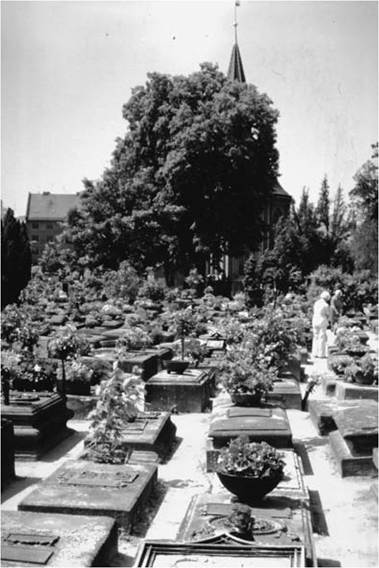
FIGURE 1.1 Plague cemetery in Nurnberg, Germany. Headstones often were laid on top of graves to prevent wild pigs and other animals from scavenging the dead (photo by R. Botzler).
The “big bad wolf” from the Little Red Riding Hood fairy tale may play on the fear many of European ancestry held for wolves (Canis lupus); this fear has been traced to a severe wolf rabies outbreak in Europe during the 1760s (Clarke 1971). However, in a more extensive study, Linnell et al. (2002) considered most wolf attacks on humans in France during the 1760s to be predatory rather than rabies-induced. The authors cite a number of reported wolf attacks on humans, especially in Finland, France, and Estonia, and more recently India, Russia, and additional regions of Asia; but they also assert that attacks by normal, healthy wolves are quite rare and unusual, and have not been reported in North America (Linnell et al. 2002).
Public health concerns have played an important role in the study of many other wildlife diseases. For example, most emerging human diseases have been identified as zoonotic (Lederberg et al. 1992); one estimate is that about three-fourths of the emerging diseases in humans are zoonoses (Taylor and Woodhouse 2000).
Many emergent diseases in humans have followed changes in habitat or populations of wild hosts, with rodent species frequently being of special concern (Mills et al. 1994, Poss et al. 2002). Hantavirus infections and avian influenza both can produce significant human mortality and loom as potential sources of serious zoonoses.Besides giving insights into the sources and risks ofzoonotic diseases to humans, the study of diseases in wildlife also may provide models for better understanding similar human diseases. Alternatively, the understanding of human diseases can provide important insights into diseases transmitted to nonhumans (anthropo - zoonoses), including other primates (Cranfield et al. 2002).
Domestic Animal Health
In addition to disease agents shared with humans, wildlife also share many disease agents with domestic animals. Rinderpest (literally “cattle pestilence”), caused by a morbilliv- irus closely related to the human measles virus, was considered a great scourge among domestic cattle and wildlife in Africa (Branagan and Hammond 1965, Plowright 1982) before its eradication (Anonymous 2011). The impacts of this disease on imported cattle were so severe that strenuous efforts were made to contain infections; these efforts included establishing belts of immune cattle in key habitats, and even constructing a 265-km barrier fence between Lake Tanganyika and Lake Nyassa in Africa, with a 40-km game-free strip maintained on each side of the fence by professional shooters (Plowright 1982, McCallum and Dobson 1995). This led to considerable wildlife mortality during the ongoing slaughter of animals in this game-free strip; the fence further disrupted the natural daily and seasonal migration patterns for wildlife between key habitats.
In addition to the concern for humans, rabies also may have a considerable impact on wildlife and domestic animal populations (Beran 1994). Rabies in vampire bats (Desmodus rotundus) occurs from tropical Mexico to northern Argentina and Chile, and the disease has led to direct losses of millions of dollars annually among cattle, as well as additional losses through reduction in production and secondary infections among livestock (Kverno and Mitchell 1976).
Rabid bats also have contributed considerably to public health costs for rabies control and postbite prophylaxis of humans. The environmental and ecological effects of killing vampire bats as a means of control have not been assessed.Avian cholera, caused by the bacterium Pasteurella multocida, is a serious disease among both domestic (Heddleston 1972) and many wild birds, including migratory wildfowl (Botzler 1991, Samuel et al. 2007). In North America, the first known epizootics among wildfowl occurred in Texas (Gordus 1993) and California (Rosen and Bischoff 1949, 1950) and were associated with exposure to carcasses of domestic chickens that had died from avian cholera. However, despite these historical connections and an ongoing concern that wild birds may be a source of infection for domestic birds, there is little direct evidence for consistent transmission of Pasteurella multocida between wild and domestic birds (Snipes et al. 1988, 1989; Christiansen et al. 1992).
Many helminth parasites and protozoa also are shared between domestic animals and wildlife (Fig. 1.2). These include lungworms and intestinal nematodes, tapeworms and flukes among mammals (Longhurst et al. 1952, Soulsby 1968, Dunn 1969, Fraser and Mays 1986), as well as a number of intestinal parasites among domestic (Soulsby 1968) and wild (Wehr 1971) birds.
Although interest in shared diseases between wildlife and domestic animals initially stemmed from veterinary concerns about the role ofwildlife as sources ofdiseases for domestic animals, it also is important to note that wildlife can be adversely affected by diseases acquired from domestic animals. Recent epizootics in
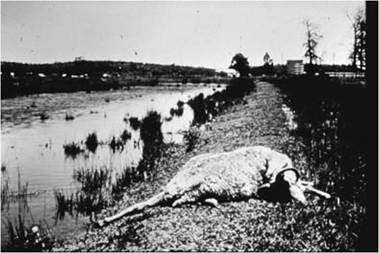
FIGURE 1.2 A sheep dying from effects of liver flukes (Fasciola hepatica) in habitat typical of the snail intermediate host (Courtesy of W. Frank, Universitat Hohenheim, Germany).
African mammals of both canine distemper (Harder et al.
1995, Roelke-Parker et al. 1996, Carpenter et al. 1998) and rabies (Cleaveland and Dye 1995) followed transmission of these viruses from domestic dog reservoirs in conjunction with increasing encroachment of human populations on wildlife reserves (Poss et al. 2002). As an added concern, some of the emerging infectious diseases in both wildlife and domestic animals also are zoonotic (Mahy and Brown 2000, Friend et al. 2001, Daszak and Cunningham 2002, Kahn 2006).Some diseases intersect with public health, domestic animals, and wildlife. Influenza, caused by a myxovirus, is an example. Wild ducks, geese, shorebirds, and domestic pigs are important reservoirs for these viruses and can transmit them to domestic fowl (Slemons and Brugh 1994, Acha and Szyfres 2003, Fouchier et al. 2005). Human cases usually occur after exposure to infected domestic animals such as pigs and fowl, in which viral strains have undergone a genetic recombination (Slemons and Brugh 1994, Alexander and Brown 2000); human cases of the highly pathogenic avian influenza H5N1 have been tied to domestic fowl.
Wildlife Health
While research addressing the role of wildlife diseases among humans and domestic animals has occurred over many years, a focus
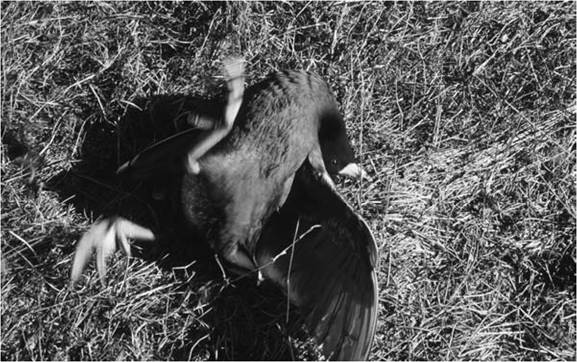
FIGURE 1.3 An American coot (Fulica americana) dying from avian cholera (Pasteurella multocida infection). Note the convulsions and torticollis (“twisted neck”).
on wildlife diseases with a specific concern for the wildlife themselves has developed more recently, emerging first as a formal discipline about 1951, with the founding of the Wildlife Disease Association. Initially, most available information among interested professionals was transmitted through the Wildlife Disease Association Newsletter, which was replaced with the Bulletin of the Wildlife Disease Association in 1965, which, in turn, was continued as the Journal of Wildlife Diseases after 1970. Several books emerged during and after the 1960s that also helped establish wildlife disease as a distinct discipline (McDiarmid 1962, 1969; Davis et al. 1970, 1971; Davis and Anderson 1971; Page 1976; von Braunschweig 1979; Davis et al. 1981; Fowler 1981; Wobeser 1981; Edwards and McDonnell 1982; Hoff and Davis 1982; Fairbrother et al. 1996; Samuel et al. 2001; Williams and Barker 2001; Majumdar et al. 2005; Wobeser 2006; Thomas et al. 2007; Atkinson et al. 2008).
Most early concerns about wildlife diseases among biologists and managers were focused on major mortality events or mortality factors affecting the management of economically important game species (e.g., waterfowl, ungulates, upland game) (Fig. 1.3). In recent years, greater emphasis has been placed on better assessing the role of parasites and diseases on general fitness (survival, fecundity, mate selection) for all wildlife species. Concern for diseases in threatened and endangered species, and in relocation and translocation programs also has increased. Many disease investigations in conservation programs continue to be focused on high-profile species that have undergone a sudden demographic crash (Munson and Karesh 2002).
Recent emerging infectious diseases of wildlife include the chytrid fungus (Batrachochy- trium dendrobatidis) (Daszak et al. 2004), white nose syndrome (Pseudogymnoascus [Geomyces] destructans) (Blehert et al. 2009), and devil facial tumor disease (Hawkins et al. 2006). Emerging wildlife diseases can have a particularly severe impact on small, fragmented populations (Daszak and Cunningham 2002) and have been responsible for some local and regional extinctions (McCallum and Dobson 1995, Daszak and Cunningham 1999, Woodroffe 1999). Reasons proposed for the intensified transmission and better detection of emerging diseases include removal of geographic barriers to human and animal transport, as well as ecosystem disruption, climate change, and habitat fragmentation (Graczyk 2002).
In a broader sense, devising conservation strategies that are practical in the current understanding of the “state of the Earth” will require models that address disease risks (Munson and Karesh 2002), including risks to humans, domestic animals and plants, wildlife, and whole ecosystems, and that further recognize that all of these groups have shared risks and cannot be viewed in isolation from the others. Such strategies call for a better understanding of the role of wildlife in these larger disease models, as well as call for policies and approaches to integrate human, agriculture, and wildlife disease studies, as addressed in the One Health concept (www.onehealth.com).
More on the topic WHY STUDY WILDLIFE DISEASES:
- OTHER CLOSTRIDIAL DISEASES IN WILDLIFE
- ROLE OF DISEASES IN WILDLIFE POPULATIONS
- Noninfectious diseases of wildlife
- Botzler Richard G., Brown Richard N.. Foundations of Wildlife Diseases. University of California Press,2014. — 458 p., 2014
- STEPHANIE SPECK1 AND J. PAUL DUFF2 1 Bundeswehr Institute of Microbiology, Department of Virology and Rickettsiology, Munich, Germany 2Animal Health and Veterinary Laboratories Agency Diseases of Wildlife Scheme (AHVLA DoWS), Great Britain Wildlife Disease Surveillance Partnership, Penrith, Cumbria, UK
- 1 SOME WILDLIFE RELATED EMERGING DISEASES (WIREDS) IN EUROPE
- 8 species (Family)-Specific wildlife DISEASES IN EUROPE
- 3 SELECTED SOCIO-ECONOMICALLY IMPORTANT WILDLIFE RELATED PATHOGENS AND DISEASES IN EUROPE
- Can Species Diversity Suppress Human Diseases? A Case Study
- The various cardiovascular diseases observed in HIV-infected patients and widely described in the literature have been predominantly coronary and peripheral arterial diseases (PAD) and remain poorly known.
- Control of Paratuberculosis in Wildlife
- BTB Control in Wildlife