Global Outbreaks from an Historical Perspective
The historical origin of the contagious diseases, which constitute global public problems, goes back to human beings start settling and cultivating the soil.
The life of hunter-gatherer groups varied according to regional and climatic factors, but it was more comfortable and healthier than the life of the settled societies.
Destruction of forests over time in order to reach cultivable agricultural areas narrowed the living space of various animals (such as mice, ticks, mosquitoes, bats) and forced them to live with people. Various infectious diseases such as tuberculosis, malaria, plague, typhus, measles, and smallpox have found an environment suitable for the spread of an epidemic, especially after domestication of animals (Table 2.1). In the historical development process, upon the geographical discoveries, overseas trade, industrial revolution and the working environment, population growth, and the change in settlement style, most people had to live in stuck collective dwellings that are far from hygienic conditions that paved the way for the spread of infectious diseases (Harari 2015). In line with these developments, working, living, and transportation conditions were the main determinants for creating an environment suitable for the infectious disease to become an epidemic.We have arranged the heaviest fatal epidemic diseases experienced throughout human history, benefiting from the historical development table outlined by LePan
Table 2.1 Domesticated animals and human diseases that they’ll be able to cause
| Human diseases | Animal that carries a close relative of the microbe |
| Measles | Cattle (Rinderpest) |
| Tuberculosis | Cattle |
| Smallpox | Cattle (Smallpox in cows) |
| Flu | Pig and duck |
| Whooping cough | Pig and dog |
| Falciparum Malaria | Birds (Chickens, ducks) |
Source Diamond (2010)
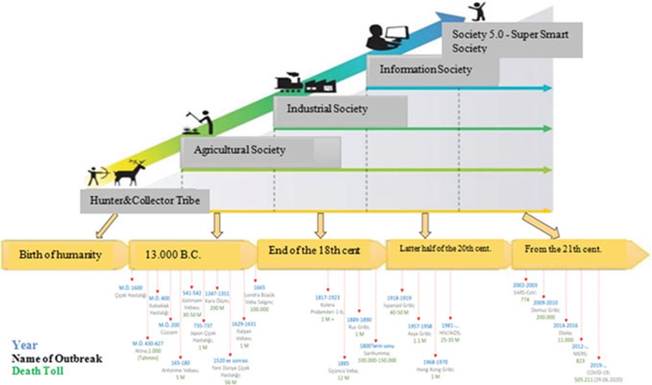
Fig. 2.1 Pandemic history from hunter society to super intelligent society. Source (Generated by the author by compiling the data in Fukuyama 2018; Yildiz 2018; LePan 2020)
(2020) and the social development map visualized by Fukuyama (2018), Yildiz (2018) (Fig. 2.1).
Table 2.2 shows the global outbreaks experienced throughout human history, the pathology of the disease, and the number of deaths caused.
2.3
More on the topic Global Outbreaks from an Historical Perspective:
- Global Outbreaks from an Historical Perspective
- Historical Development
- Corona Virus-Based Millennium Outbreaks and Intervention Through Fiscal Policy Instruments
- Historical Perspective of BTB in Nigeria
- Historical Perspective
- Some clarifications about the new perspective
- Historical surveys and descriptive works
- The Historical Context
- Conclusion
- The Postcolonial Perspective