Christian Mission and the Boxer Uprising
Christianity was not new to nineteenth-century China. Nestorian Christianity first reached China via the Silk Road during the Tang dynasty (618-907), and Iberian Catholicism arrived by sea in the sixteenth century.
Following a conflict over Catholic refusal to adhere to Confucian ritual proscriptions, Christian mission was banned in 1732, but was again allowed as a provision of the Treaty of Tianjin in 1858. Once so opened, China quickly received a large and diverse influx of Christian missionaries, both Catholic and Protestant. As had been the case during the earlier period of Iberian Catholicism, mission was frequently bound to national interest, producing a network of rivalries among competing missions and with local elites and religious figures such as Buddhist monks. Unlike the earlier period, this new reintroduction of mission came at a time of Qing dynastic decline, and the increasingly aggressive search by foreign powers for special concessions and spheres of interest within China. Some missions were bystanders to these events; others were willing antagonists. Many missionaries and diplomats felt that their aggressive defence of the Christians was a fair response to official xenophobia; others were unapologetic in their ambition to seed conflict that would result in diplomatic gain. As China's position continued to deteriorate during the last decade of the nineteenth century, local officials were cautioned to avoid such conflict at all costs.It is difficult to characterise simply the reasons behind Christian conversion, or the hostility that was felt against the religion. While most Catholic and Protestant missions set standards of knowledge and behaviour for new converts, it was not uncommon for one to accuse the other of accepting converts with more enthusiasm than care. More serious charges came from suspicious Chinese, who accused the missionaries of sorcery.
Missionaries used their diplomatic leverage to protect their charges in civil and criminal disputes, creating deep grudges against the Chinese Christians. The Christians themselves frequently exacerbated these divisions by refusing to participate in village rituals. Often entire families would convert to Christianity, thus bringing religious difference into lineage feuds and conflicts that went back decades or longer.These forces could come together with deadly results. In 1870, a mob gathered at the French church in Tianjin, enraged by rumours that Catholic nuns were kidnapping Chinese children and using their eyes and organs to make potions (the nuns did in fact offer a cash payment to people who brought dying children to the church for baptism). Sent to calm the situation, the bellicose French consul instead shot the magistrate's assistant (possibly by accident), prompting the crowd to attack the church, killing the diplomats, priests and nuns, as well as a number of Russian bystanders and about forty Chinese Christians.
The brewing tensions reached a peak in the Boxer Uprising of 1900. For a number of years, the North China Plain had been afflicted by drought (Figure 2.2), a condition that many interpreted as Heaven's displeasure at the spread of the foreign religion. This sentiment spread through the countryside through religious and martial arts networks, including one style of boxing called Plum Flower Fist (Meihua quan). Along with fighting techniques, these networks spread the techniques of direct possession, by which young men of a pure heart could be directly
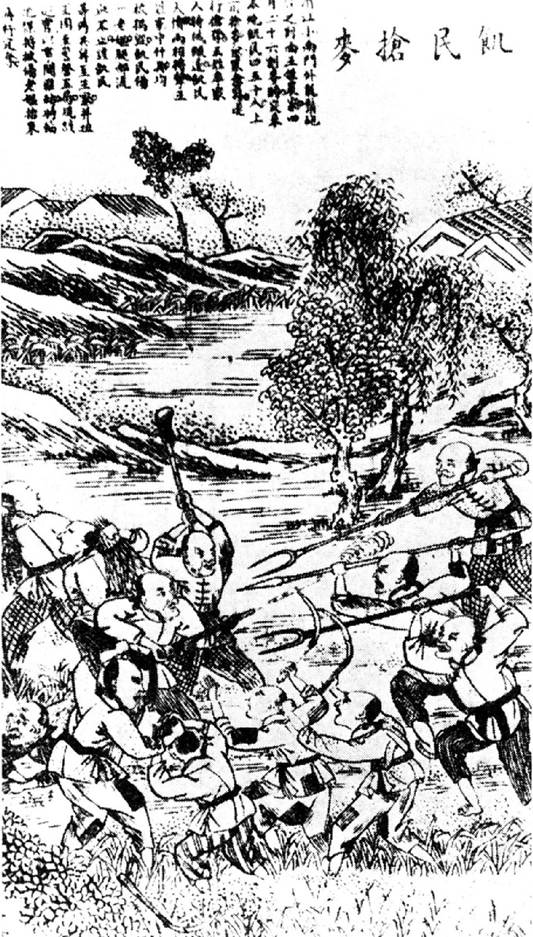
Figure 2.2 ‘Starving people looting grain'. This woodcut image from around 1900 hints at the severity of the drought in northern China, and suggests the role of poverty and natural disasters in driving events like the Boxer Uprising.
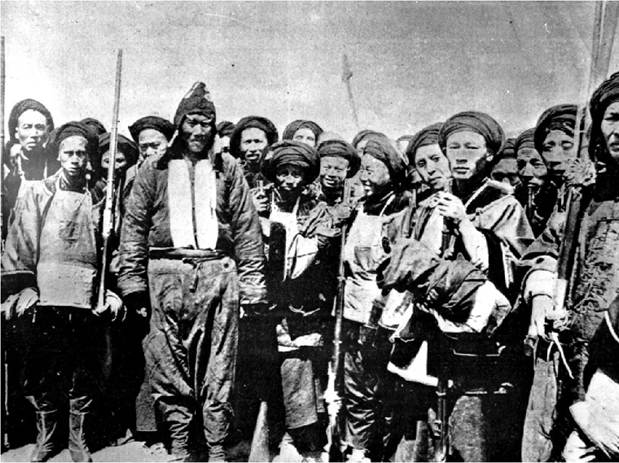
Figure 2.3 Boxers in Beijing, 1900.
possessed by martial deities such as Guan Gong, or by apotheosised literary figures like the Monkey King, Sun Wukong, from the classic Journey to the West. So possessed, these young men would be invulnerable to bullets (daoqiang buru) and ready to enter battle against the foreigners. Still without a leader, the movement consisted of bands of men like the ones shown in Figure 2.3 who began converging on the foreign enclaves in Tianjin and Beijing. The movement called itself the Society of Righteousness and Harmony (Yihe tuan). Seeing their penchant for martial arts display, the foreigners dubbed them Boxers. A smaller force consisting solely of women, particularly pre-pubescent girls, was called the Red Lanterns Shining (Hongdeng zhao), and was credited with a variety of magical powers, including the ability to fly, and to destroy armies and buildings with a wave of their fans.
The rise of the Boxer movement coincided with and exacerbated chaos in the Qing court. In 1900, the Empress Dowager Cixi (1835-1908), who had revealed herself to be the true power in Beijing, reversed her earlier policy of suppressing the Boxers, and instead supported them, issuing a demand for all foreigners to leave China. Doubting her assurances of protection, the foreigners chose instead to defend the legations while waiting for relief from the 20,000-strong Eight Nation Expeditionary Force that reached Beijing on 14 August. Many local Christians did the same, barricading themselves into stoutly constructed and easily defensible churches. Provincial officials acted on their own volition: the Shanxi governor Yuxian (1842-1901) assured his infamy by offering protection to fifty-four local missionaries and then having them slaughtered inside the government compound.[74] Others, such as Shandong governor Yuan Shikai (1859-1916), ignored the order to support the Boxers, and others (particularly Muslim units in the army) were from the outset hostile to the movement.
Although the Boxers are remembered as anti-foreign, the violence of the movement and its suppression were directed mainly at Chinese. While the missionary press justly lamented the deaths of their own, the number of Chinese Christians killed was far higher, perhaps as many as 30,000 (Figure 2.4). As was so often the case, the unrest presented an opportunity to settle old grudges violently. The missionary doctor Arthur Peill recounted how Boxers in southern Zhili (modern Hebei) turned against a cluster of Muslim villages: ‘Hundreds of Boxers surrounded these unsuspecting villages, and slaughtered their inhabitants to the number of almost a thousand people, massacring men, women and children without distinction. Babies were thrown up into the air and caught on the points of spears and so on.’[75]
The suppression was equally brutal (Figure 2.5). Both foreign troops and Qing units were unsparing in their recriminations against Boxer areas. Villagers and townsfolk who had been unable to challenge the Boxers during the movement’s rise took the opportunity to exact revenge. Foreign troops added to the chaos by engaging in large-scale looting of cultural treasures. Although no admirers of the Boxers, first-hand witnesses such as Peill were nevertheless appalled at the indiscriminate violence visited by wave after wave of attacks inflicted on villages that in many cases were only tangentially connected with the movement.
As was the case with the Taipings, the violence both of and against the Boxers was intertwined with religion on many levels. Boxer practices echoed prevalent beliefs in magical invulnerability, incarnated the gods of the popular pantheon, and anticipated a world renewal that was at least inspired by the eschatology of the Eternal Venerable Mother. But in many cases, such as
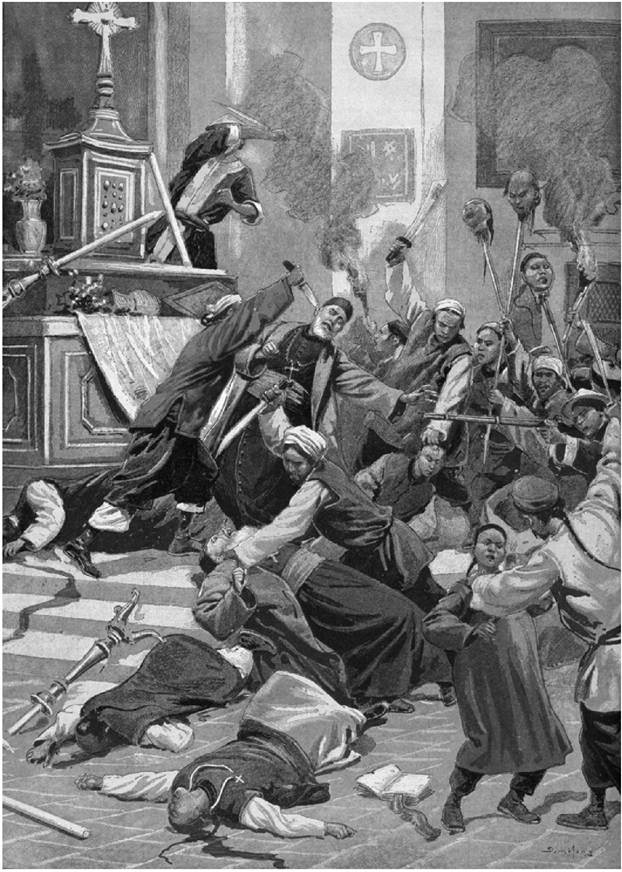
Figure 2.4 Looting of the Catholic church in Shenyang, 1900. Somewhat unusually for foreign images, this drawing highlights the murder of Chinese Christians, rather than missionaries.
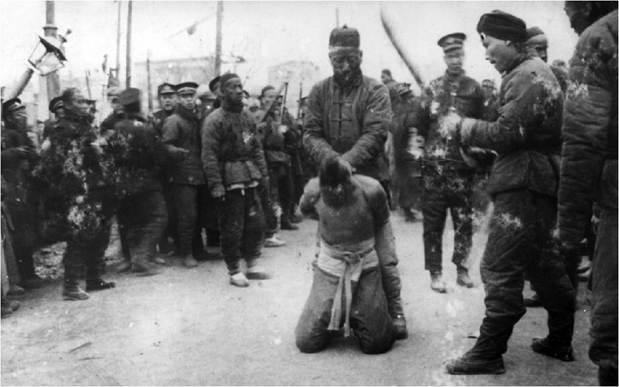
Figure 2.5 Execution of a Boxer in Beijing. Public executions and the display of mutilated corpses aimed to dispel any remaining rumours of Boxer magic.
attacks on neighbours or employers, the breakdown of order simply provided an excuse to settle long-held scores.
More on the topic Christian Mission and the Boxer Uprising:
- What Is a Mission Statement? Will it Help?
- What Is a Mission Statement? Will it Help?
- NATIONAL HEALTH MISSION
- Tay Son Uprising (1771-1802)
- MISSION INDRADHANUSH
- Mission and Goals of CAMTS
- Mission and Goals of CAMTS
- Zaporozhian Defiance; Uprising on the Don
- 18 The Khmel’nyts’kyi Uprising of 1648
- Khmel’nyts’kyi and the Uprising of 1648
- The Extermination of Monastic Militancy and the Defeat of the Shimabara Uprising
- The Peasant Uprising and the Destruction of the Great Polish Army at Piliavtsi
- The great uprising of 1648 was one of the most cataclysmic events in Ukrainian history.
- Mission Statement
- Mission Statement
- Mykhailo Drahomanov and His Mission
- Paul and the Mission to the Gentiles
- China: mission beyond the empire
- India: mission within the empire