Diplomacy and deterrence
Once the Nazi challenge gained strength, a major war became the only way by which it could be stopped. The starting date of that war would depend on the moment when the status quo Powers resisted Hitler with force.
From 1933 toAbyssinian War
On 3 October 1935, the brutal conquest of Abyssinia by Italian troops launched from neighbouring Italian Eritrea began. It arose from Mussolini’s desire to exercise the martial prowess of his Fascist regime and thereby further his revolution. The war was popular inside Italy as revenge for Italy’s defeat at Adowa in 1896. Emperor Haile Selassie appealed to the League of Nations, but his small kingdom was abandoned to its fate. The war ended on 5 May 1936.
Axis
A term coined originally by Mussolini in November 1936 to describe the relationship between Fascist Italy and Nazi Germany. The German-Italian Axis was reinforced by the so-called Pact of Steel signed by Rome and Berlin in May 1939. More broadly speaking, the term is often used (as in Chapter 8 of this book) to refer to the relationship between Germany, Italy and Japan. These three Powers were formally linked by the German-Japanese AntiComintern Pact of November 1936, which Italy signed one year later, and the Tripartite Pact of September 1940.
Comintern
The Communist or Third International founded in Moscow in 1919 as an organization to direct and support the activities of communist parties outside Russia. It was abolished in 1943 in a short-lived effort by Stalin to reassure Britain and the United States that the Soviet Union no longer sought to export Marxism-Leninism.
Versailles Treaty
The treaty that ended the Allied state of hostilities with Germany in 1919. It included German territorial losses, disarmament, a so-called war guilt clause and a demand that reparations be paid to the victors.
1938, Paris and London accommodated the Nazis.
On 21 October 1933, Germany walked out of the League of Nations. In March 1935, Hitler ordered compulsory military service in Germany and announced the existence of the Luftwaffe (German air force). In reaction to these unilateral violations of the Versailles Treaty, Britain, France and Italy consulted and issued a protest in April. This deceptive display of unity between France and the Locarno guarantors was short lived. In June, Britain signed a bilateral naval agreement with Germany. In October, the Italians, who had only just signed up to military agreements which set out how they would assist France in a war against Germany, attacked Abyssinia. In March 1936, while Europe was gripped by the crisis in the Mediterranean, German troops marched into the Rhineland. In response, Britain stepped forward to propose a new round of diplomacy, France stood still and Belgium withdrew into neutrality. The emerging security framework of the 1920s was now in ruins. The sense that Europe was on the verge of a great calamity was heightened after July 1936 with the outbreak of the Spanish Civil War. Italy and Germany sent men and materiel to assist Franco's nationalists, while the Soviet Union supplied the same to the left-wing Republican government. As Europe's ideological fissure widened, France and Britain negotiated an international agreement on nonintervention in Spain which in practice permitted German and Italian intervention to continue.Orthodox historians have explained this phase of retreat as the product of shortsighted and spineless leadership. Granted, French and British politicians never fully grasped the depth of Hitler's malevolence. However, hindsight combined with a half-century of scholarly inquiry into the nature of Nazism makes it difficult for us to appreciate the uncertainty about Germany's intentions that contemporaries had to deal with. In the cabinet rooms, foreign and defence ministries and intelligence departments of France and Britain, pessimists argued that the militaristic Germans sought to dominate Europe, for much the same reason as they did before 1914, while optimists believed that Hitler or those who purportedly had influence over him could be constructively conciliated.
Pointing to the statements of the former as evidence of foresight and those of the latter as proof of inanity does injustice to the realities of statecraft. These debates — recurring again and again in the twentieth century — sprang from the inescapable dilemma of coping with what was an inherently ambiguous and menacing situation.see Map 7.1
Uncertainty alone does not explain the initial responses of Britain and France to the expansion of German power. There were other inhibiting factors. Not least was an all-pervasive sense of revulsion at the cost of the last war. Most French and British politicians had either served in the trenches or lost someone dear. ‘Never again' was not just a slogan for peace movements and pacifists; it was the moral purpose behind the foundation of the League of Nations, the Kellogg— Briand Pact and world disarmament. The identification of the status quo Powers with liberal internationalism should not be dismissed as starry-eyed idealism. Values expressed in the form of rules or norms of conduct are potential power. As the chief beneficiaries of post-1919 order, it was in the interest of Paris and London to outlaw force and promote institutions for the pacific settlement of disputes. As one Japanese official complained, ‘The Western Powers had taught
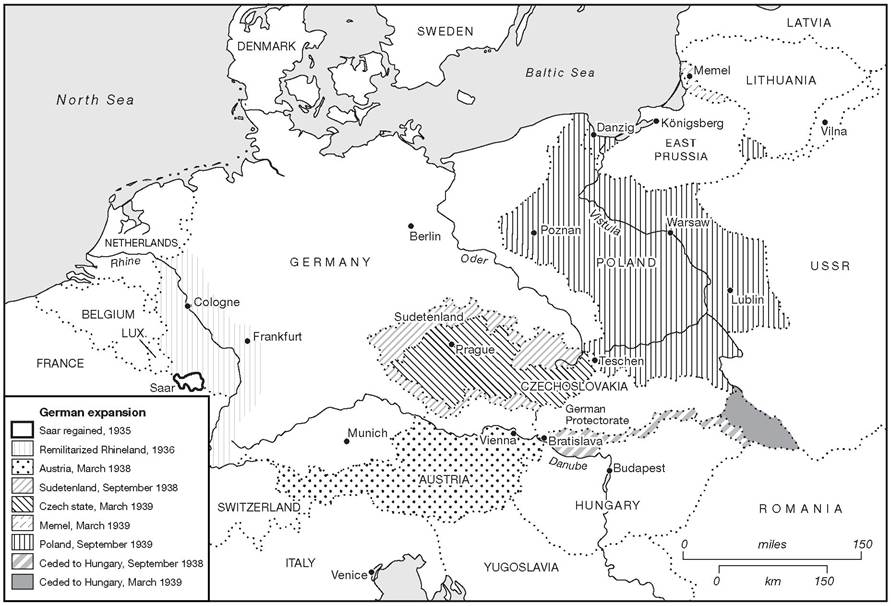
Map 7.1 German expansion, 1935-39
Source: After Lamb and Tarling (2001)
the Japanese the game of poker... but after acquiring most of the chips, they pronounced the game immoral and took up contract bridge.' This barb only captures the self-interested dimension of Western foreign policy. British, French and American statesmen believed that ‘contract bridge' was not only good for them, but also good for the rest of the world. The problem was persuading everyone to play by the new rules. This could only be done in the first instance through diplomacy. After all, to uphold the status quo, the Western Powers could not adopt the violent methods of the revisionists without undermining the norms of the liberal state system that they had created.
Of the status quo Powers, France had the least room for manoeuvre. In materiel terms, Frenchmen knew that they could not equal Germany's ultimate strength. The old adversary was not only more densely populated but also more industrialized. It took a coalition of Great Powers to win in 1918. To enforce the Versailles Treaty, French soldiers had marched in 1923, but to the enormous cost of the French economy and its relations with the British and the Americans. ‘A country's defence resides not only in its soldiers and its cannons,' Premier Herriot once observed, ‘but also in the excellence of its legal position.' France had to have justice on its side in order to construct a coalition powerful enough to face a
appeasement
A foreign policy designed to remove the sources of conflict in international affairs through negotiation. Since the outbreak of the Second World War, the word has taken on the pejorative meaning of the spineless and fruitless pursuit of peace through concessions to aggressors. In the 1930s, most British and French officials saw appeasement as a twin-track policy designed to remove the causes of conflict with Germany and Italy, while at the same time allowing for the buildup of sufficient military and financial power to bargain with the dictators from a position of strength.
detente
A term meaning the reduction of tensions between states. It is often used to refer to the superpower diplomacy that took place between the inauguration of Richard Nixon as the American president in 1969 and the Senate's refusal to ratify SALT II in 1980.
Popular Front
The Comintern policy announced in 1935 of encouraging communist parties to form coalitions with other socialist and nonsocialist parties in order to provide a common front against fascism.
resurgent Germany. True, France had security treaties with Poland, Czechoslovakia, Romania and Yugoslavia. But these small states, bitterly divided among themselves, did not add up to an ‘Eastern bloc'.
Moreover, French influence in Eastern Europe plummeted after Germany occupied the Rhineland without a shot being fired. What about Britain and Italy, the guarantors of the Treaty of Locarno? For much of the period, the British did not see themselves as France's ally, but instead as coolheaded mediators caught between the hotheads in Paris and the bullies in Berlin. As for Italy, Pierre Laval, the French premier, concluded an accord in early 1935 with Mussolini which stipulated that the two states should consult if Germany disturbed the peace. The Duce, however, saw the deal as a go-ahead for his Abyssinian conquest. The French had no choice but to alienate Italy by siding with Britain and the League of Nations.What about the Russians? In May 1935, France did conclude a mutual assistance treaty with the Soviet Union as well as a parallel agreement with Czechoslovakia. The negotiations for these treaties (as well as those with Italy) had begun a year before under Louis Barthou, the foreign minister of the centre-right government of ‘National Union'. Some argue that Barthou's diplomacy was a transitory phase of ‘realism' in French policy-making — an effort to surround Germany with powerful allies, including the Soviets. Tragically, so runs this interpretation, Barthou was assassinated in October 1934 and his realpolitik was abandoned in favour of a craven policy of ‘appeasement'. In fact Barthou's diplomacy did not mark such a radical break in continuity. Just like his friend Briand before him and those who followed him, Barthou hoped to build a multilateral and interlocking framework of mutual security guarantees in Eastern and Western Europe similar to those signed in 1925 at Locarno. To describe this strategy another way, Barthou was trying to persuade Germany to join in its own containment. Security talks with Russia, Poland, Czechoslovakia and Italy were designed to convince Berlin that Franco-German detente was the only way to alter the peace settlement. As we know, Hitler responded to this security-building effort by occupying the Rhineland and thereafter ignoring French overtures.
The door on the Locarno era was slammed shut.Domestic politics in France complicated its foreign policy. During the slump, the French witnessed a 30 per cent fall in national income and growing budget deficits, which polarized the electorate between the Right and the Left. Alignment with Fascist Italy was anathema to the Left, while a rapprochement with Soviet Russia infuriated the Right. Governments also changed frequently. Between 1933 and 1940, France was led by thirty-four separate administrations and had seven different foreign ministers. In April 1936, the election of a centre-left coalition known as the Popular Front exacerbated the ideological rift. Industrial unrest and social turmoil erupted. The presence of the French Communist Party in the coalition disgusted the right-wing group. Investors became jittery. The flight of capital from the Paris financial markets drove down the value of the franc. Even the unwavering commitment of the Popular Front premier, Leon Blum, a dedicated social reformer and disarmer, to a huge programme of rearmament in 1936 did not inspire national unity. Once Franco started his rebellion in Spain, the perception of imminent civil war in France (though greatly exaggerated) became widespread. The image of a left-wing government embattled by rightwing generals was just a little too close to home. Blum's cabinet considered assisting the Spanish Republic, but feared that this might spark civil war in France as well as a general war in Europe. The Popular Front therefore championed nonintervention and worked with the British to put it into effect. After the setbacks of 1935—36, what France needed most was time to rearm and a firm embrace from the other powerful parliamentary democracy in Europe, Britain.
Unfortunately for the French, the last thing the British were prepared to do was offer security guarantees. Once again, painful memories of the First World War and a long-standing aversion to entangling alliances played an important part here. A deep hostility towards and misunderstanding of the French were equally important. In the early 1930s, many British officials believed that German recalcitrance and even the advent of Nazism were attributable to French obstinacy. Ramsay MacDonald, Britain's prime minister from 1931 to 1935, considered ‘the diplomacy of France... an ever active influence for evil in Europe'. The ideological conflict in France that followed the election of the Popular Front only served to strengthen the deeply held conviction that it was an unreliable ally. Britain's strategic predicament also spoke in favour of isolation from Europe. Britain was a global Power. Unlike the French, the British could not focus solely on the Nazi menace. Japan threatened Britain's eastern possessions and commercial interests in China, while Italy, with its battlefleet concentrated in the Mediterranean and a large army positioned in Libya, endangered Egypt and the Suez Canal. These commitments exceeded Britain's defence resources.
The rise of the triple threat did not mean that the eyes of British strategists turned away from the German threat. A top-level committee of civilian and military officials reviewing Britain's defences in 1933—34 identified Germany as Britain's ‘ultimate potential enemy'. Some influential voices advocated a retreat into isolation, but most recognized that Britain could not abandon Europe. Germany could not be allowed to crush France, occupy the Low Countries and position air and sea forces close to Britain. However, another great war to prevent Germany's domination of continental Europe would initiate another accelerated period of decline in Britain's standing as a global financial and trading nation to the benefit of the United States. Peace in Europe was therefore Britain's ultimate national interest. British diplomats accordingly drew up disarmament conventions and spoke of multilateral security accords for Eastern and Western Europe comparable to those of the French. The formula for the pacification (or appeasement) of Europe was plain: Germany would offer France a security guarantee and, in exchange, France would permit a relaxation of the Treaty of Versailles.
collective security
The principle of maintaining peace between states by mobilizing international opinion to condemn aggression. Commonly seen as one of the chief purposes of international organizations such as the League of Nations and the United Nations.
Britain's domestic politics reinforced this diplomatic stance. The view that the Versailles settlement had been untenable and indefensible was common among the political elite and opinion-makers. As in France, the man on the street regarded the League of Nations and disarmament as the twin pillars of foreign policy. In parliament, the Labour Party was the most vocal in support of the League, but enthusiasm for Geneva diplomacy and collective security cut across RightLeft boundaries. As a general election approached in the autumn of 1935, Prime Minister Stanley Baldwin, the leader of a cross-party - but in the main
protectorates
Territories administered by an imperial state without full annexation taking place, and where delegated powers typically remain in the hands of a local ruler or rulers. Examples include French Morocco and the unfederated states in Malaya.
Conservative — National Government, knew that electoral victory and parliamentary backing for his government hung on one issue: ‘the question of peace and war and the future of the League of Nations'. While the initial preparations for rearmament were under way, Baldwin promised in an election speech that there would be ‘no great armaments'. His first foreign secretary, Sir Samuel Hoare, discovered the perils and pitfalls of reconciling a declaratory policy of adherence to the League of Nations and collective economic sanctions with a prudent one of war avoidance. In December 1935, newspapers reported that Hoare and the French premier, Laval, were prepared to defuse the crisis in East Africa by offering Mussolini a protectorate over Abyssinia. Public indignation forced Hoare to resign. He was replaced by the dashing Anthony Eden, the fomer minister for League of Nations affairs, who was regarded by the British public as a League man.
However, the search for an agreement with Germany — the policy that later took on the pejorative label ‘appeasement' — was not the product of Britain's material weakness or driven by public opinion. Politicians were sensible to take these factors into account, but appeasement as practised under Baldwin and his successor, Neville Chamberlain, was an interventionist policy designed to reshape Europe to suit Britain's security interests and to uphold Britain's global empire. A prime example of this sort of thinking put into practice was the conclusion of the Anglo-German naval agreement of June 1935. Hitler's offer to limit the size of his navy to 35 per cent of the size of the Royal Navy was in fact an attempt to bribe Britain into giving him a free hand in Central and Eastern Europe. While ignoring any suggestion that Britain would turn away from Europe, the British Admiralty and Foreign Office exploited Hitler's offer to advance their own strategic purposes. In terms of naval strength, the treaty would commit Germany to build a conventional battleship fleet instead of a much more dangerous one composed of small commerce raiders and cruiser submarines. In diplomatic terms, the naval accord would be integrated into the larger set of negotiations taking place between the five leading naval Powers — Britain, Japan, the United States, France and Italy — towards a new global naval armaments limitation treaty.
Hitler thus failed to procure Britain's disinterest in Europe with his naval appeasement. The British instead sought to solve Europe's troubles through the negotiation of a comprehensive settlement. Similar to French proposals, this new security system would be based on interrelated Western and Eastern treaties of mutual guarantee modelled on Locarno, combined with Germany's return to the League, as well as a general convention to restrict the use of bombing aircraft against civilians. The question was how to persuade the Germans to lock themselves into this multilateral framework. Most agreed that the answer was to redress German grievances arising from the 1919 settlement. Unfortunately, Hitler had an uncanny capacity to divine exactly the right moment to seize for himself the concession that the French and British were about to offer him in exchange for security talks. In this way, he frustrated British and French diplomacy first in March 1935, with his unilateral denunciation of the military clauses of the Versailles Treaty, and once again, a year later, with the reoccupation of the Rhineland. After March 1936, fresh efforts to extract from Hitler the basis for talks went unanswered. While the Spanish Civil War appeared to begin the slide into general European war, some held out the prospect that colonial or economic concessions might induce Hitler to come to the bargaining table. However, indications that such offers might initiate progress originated not from the Führer, but from the president of the Reichsbank, Hjalmar Schacht. In London, the misconception that reputed moderates such as Schacht had influence over Hitler sustained the mistaken view that a general agreement with the Third Reich could be negotiated, if only the right diplomatic approach was made.
The emphasis in British and French policy on diplomacy did not exclude considerations of force. In 1936, Britain and France launched large-scale programmes of rearmament designed to compel Hitler to negotiate. As chancellor of the exchequer, Chamberlain favoured spending on the Royal Air Force over the British Army because he believed air power to be ‘the most formidable deterrent to war'. Britain's planners aimed to build up by 1939 enough air and naval strength to deter Germany, but a balance had to be struck between acquiring the armaments to defeat an initial German attack and husbanding the financial strength necessary to purchase overseas supplies and to raise capital abroad for a long war — what was termed the ‘fourth arm of defence'. The Maginot Line — a 200-mile system of fortifications along the Franco-German frontier — was France's declaration of deterrence expressed in steel, barbed wire and concrete. The French also had a large body of trained men to mobilize in case of a sudden German attack, but cuts to defence spending in the early 1930s had left some serious gaps in their air and land armaments. These gaps could not be closed until the 1936 defence programmes paid off in 1939—40. Expectations of what would happen if deterrence failed helps to explain the Western response to Germany. British and French strategists agreed that the ‘next war' would be total, and would follow roughly the pattern of 1914—18. Indeed, the war was likely to begin with another German miscalculation. Hitler and his advisers might gamble that they could win a quick victory by ordering the Luftwaffe to deliver a devastating ‘knockout blow' on London, or perhaps a Schlieffen-like assault on France with massed bombers and fast tanks. Once this German ‘knockout blow' had been repelled, so British and French planners argued, the war would become another contest of endurance. As the First World War had shown, Germany did not have the raw materials and resources to win such a contest. Thus, while London and Paris mobilized the superior quantities of men and materiel available to them from their overseas empires and from the rest of the world, Allied sea and air power would cut off the Reich from seaborne supplies and pummel its industrial heartland. Once the Allies had reached a crushing level of supremacy, the final offensives would begin. In sum, the premise of British and French deterrence strategy was to threaten Hitler with a long war, by convincing him that he could not win a short one. Since most agreed that another great war would extinguish European civilization, the decision to issue threats of force could not be taken lightly.
Schlieffen Plan
The German pre-1914 plan for a pre-emptive military offensive against France, which would involve troops passing through neutral Belgium. It is named after the German army chief of staff, General Alfred von Schlieffen.
Aversion to force thus arose from sensible strategic calculations and deep anxieties about a future apocalypse. Statesmen also saw that there was something more at stake in the arms race than relative military strength. The deterrence strategies of the status quo Powers were shaped by their national identities, values and a dedication to liberal economies and free societies. As one British minister told his colleagues, Britain could not match the arms drives of the dictators ‘unless we turned ourselves into a different kind of nation'. The lure of doing so was real enough. Even the lifelong socialist Leon Blum once confessed that in ‘attempting to oppose fascism's bid for power... one is too often tempted to follow in its footsteps'. Yet, as British and French statesmen well knew, the cost of emulating the totalitarians would have been to sacrifice everything their nations stood for.
More on the topic Diplomacy and deterrence:
- Deterrence theory again
- The Limits of Deterrence
- Justifying punishment: Deterrence
- Combining deterrence and retribution
- The Evolution of National Values in Diplomacy
- Art and diplomacy
- The ‘new diplomacy'
- Japanese cotton-textile diplomacy in the first half of the 1930s
- Triangular diplomacy and the 'two detentes'
- War within the family: politics and diplomacy