The ‘new diplomacy'
The starting point for this analysis is the breakdown of the diplomatic, military and domestic political stalemate in 1917, and the coming of the western armistice in November 1918.
The first break in the triple stalemate came on the home front in war-exhausted tsarist Russia. The refusal in March 1917 of the Petrograd (St Petersburg) garrison to fire on strikers and food demonstrators triggered the abdication of Nicholas II. A ‘dual' authority replaced the tsarist regime, shared between the Provisional Government and the Petrograd Soviet of workers' and soldiers' deputies. Both centres of political power remained committed to the war, but not equally so. The Provisional Government hoped to remobilize Russia's demoralized armies in order to pursue imperial Russia's original war aims. The Petrograd Soviet, in contrast, expressed the longing on the streets, in factories and on the front line for peace — though not peace at any price. In April 1917, when the Provisional Government reaffirmed Russia's interest in Constantinople and the Straits, the Petrograd Soviet called for peace without annexationsself-determination
The idea that each national group has the right to establish its own national state. It is most often associated with the tenets of Wilsonian internationalism and became a key driving force in the struggle to end imperialism.
or indemnities, and a frontier settlement based on the principle of national self-determination. Although the Petrograd Soviet's call for a non-imperialist peace energized Europe's socialist and left-wing opposition parties, the official war aims of the leading Powers in both coalitions remained unchanged. An attempt by the international socialist movement to revive itself by holding an international conference on peace in Stockholm was thwarted by the Allies. Worse still for Russia, the offensives launched in June and July in the name of the new head of the Provisional Government, Alexander Kerensky, ended in utter disaster.
Russia desperately needed peace.The Bolshevik seizure of power in November 1917 with the slogan of ‘peace, land and bread' initiated Russia's exit from the war. According to Lenin, the expansionist impulses of monopoly capitalism had caused the war and these inherently self-destructive forces would lead to the ruin of capitalism itself. A great wave of workers' revolutions, so the Bolsheviks believed, would sweep away the bourgeois ruling classes, thus creating an enduring peace within a new international solidarity of workers' states that would replace the pre-1914 world of imperial competition. In the same way that war had destroyed tsardom, it was hoped that the war would soon spark more proletarian revolutions across Europe. To ignite the revolutionary spark, the Bolsheviks issued a Decree on Peace in November 1917, which called for a general three-month armistice and a final peace settlement without annexations or indemnities. At the same time, in a bid to mobilize public opinion, they exposed the annexationist war aims of the Entente by publishing secret inter-Allied agreements on war aims. This appeal to the streets for revolutions fell flat. After the armistice on the eastern front was concluded, the Bolsheviks presented the Central Powers with a six- point peace plan, once again rejecting annexations and indemnities and now calling for the application of national self-determination inside and outside Europe. The Central Powers accepted on condition that the Allies concurred too. As they anticipated, the Allies refused. When negotiations resumed in January 1918, the Central Powers made clear their resolve to impose a punitive peace by force. The first blow to the Bolsheviks was the treaty of 9 February 1918 between the Central Powers and now-independent Ukraine. L. D. Trotsky, Lenin's commissar for foreign affairs, stalled brilliantly, walking away from the talks declaring ‘no war, no peace', but the Germans called his bluff and resumed their advance. Confronted with a choice between the survival of his regime and total defeat, Lenin chose survival.
see Map 2.1
The resulting Treaty of Brest-Litovsk (3 March 1918) stripped Russia of its Great Power assets. The Bolsheviks surrendered Poland, the Baltic States, Ukraine, Finland and the Caucasus, nominally as ‘independent' states, but in fact as German satellites. Russia lost sovereignty over a third of the former empire's population, a third of its agricultural land and nearly 80 per cent of its iron and coal industry. These terms represented a triumph for the German high command and the fulfilment of the dreams of German imperialists. Lenin, however, regarded the treaty as a temporary measure. Once Russia had recovered, the Treaty of Brest- Litovsk would be reversed. In the meantime, peace with the Central Powers caused tension with Russia's former Allies. As war developed inside Russia between
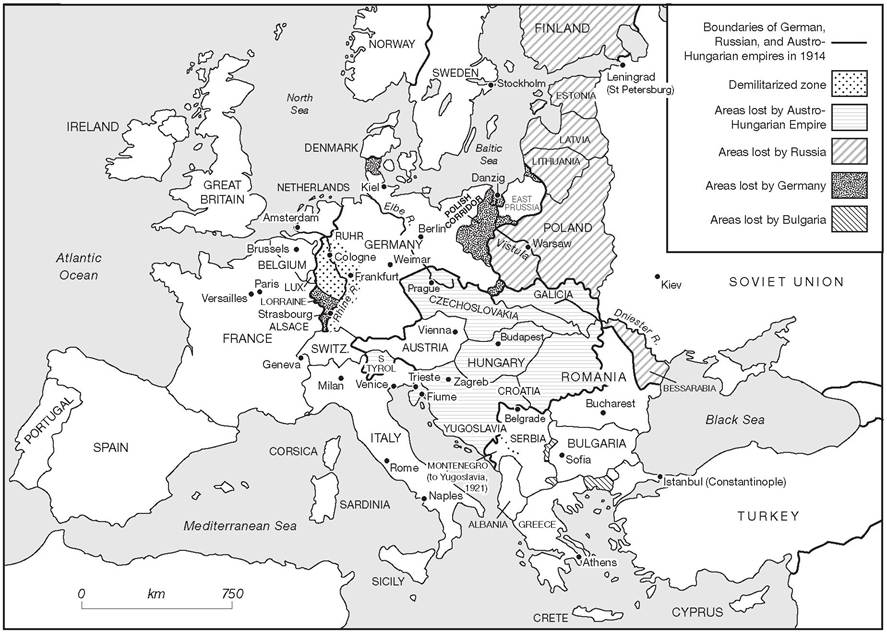
Map 2.1 Territorial changes in Europe after the First World War
Source: After Keylor (1998)
counter-revolutionaries and the Bolsheviks, the Allies dispatched forces to intervene, at first to prevent stockpiles of Entente arms falling into German hands, and later to help bring down the Bolsheviks.
Lenin's was not the only ideological voice to be heard. The American entry into the war in 1917 had a similar impact. The Russian Revolution and the American entry sharpened the distinction between liberal and autocratic Powers. A common anti-imperialist streak ran through Lenin's ‘Decree on Peace' and President Wilson's cry of ‘peace without victory'. However, Lenin pulled out of the war first to save his regime and then later to reshape world politics through workers' revolutions from below; Wilson aimed to reform the international system through the exercise of American power at the top. Wilson's ‘new diplomacy' combined realism and idealism (though, as we shall see, not always in equal measures). According to the president, the war had been caused by an anarchical and lawless system of states, which had brought about a frantic search for security through the stockpiling of armaments.
As the war progressed, American economic policies had steadily favoured the Entente, while Wilson had labelled Germany an almostU-boat (English abbreviation of Unterseeboot)
A German submarine.
fourteen points
A speech made by the American president Woodrow Wilson on 8 January 1918 in which he set out his vision of the post-war world. It included references to open diplomacy, self-determination and a post-war international organization.
collective security
The principle of maintaining peace between states by mobilizing international opinion to condemn aggression. Commonly seen as one of the chief purposes of international organizations such as the League of Nations and the United Nations.
League of Nations
An international organization established in 1919 by the peace treaties that ended the First World War. Its purpose was to promote international peace through collective security and to organize conferences on economic and disarmament issues. It was formally dissolved in 1946.
irremediably militaristic state. If Germany and its allies won, he had reasoned, the United States would be forced to transform itself into a heavily armed garrison state in which liberties would be crushed by militarization. The need to defeat Germany and the American ambition to build a better world thus drove Washington into the Entente coalition.
The US declaration of war on 6 April 1917 was not immediately decisive. To be sure, American maritime power and finance rescued Britain and France from Germany's U-boats and probable economic collapse, but the Americans had only 80,000 troops in Europe by October 1917. By 1919, the number would rise to two million. In the meantime, Wilson played a waiting game. He affirmed his selfappointed role of mediator — America was an ‘associated' Power, not an Entente ally — and hoped that with Germany defeated and France and Britain reliant on American men, materiel and money, he would be able to impose a liberal peace on all the belligerents.
His vision was embodied in his famous fourteen points of 8 January 1918. The fourteen points were a reformist reply to the Bolsheviks' peace manifesto and a notice to the Entente that their secret agreements on war aims and spoils would have to be revised. Collective security and selfdetermination were Wilson's binding themes. He called for ‘open covenants openly arrived at', ‘freedom of the seas', the removal of economic barriers, the reduction of armaments and the foundation of a League of Nations. Belgium would be restored; Poland made independent; Alsace-Lorraine returned to France; and Italy's frontiers redrawn along national lines. German forces would also have to withdraw from Russia, and the Austro-Hungarian and Ottoman empires would be forced to grant autonomy to their subject peoples.Wilson's ‘new diplomacy' confounded the battle-scarred British and French as much as Lenin's; the difference was that the Western Europeans now needed ‘Uncle Sam' to win the war. The disasters they had suffered in 1917 had driven this point home. Russia had been knocked out of the war. Romania was reduced to a German satellite. French and British offensives were halted with horrific casualties. French troops had even mutinied. The Italians were routed at Caporetto. German U-boats played havoc with Allied shipping. In fact, the need for troops, supplies and credit from the United States very quickly raised questions about the potential impact of American dominance. One French statesman worried
that before Germany has been thoroughly beaten she may propose terms which President Wilson may consider acceptable, but which would not be acceptable at all to France and England, and President Wilson may put pressure on the Entente Allies to accept them.
At the end of 1917, a co-ordinating conference initiated close inter-Allied cooperation on the strategic and economic matters, but, inauspiciously, a joint political response to the Bolshevik Decree on Peace could not be hammered out.
Wilson's insistence that Americans would not fight for ‘selfish aims', ‘with the possible exception of Alsace-Lorraine', offered Georges Clemenceau, the French premier, very cold comfort. Moreover, Wilson's reference to ‘freedom of the seas', ‘impartial adjustment of all colonial claims' and the removal of economic barriers caused David Lloyd George, Britain's prime minister, equal unease. The Entente, of course, was not a perfect alliance. Paris and London bickered over Eastern Europe and their designs on the Ottoman Empire clashed. But, judging from Wilson's public statements, what united them was the craving for peace with victory. Wisely, before the Central Powers capitulated, the Europeans played down their differences with the president to ensure unity.In Germany and Austria-Hungary, Wilson's fourteen points helped to spark strikes and demands from the opposition parties for a non-annexationist peace. Yet, despite desperate war-weariness, labour strife and food shortages, the domestic balance against a negotiated settlement held firm. In Berlin, the ascendancy of Generals Paul von Hindenburg and Erich von Ludendorff over the civilian leadership was confirmed by Bethmann Hollweg's replacement by an uninspiring civil servant, George Michaelis, who was amenable to the high command's wishes. When in July 1917 the liberal-left majority in the Reichstag called for political reform and a ‘peace of understanding', the new chancellor replied that he accepted the Reichstag's Peace Resolution ‘as I understand it'. Austria-Hungary grew ever more reliant on Germany as the empire fell to its knees under the burden of war. Its leadership considered a negotiated settlement, but its contacts with Britain and France made no headway, for Italy's plans to make gains at Austria's expense blocked any deal. In any case, Vienna really wanted a general peace, not a separate one. This could come only if Berlin moderated its war aims — something beyond Vienna's power to achieve. In the end, the opportunity presented by Russia's collapse locked the Central Powers into one last desperate gamble on battlefield victory, while the Treaty of Brest-Litovsk hardened Allied attitudes towards their foes.
Reichstag
The lower house of the
German parliament during the Wilhelmine and Weimar periods.
More on the topic The ‘new diplomacy':
- The Evolution of National Values in Diplomacy
- Art and diplomacy
- Japanese cotton-textile diplomacy in the first half of the 1930s
- Diplomacy and deterrence
- Triangular diplomacy and the 'two detentes'
- War within the family: politics and diplomacy
- From gunboat diplomacy to the 'Good Neighbor' Policy
- From Territorial Empire to the Open Door and Dollar Diplomacy
- Racial Violence, American Diplomacy and the Rise of the Civil Rights Movement
- Paradox of the Military in a Democracy
- The Diplomat Warrior
- Methodological Approaches
- Conclusion
- The implementation of the peace
- Revolutionaries and reformers from Chile to Nicaragua
- The Four Contexts
- THE THEORY AND PRACTICE OF EMPIRE-BUILDING
- The Settler Colonial Frontier: Vacillations of Conciliation and Warfare