Triangular diplomacy and the 'two detentes'
In March 1969, when Soviet and Chinese troops clashed on several occasions along the Ussuri River, several of the conditions that resulted in the relaxation of East-West and Soviet-American tensions came together.
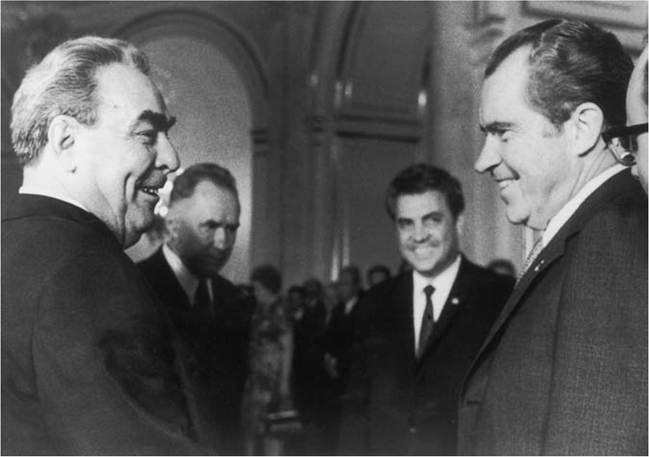
For one, the Nixon administration, and particularly the president himself and his national security adviser, Henry Kissinger, was keen on using the Sino-Soviet hostility as a diplomatic card in the Soviet-American relationship and as a way of pressuring the North Vietnamese. To maximize such leverage, the United States pursued an opening to China and, after a long series of signals and several false starts, the Chinese finally invited Kissinger to visit Beijing in July 1971; at that time Nixon’s visit was scheduled for the following February.It seems that the ‘opening to China’ removed many obstacles in the way of further Soviet-American detente. In the three years that followed Kissinger’s secret trip to Beijing, the two superpowers negotiated several agreements and commenced an era of Soviet-American summitry. At the Moscow Summit of 1972 the United States and the Soviet Union signed the first SALT agreement. There were, in fact, two treaties: one capping the number of offensive missile launchers (both ICBMs and submarine-launched ballistic missiles, or SLBMs), and another, which included strict limits on defensive missile systems (so-called anti- ballistic missiles). At the 1973 summit in the United States the two sides signed the Prevention of Nuclear War agreement. At the November 1974 Vladivostok Summit between the new American president, Gerald Ford, and Brezhnev, the two leaders made a tentative agreement on a SALT II treaty (Nixon — having bowed out of office following the Watergate scandal in August 1974 — could only watch from the sidelines).
see Chapter 15
submarine- (or sea-) launched ballistic missile (SLBM)
A ballistic missile designed for launch by a submarine (or surface ship).
Anti-Ballistic Missile (ABM) Treaty
An agreement between the United States and the USSR signed on 26 May 1972, limiting the number of ABM deployment areas, launchers and interceptors. The United States withdrew from the treaty in 2002.
Plate 11.1 Moscow, 31 May 1972. US President Richard Nixon meets General Secretary Leonid Brezhnev in Moscow after the Strategic Arms Limitation Talks (SALT). (Photo: Keystone/Hulton Archive/Getty Images)
All in all, it was a remarkable set of deals and summits that constituted a significant break from the atmosphere of the late 1960s, when America's growing involvement in Vietnam and the Warsaw Pact's invasion of Czechoslovakia had marred the early tentative efforts at detente. The early 1970s also stood in extremely sharp contrast to the crisis years of the early 1960s. While the Soviets and the Americans had been, in October 1962, on the brink of nuclear confrontation, they signed, less than ten years later, the first strategic arms limitation agreement. From the American perspective, moreover, there were the promising prospects of the normalization of Sino-American relations in the early 1970s and the apparently permanent split in Sino-Soviet relations that had opened up. One should, though, bear in mind that the principal actors on the American side (Kissinger and Nixon) had relatively modest goals in their quest for detente. It was not aimed at ending the Cold War but rather at changing the methods and framework used in fighting it. Their major contribution was to have lived up to Nixon's promise (delivered in his inaugural address in 1969) to open ‘an era of negotiations' and, with the introduction of regularized summitry in the first half of the 1970s, Soviet-American relations had, clearly, made a qualitative quantum jump.
In the meantime, the process of European detente took on a life of its own. Two key factors account for this.
On the one hand, the issues involved in the European detente process were different from those discussed between Soviet and American leaders. Instead of nuclear arms, the Europeans focused on a wider range of issues from economic and cultural exchanges between East and West to the formalization of Europe's post-war borders. On the other hand, European detente was, far more than its Soviet-American sibling, a dynamic process that stretched from the mid-1960s well into the 1980s when superpower detente was already dead in its tracks.The main treaties associated with the European detente process coincided with Soviet-American detente. The first set of agreements included the 1970 SovietWest German and Polish-West German treaties, the September 1971 Four-Power agreement on Berlin and the December 1972 Basic Treaty between East and West Germany. All of these were, either directly or indirectly, results of the changes that had taken place in West German foreign policy during the 1960s. European detente thus appeared to signal an end to the ongoing squabbles about the division of Germany, the main point of contention in post-war Europe. In August 1975, however, European detente went far beyond the specific question of Germany. After several years of painstaking negotiations, representatives from thirty-five countries (all the European countries save Albania, as well as the United States and Canada) gathered in Helsinki to sign the Helsinki Accords, the final outcome of the CSCE. Divided into three major ‘baskets', the Helsinki Accords were a remarkable series of documents that dealt with virtually all aspects related to panEuropean security issues. Basket I, for example, included provisions about the ‘inviolability of borders', while Baskets II and III dealt with such issues as economic and cultural relations and human rights. In short, the CSCE extended far beyond the ‘traditional' security issues of borders into economic and human security. In part because of this, it was also bound to become a very controversial document.
Indeed, even as the thirty-five countries prepared to sign the Helsinki Accords, different interpretations emerged. Most Soviet leaders assumed, and many in the West disapprovingly feared, that Basket I, which defined the ‘inviolability of borders', was equal to a multilateral acknowledgement of the legitimacy of Soviet control over Eastern Europe. Defenders of the treaty, however, pointed out that the Soviet and East European acceptance of the human rights provisions in Basket III would, in turn, act as a significant boost to the various dissident and prodemocracy groups in the Soviet bloc which had traditionally been heavily suppressed. Similarly, while many West Germans feared that the combination of the 1970—72 German treaties and the CSCE's notion about inviolability of borders translated into a permanent division of Germany, others took heart from the fact that the CSCE did approve the possibility of a ‘peaceful transformation of borders'.
In the long run, the CSCE's Basket III would indeed have a corrosive effect within the Soviet bloc. Already two years after the signing of the Helsinki Accords, dozens of so-called Helsinki Groups had been established with the specific purpose of monitoring human rights abuses within the Soviet bloc. The 1975 CSCE thus commenced a decade-and-a-half-long process during which individuals like the future Czech president Vaclav Havel challenged, eventually successfully, the totalitarian rule in Eastern Europe. In 1975, though, few observers seriously considered the possibility that the CSCE would yield a long-term transformation in the nature of East-West relations. Instead, most were concerned with the rapid increase in Soviet-American tension.
Detente in trouble: Watergate, Angola and the Horn of Africa
In the mid-1970s, after a promising series of summits and agreements, the hopes and promises for a permanent shift in the Soviet-American relationship began to dissipate. Soviet-American detente began to fall apart as domestic troubles plagued the second Nixon administration and as the Americans and Soviets engaged in a proxy contest for influence in the Middle East after the October War of 1973.
After Nixon's ignoble exit in August 1974 the decline of detente only accelerated; the term itself became so unpopular in the United States that President Gerald Ford banned its use in his 1976 election campaign. Most disturbingly from the American point of view, the Soviets appeared suddenly to be keen on expanding their influence into Africa as they, along with Cuba,supported the winning faction in the Angolan Civil War and sent large numbers of advisers to Marxist Ethiopia. In a fascinating reversal of allegiances, the United States responded by supporting neighbouring Somalia, which had previously been a Marxist enemy of the formerly ‘pro-Western’ Ethiopia. Such increasingly heated proxy conflicts clearly marked the demise of American—Soviet detente.
One cannot fully comprehend the collapse of detente without briefly exploring American domestic developments. While the fall of Richard Nixon did not cause the demise of detente, it probably did accelerate the attacks on his policies. This was particularly the case with the Nixon administration’s effort to move ahead with the economic side of detente. As early as 1972 the Democrat Senator Henry Jackson had picked up the anti-detente banner by insisting that any economic agreements between the United States and the Soviet Union should be tied to the Soviet Union’s human rights record. As a result, plans for granting the USSR most favoured nation (MFN) status were blocked when Congress introduced an amendment that tied the MFN Bill to the relaxation of emigration measures. The Soviets, predictably, criticized such linkage as interference in their internal affairs. Various other Congressional moves in 1973 and 1974, such as legislation restricting the president’s war-making capability (the War Powers Act of 1973), ending bombing in Indochina and cutting American aid to South Vietnam, further emphasized Congress’s general desire to limit the executive branch’s freedom of movement in foreign policy. While Nixon’s resignation in August 1974 restored some of the trust between Congress and the White House, the 1975 Congressional investigations into the conduct of the CIA revealed illegalities that further undermined presidential authority.
In the 1976 presidential elections the attack on detente was twofold. On the one hand, the Republican Party’s primaries were characterized by Ronald Reagan’s conservative challenge. In the spring of 1976 Reagan accused the Ford administration of bargaining away America’s superiority in nuclear weapons and legitimizing the Soviet Union’s hegemony over Eastern Europe by participating in the CSCE. After a narrow victory over Reagan, President Ford faced similar charges from Jimmy Carter, the Democrats’ presidential candidate. In Carter’s campaign rhetoric, though, his main criticism of foreign policy was its lack of a moral agenda. Nixon, Kissinger and Ford had, according to Carter, adopted a realpolitik approach that did not represent America’s democratic value system. When he won the November 1976 presidential election Carter assured the nation that he would restore moral principles and human rights as the main ideas guiding foreign policy. From Moscow’s perspective, however, an emphasis on human rights was easily understood as an effort to intervene in the country’s internal affairs. Carter did not, for example, win any friends within the Soviet Politburo when he called for the Soviets to allow the famous dissident Andrei Sakharov — the winner of the 1975 Nobel Peace Prize who was held in internal exile — to speak freely and publicly.
Carter’s rhetoric may have been provocative but it was hardly the only reason for the demise of detente. As many critics of detente pointed out, the Soviets did their fair share to undermine detente in the mid-1970s. By intervening more boldly in areas where their national security interests appeared to have no obvious relevance, the USSR seemed to shift towards a new kind of globalism at about the same time as American domestic critics pounded the Nixon and Ford administrations for their ‘immoral’ and weak foreign policy. In particular, the Soviets appeared to have ‘discovered’ Africa as the new frontier of the Cold War. The key word, though, is ‘appeared’: the Soviets rarely intervened directly, choosing to prop up allies and stooges instead (such as the Cubans who went to Angola).
Soviet interventionism may have been to blame for the decline of detente, yet it is important to ask what the motivations behind it were. There are a number of possible explanations. First of all, by 1974 the Soviets had discovered that for all their talk about practising restraint and co-operating with the Soviet Union to resolve regional crises, the United States was not unwilling to seek unilateral advantages for itself if an opportunity appeared. In the 1973 Middle East War and see Chapie-18
the peace process that followed, Secretary of State (since September 1973) Kissinger may have acted in a more even-handed manner towards the principal adversaries than his predecessors had done in the 1960s, but as Kissinger shuttled between Israel and its Arab neighbours in a successful bid for disengagement, he clearly enhanced the American role in the region. The Soviets, while acting as cosponsors of the Geneva Peace Conference on the Middle East, were effectively excluded from the day-to-day diplomacy. This, in turn, meant that Moscow’s influence in the region was severely diminished. To the Soviets, Kissinger’s quest for increased influence in the Middle East was surely an indication that Washington preferred seeking unilateral advantage to co-operation.
If the United States could do this, then why should not the Soviet Union follow suit? After all, viewed through the lenses of Soviet leaders, detente had been possible because the Americans had finally been convinced that the USSR was their approximate equal. That much had, after all, been recognized in the SALT I agreements that were based on the assumption of nuclear parity. Given the CSCE process, the legitimacy of the Soviet hold in Eastern Europe was, moreover, coming to be recognized only a few years after the USSR had aroused moral outrage by the Warsaw Pact invasion of Prague. If anything, detente appeared to acknowledge Moscow’s stature as the other legitimate superpower at the time when America’s power was waning. And if the Soviet Union was now a superpower, it surely had the right to act in that manner; it had gained the right to be more than a mere regional Power in Eastern Europe.
An added reason for Soviet activism may have been the American inability to project its military power in the mid-1970s. In 1975 anti-interventionism in the United States received a further stimulus when the North Vietnamese launched a successful offensive against the South, resulting in the unification of Vietnam by late April. While condemning the ‘treachery’ of the North, President Ford was see Chapter 12
unable to persuade Congress to approve a last-minute aid package to the South Vietnamese government. As America’s longest war came to an end, a ‘Vietnam syndrome’ set in, restricting US willingness to risk another disastrous military engagement. In the context of the post-Vietnam fatigue and a general domestic attack on presidential war-making powers, it was inconceivable that it would, for example, use its military force to influence the outcome of the Angolan Civil War. As a number of historians have argued, the Soviets, already in a triumphant mood
decolonization
The process whereby an imperial power gives up its formal authority over its colonies.
apartheid
The Afrikaans word for racial segregation. Between 1948 and 1990 ‘apartheid’ was the ideology of the Nationalist Party in South Africa.
see Chapter 17
see Chapter 17
because of the American acknowledgement of nuclear parity, were therefore encouraged to turn even more ‘confidently’ to the Third World by the American withdrawal from Vietnam and the anti-interventionist domestic scene in the United States. Indeed, one way to sum up the Soviet thinking is to note that in the mid-1970s — notwithstanding the split with China — history appeared to be on the side of the Soviet Union.
Examples of Soviet interventionism in the so-called Third World included Moscow’s role in the Angolan decolonization crisis. While no Russian troops entered Angola, the United States considered the active Cuban involvement (up to 12,000 troops by the start of 1976) and Soviet material support for the Popular Movement for the Liberation of Angola (MPLA) as signs that the communist bloc was moving into Africa. Disastrously for America’s overall reputation in Africa, the Ford administration chose to encourage apartheid South Africa’s intervention in the Angolan crisis. In part owing to the failure of this involvement and in part because of Congress’s refusal in late 1975 to grant any more money for American operations in Angola, the Soviet/Cuban-backed MPLA emerged as the victor in this stage of the Angolan Civil War. By February 1976 the People’s Republic of Angola was recognized by most African countries and by Portugal, the former colonial Power, but the United States vetoed Angola’s membership in the UN.
While subsequent events made it clear that the new Angolan government was keen on keeping the Soviet Union at arm’s length while accepting a continued Cuban presence, the United States clearly interpreted the outcome of the Angolan crisis as a net loss within the context of a Soviet-American confrontation. If the Soviets had considered American behaviour in the aftermath of the Middle East War as a breach of the ‘rules of detente’, the Ford administration viewed the Angolan crisis from a similar perspective. Together with the collapse of South Vietnam (and the communist take-overs of neighbouring Cambodia and Laos), the Angolan debàcle further encouraged the conservative critics of detente in the United States.
A few years later American suspicions over Soviet activity focused on the Horn of Africa, where a crisis between Ethiopia and Somalia provided a pretext for somewhat reluctant Russian intervention. By February 1978 there were about 15,000 Cuban troops in Ethiopia while the Soviets had supplied approximately $1 billion in military aid. Perhaps surprisingly, the United States did not initiate a military aid programme for Somalia. However, it did provide indirect aid via Iran, Saudi Arabia, Egypt and Pakistan, including American military equipment. Yet the Carter administration, concerned over a growing Soviet role in a region so close to the oil-rich Middle East (and in close proximity to the Red Sea naval routes), threatened the USSR with grave consequences to detente. Indeed, the United States made clear its determination to link the future of detente with Soviet action in the Horn of Africa (and other regional conflicts). While the Carter administration was deeply divided over such linkage - with Secretary of State Cyrus Vance opposing it and National Security Advisor Zbigniew Brzezinski proposing to take it further - the crisis in the Horn of Africa only further complicated the prospects for continued detente.
More on the topic Triangular diplomacy and the 'two detentes':
- The Evolution of National Values in Diplomacy
- Art and diplomacy
- The ‘new diplomacy'
- Japanese cotton-textile diplomacy in the first half of the 1930s
- Diplomacy and deterrence
- War within the family: politics and diplomacy
- From gunboat diplomacy to the 'Good Neighbor' Policy
- From Territorial Empire to the Open Door and Dollar Diplomacy
- Racial Violence, American Diplomacy and the Rise of the Civil Rights Movement
- Paradox of the Military in a Democracy
- The Diplomat Warrior
- The Kite Model of Law in Principle
- Methodological Approaches
- Conclusion
- The implementation of the peace