Japanese cotton-textile diplomacy in the first half of the 1930s
Next, as the case studies of our arguments, we would like to analyze Japanese cotton-textile diplomacy with British India and the Dutch East Indies.
1 Was Japan isolated from the world economy?
In the first half of the 1930s, Japan was able to take advantage of its proximity to the markets in South and Southeast Asia to compete successfully with European goods.
The main factors behind the increase in exports of Japanese cotton textiles were their low prices that had come about through the rationalization of the cotton industry since the 1920s and the devaluation of the Japanese yen, particularly in the second half of 1932.48 The Japanese yen fell very rapidly in value relative to the Dutch guilder and Indian rupee.49 This accelerated the increase in exports of Japanese cotton textiles to British India and the Dutch East Indies. The increase in exports of Japanese textiles became a central conflict in Anglo- Japanese and Dutch-Japanese commercial relations, and it prompted Japan to hold trade negotiations with Britain and the Government of India in 1933, and with the Dutch colonial government in 1934.50Until now in Japanese historiography, most scholars see these trade negotiations as part of the process of adjusting the differences in industrial interests between the European and Japanese cotton industries.51 Thus, they emphasize that each country's diplomatic policies toward the trade negotiations were formulated to serve the interests of each country's cotton textile industry; that is, to secure its markets abroad. Some have even suggested that the culmination of the Pacific War was brought about partly by the tendency of the Japanese cotton industries to expand rapidly into Asian markets, most of which were under European control in the 1930s.52 They claim that the increase in exports of Japanese cotton textiles to the European colonies in Asia forced the European powers to intensify their protectionist policies, thus isolating Japan from the world economy.
The common understanding is that these trends intensified after the Dutch-Japanese trade negotiations, which were suspended in December 1934. The historiography in Japan has further supposed that the negotiations were 'broken off',53 and that Japan abandoned its co-operation with industrial Europe. Thus, they concluded that Japan's diplomatic policy toward Europe in the 1930s was formulated to serve the interests of its cotton textile industry, and did not maintain the status quo.However, if we look at the figures from the cotton statistics yearbooks of that time period, edited by the Japan Cotton Spinners' Association, this argument does not hold up. That is, the trade statistics do not correspond with the notion that Japan was forced into isolation from the world economy. The amount of exports of Japanese cotton textiles to British India was 478 million yards in 1936, compared with 357 million yards in 1928. In the case of the Dutch East Indies, Japanese cotton textile exports amounted to 350 million yards in 1936 compared with 172 million yards in 19 28.54 This fact proves that Japanese cotton exports were maintained at the same level, even after the two rounds of trade negotiations.
The idea of gentlemanly capitalism offers an alternative interpretation regarding the motivation behind British policy in Asia.55 Not only were the colonies expected to serve as markets for European goods, but they also had to pay the interest on government loans, dividends on investments, and the political costs of the home government such as home charges in the case of British India, and pension payments in the case of the Dutch East Indies.
Figure 8.1 shows that two kinds of economic policies were needed for the home country to enable the colonies to pay such interest, dividends, and political costs on a regular basis. One was to maintain an export surplus from the colonies, which was necessary for payment of their debts to Europe. So, the colonies were encouraged to promote exports of primary products, such as raw cotton, tin, rubber, sugar and timber, to industrial countries.56 This is why Britain was prepared to open its home market to the dominions in the 1930s.
The Ottawa Preferential Arrangements led to a far more rapid rise in colonial imports to Britain than British exports to the colonies.57 Without securing a significant slice of the British market, many colonies and dominions, including India, could not have paid their debts to Britain. It is thought that these relationships also existed between Holland and its colonies in Southeast Asia. The Dutch colonies, however, were encouraged to increase exports of primary products to industrial countries, especially to the United States and Japan. Japan was a particularly attractive market because its recovery from the Great Depression was very rapid after 1932.58The second policy was to force the colonies in Asia to set their exchange rates relatively high.59 The tendency in East Asia was to devalue the currency, such as in Japan after 1932 and China after 1935, while South and Southeast Asia increased or set their exchange rates relatively high. In the latter case, the exchange rate was often more or less fixed, because exchange rate fluctuations were not desirable from the point of view of regular debt payments. Japan's re-embargo of gold exports in December 1931, and the subsequent depreciation of the Japanese yen, facilitated a rapid increase in Japanese exports, especially to British India and the Dutch East Indies. Japanese exports were promoted by the fact that the exchange rate of the European colonies was set relatively high.60
At the same time these relatively high exchange rates aggravated deflation in the colonies in the 1930s.61 Western colonies needed Japanese exports, which consisted mostly of cheap consumer goods, because the purchasing power of consumers in the colonies was
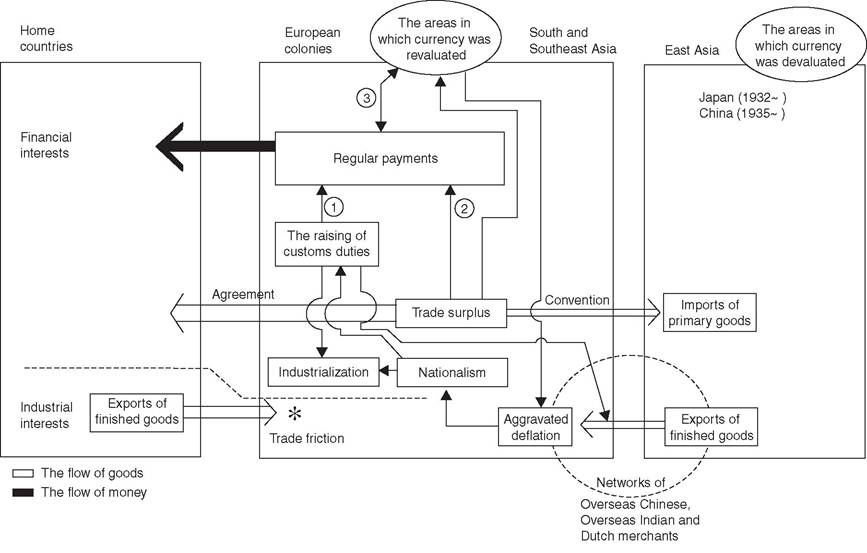
Figure 8.1 The Emerging ‘Devaluation Sphere' in East Asia and the International Order of Asia in the 1930s
158
weakened in the 1930s.
This was a kind of social policy for colonial consumers.2 The nature of the cotton trade negotiations from 1933 to 1934
The Government of India and the Dutch East Indies government tried to co-operate with third-country foreign markets, especially Japan, in order to export food and raw materials and to secure smooth payments to the home country. Thus, the following two subjects became the focus of each round of trade negotiations from 1933 to 1934;62
1) What amount of primary products, such as raw cotton and sugar, was Japan willing to buy from the European colonies, to enable the colonies to secure an export surplus?
2) What amount of Japanese cotton textile goods would Japan be permitted to export? In the case of the Dutch East Indies, especially, what proportion of Japanese cotton textile goods would Japan grant to Dutch merchant importers, to profit them in dealing with Japanese goods so that they could pay dividends to Holland regularly?
The idea that the increase in Japanese competition in British India and the Dutch East Indies was a threat to European manufacturers was not the focus of each round of cotton trade negotiations. Thus the Japanese formal delegations in the Indo-Japanese and the Dutch-Japanese trade negotiations did not include a member of the cotton textile industry. The documents of the Japan Cotton Spinners' Association, one of the most powerful industrial bodies, show that the representatives of this Association voluntarily went to British India and the Dutch East Indies to report back to the Association in Osaka.63 This means that the interests of the private manufacturing sector, especially the Japanese cotton industry, were not reflected in these negotiations and that there was a discrepancy in the interests of the representative of the Japanese government and private representatives.
In the case of the Indo-Japanese trade negotiations in 1933-34, Japan boycotted the import of Indian raw cotton from August to December 1933.
But this aggressive act was led by the Japan Cotton Spinners' Association, and was not actually orchestrated by the Japanese government. The representatives of the Japanese government was prepared to purchase raw cotton regularly, but they used the boycott movement as a lever to improve the conditions of the Indo-Japanese cotton treaty for Japan's benefit. As Keizo Kurata, who was a leader of this boycott and an executive of Dai Nihon Boseki Kaisha (one of the big five cotton spinning companies in the prewar period), pointed out, the boycott was not actually in effect in December 1933, because European and Indian merchants bought Indian raw cotton in the inner district even while the Japanese trading companies maintained a policy of not purchasing raw cotton.64 When the representatives of the Japanese government realized that the boycott led by a private body was no longer in effect, they immediately concluded a trade agreement, conceding to the British Indian government. The Indo-Japanese negotiations were completed in early January 1934. The agreement was on a barter basis: Japan was allowed to export 400 million yards of cotton textiles to India, provided that it imported 1.5 million bales of Indian cotton in return. This implied that the Japanese market was also necessary in order for British India to secure an export surplus from the point of view of maintaining London's financial position and the stability of the empire in the 1930s. The focus of the Indo-Japanese cotton trade negotiations was to maintain the level of exports of Indian raw cotton.65In the case of the Dutch-Japanese trade negotiations in 1934, most studies emphasize that they were not completely successful, because negotiations were suspended until June 193 6.66 But during negotiations, both sides tried to make a compromise in the following two agendas:
1) Japanese trading firms in the Dutch East Indies were to handle a quarter of the total imports on the basis of the 1933 figures.
2) The Japanese government 'advised' the business circles concerned to give a preference to the Dutch East Indies in its raw sugar purchases.
The first agenda indicated that Japan's Foreign Ministry conceded to the government of the Dutch East Indies, because Japanese firms handled 38 per cent of total imports in 1933. This meant that the handling of 13 per cent of total imports on the basis of the 1933 figures were conceded to Dutch importers, such as N.V. Internationale Crediet-en Handels- Vereeniging 'Rotterdam', Borneo-Sumatra Maatschappij, Jacobson & van den Berg, and Geo. Wehry & Co.67 The Japanese government proposed this first agenda without asking the Japan Cotton Spinners' Association or the Japanese trading companies dealing withJapanese cotton textile goods. The Japanese government negotiated on the basis of wanting to co-operate with Holland and the Dutch East Indies, not taking into account the interests of Japanese cotton industries.68 Seizaburo Nakayama, an employee of Mitsui Bussan dealing with Javanese sugar, was the only private representative in the formal delegation. Japan's Foreign Ministry needed him as an expert. If Japan were to give preference to the Dutch East Indies in its raw sugar purchases, then Japan's Foreign Ministry would need to deal with a conflict of interests that would erupt between the Javanese and Taiwanese sugar industries.69
However, the negotiations were suspended due to antagonisms on the Japanese side. The increase in imports of Javanese sugar aroused the keen competition of Taiwanese sugar in East Asia. Japan's Foreign Ministry decided not to make a formal agreement with the Dutch East Indies government, because the Governor-General of Taiwan opposed a preference to the Dutch East Indies. Thus, the negotiations could only result in a 'gentlemen's agreement'; that is, the Japanese government would vaguely recommend to the business circles concerned that they show preference to the Dutch East Indies in its raw sugar purchases. It might be argued that these negotiations were formally broken off and Japan began to abandon co-operation with industrial Europe.
But the interdependence between Japan and the Dutch East Indies was in fact maintained. Japan increased its imports of Javanese sugar. Japan took 10 per cent of the total exports of Javanese sugar in 1930-33 and 17 per cent in 1934-36, increasing in line with the fall in Javanese exports to British India. Additionally, the Dutch merchants' share of imports of Japanese cotton textile goods increased. They took 18.4 per cent in 1932 and 44.3 per cent in 1935. Toyo Menka, which handled about 10 per cent of Japan's total exports of cotton textiles in the 1930s, reinforced its connection with the Dutch merchants. When a provisional commercial treaty, known as the Ishizawa-Hart Agreement, was signed in April 1937, Japanese merchants in the Dutch East Indies were to handle a quarter of the total imports on the basis of the 1933 figures, and Japan promised to give preference to the Dutch East Indies in its raw sugar purchases. These provisions were made in confirmation of accomplished facts.70
More on the topic Japanese cotton-textile diplomacy in the first half of the 1930s:
- British perceptions of Japanese economic development in the early 1930s
- Theme 5. The Ukrainian Lands under the Rule of the Polish-Lithuanian Commonwealth (the Second Half of the 16th - the First Half of the 17th Centuries)
- Theme 4. The Ukrainian Lands under the Rule of the Grand Duchy of Lithuania and the Kingdom of Poland (the Second Half of the 14th - the First Half of the 16th Centuries)
- For three and a half centuries Europeans extended the bounds of their overseas possessions. In the half century that commenced in the 1770s the scope of imperial holdings shrank dramatically.
- The Evolution of National Values in Diplomacy
- Art and diplomacy
- The Sino-Japanese War
- The ‘new diplomacy'
- The Japanese Invasions of Korea
- Nineteenth-Century Japanese New Religions
- Britain and the Japanese invasion of Manchuria
- Diplomacy and deterrence
- Triangular diplomacy and the 'two detentes'
- From Territorial Empire to the Open Door and Dollar Diplomacy
- War within the family: politics and diplomacy
- Agriculture and Violence in the Japanese Islands
- The road to the Sino-Japanese war
- Viewpoints of analysis on the International Order of Asia in the 1930s