Discussion
In 90 years, the Aztecs built an extensive empire through the strategic use of existing administrative forms of the city-state, both for expanding their territories and maintaining control.
As the empire grew, it was progressively organized in order to promote and protect various kinds of income to the imperial capital. The implementation of a set of imperial strategies served to link together the diverse regions of the empire, even if the Aztecs did not have total control over their territories. Rebellions happened each time a subjected people had the feeling that the empire was weakened (e.g., at times of royal succession). But the Aztecs were fast to respond and always put down these rebellions. The arrival of the Spaniards in 1519 presented a new occasion for some of the subjected people to rebel against the Aztecs, allying themselves with the Spanish forces, and this time, they were far stronger (see later discussion).A number of recent theoretical and comparative works on empires and imperialism help illuminate the Aztec case as described in the preceding. For example, the model of Gerring et al.[1741] advances understanding of the indirect nature of Aztec control over its provinces. This model posits the level of political development in peripheral/provincial areas as the primary determinant of whether an empire employs direct or indirect control. Better organized peripheral polities permit and favor indirect control, whereas lower levels of political development necessitate direct control. Scholars have discussed Aztec indirect control, often using the concept of “hegemonic control,” for several decades.[1742] The reasons the Aztec rulers chose an indirect strategy over a program of more direct control, however, remained vague in that literature. But given the fact that almost all of the areas conquered and incorporated into the empire were the settings of functioning city-states, the model of Gerring et al.
predicts that provincial control would be indirect in most areas. When local regimes and polities were destroyed in the process of imperial conquest, a more direct form of rule was instituted. Most areas without city-state organization were left alone and not conquered, and this resulted in the discontinuous, or “Swiss cheese” spatial pattern of the external provinces.The Aztec Empire employed three ofManns four strategies ofimperial domination:[1743]
(1) Rule through clients has been discussed earlier. Many or most of the tax provinces were controlled this way, as were the frontier client states.
688 MICHAEL E. SMITH AND MAELLE SERGHERAERT
(2) Rule directly through the army was not a strategy found in Aztec Mexico.
(3) Compulsory cooperation was employed in a partial sense. Two of Mann's five components (military pacification, and coerced diffusion) were clearly present in the Aztec case, one was clearly absent (the military multiplier), and the other two were probably absent (authority and economic value, and intensification of labor).
(4) Development of a common ruling class structure was a prominent strategy of the Aztec Empire.
Also relevant are Mann's concepts of despotic power and infrastructural power. In Mann's (1984) original formulation, and his later modification (Mann 2008), most premodern empires fit into one box of his two-by-two chart: low infrastructural power and high despotic power. For the goal of a broad comparative treatment of empires, however, it is more useful to consider a wider range of values of despotic and infrastructural power. Figure 24.4 shows such a modification to illustrate the historical trends of state power at the Aztec imperial and city-state levels. The petty kings of Aztec city-states had far less despotic power than the emperor, but they enjoyed a higher level of infrastructural power. It is easier to establish the institutions and practices of infrastructural power (e.g., regular taxation, standardized administration, dependent labor systems) in a small polity than in an extensive premodern empire with poor communications technology.
It appears that these city-state institutions were expanding their influence and extent through time, in part aided by the peace established by imperial expansion. There is little indication, however, that city-state kings were increasing their despotic power.Compared to city-states, the rulers of the Aztec Empire had less infrastructural power but greater despotic power. The office of emperor expanded greatly in power and influence in the 90 years of the empire's existence, and this is indicated in Figure 24.4 by a movement from moderate to high despotic power (the scale of power in the diagram is for heuristic purposes, based on a comparisons of indigenous polities in the New World). At the time of Spanish conquest, for example, the Inca emperor probably had greater despotic power than the Aztec emperor, but the
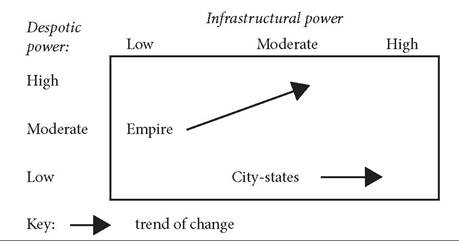
Figure 24.4. Trajectories of infrastructural and despotic power for the Aztec Empire and the city-states.
gap may have been closing (prior to the civil war that erupted upon the death of the Inca emperor Huayna Capac by smallpox).
The Aztec Empire seems to have been increasing its infrastructural power as well in the final Pre-Spanish decades. The “pax Azteca” resulting from imperial expansion, combined with the growing strength of elite networks throughout the empire, permitted the growth of an incipient bureaucratic structure in the outer empire,[1744] as well as other manifestations of infrastructural power, such as regular taxation, literacy, and improved communication.[1745] These processes intensified and were accompanied by an expansion in commercial exchange and a growth in urbanization throughout the empire.[1746]
More on the topic Discussion:
- Discussion
- Discussion
- Discussion
- Discussion
- Discussion
- Discussion
- Discussion
- DISCUSSION AND FINDINGS
- RESULTS AND DISCUSSION
- DEBATES AND DISCUSSION
- Framework for Discussion
- Results and Discussion
- Discussion of Dukali
- Chapter 51 Discussion of Putnam's Comments Noam Chomsky