Discussion
13.4.1 Interpretation of Main Results
ZambeziLand demonstrates how a society of initially small and egalitarian groups could evolve into a complex society with a few large groups in response to changes in how individual members perceive their group and the state of extant leadership.
The key in the model’s political process—important in societies such as those known to have existed in the Zambezi Plateau—is taking a particular kind of collective action during the fast process: in this case, to abandon a group that is perceived to be unsuccessful and join another, more successful group. Figures 13.4,13.5,13.6,13.7, 13.8,13.9,13.11,13.12,13.13,and 13.15 show instances of emergent slow processes generated by numerous fast processes iterating by canonical variations during 100 branching processes of collective action attempts in response to situational changes.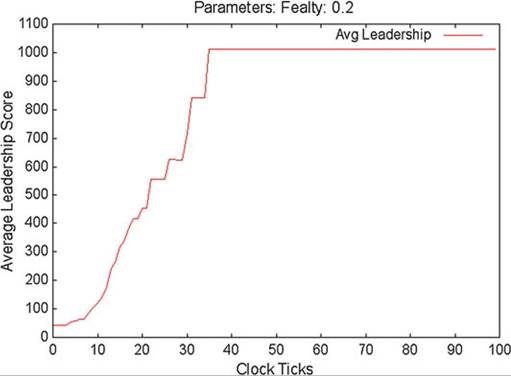
Fig. 13.9 Average leadership score for individual fealty payoff = 0.2
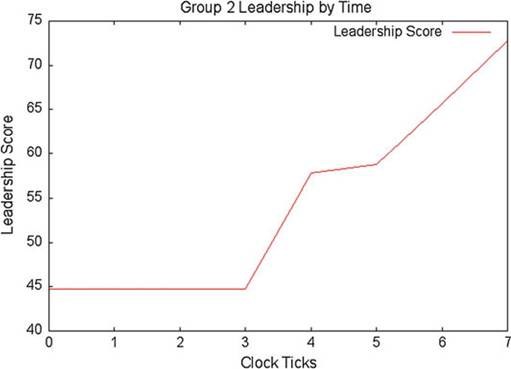
Fig. 13.10 Group 2 leadership score for individual fealty payoff = 0.25
Model runs (i.e., slow processes, in terms of the Canonical Theory) end with a few large groups, in spite of groups and group leadership having more than one chance to improve overall feeling of loyalty to the leadership. Groups must, at each clock tick (fast process), re-assess their need for collective action, and this assessment is largely independent of the group’s past history during previous ticks (fast processes). Although this simplifying assumption is more forgiving than the real world, it is still sufficient to cause failure of some groups and the rise of large groups in the slow
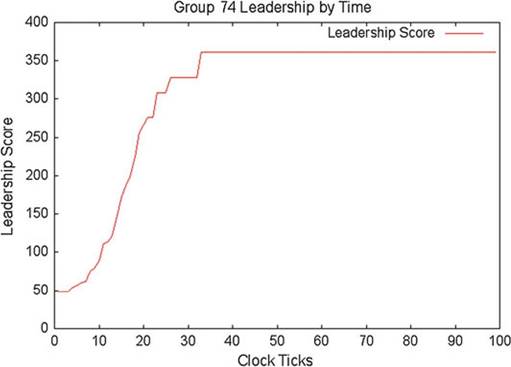
Fig.
13.11 Group 74 leadership score for individual fealty payoff = 0.25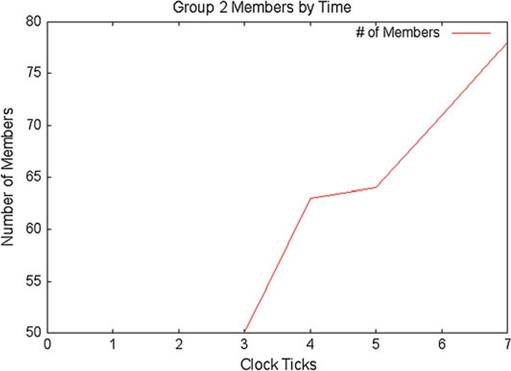
Fig. 13.12 Group 2 membership for individual fealty payoff = 0.25
process. Comparing Fig. 13.14 with Fig. 13.15 results show that one group suffered a significant fall in average feelings of loyalty, but then recovered, due to successful collective actions and addition of members from failed groups.
Some results were expected, given the importance of membership in groups with strong leaders. However, it is surprising how few groups remain in the stable system, and the speed at which the system coalesces is also surprising. This dynamic phenomenon merits further investigation. It may be due to the fact that the model does
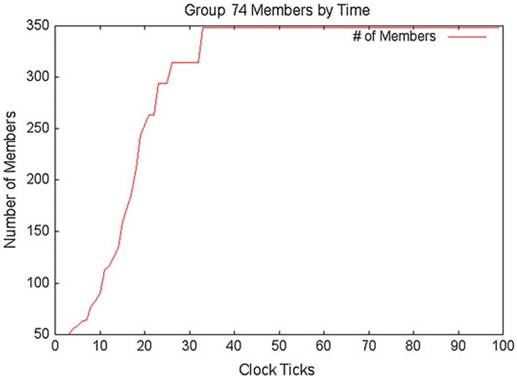
Fig. 13.13 Group 74 membership for individual fealty payoff = 0.25
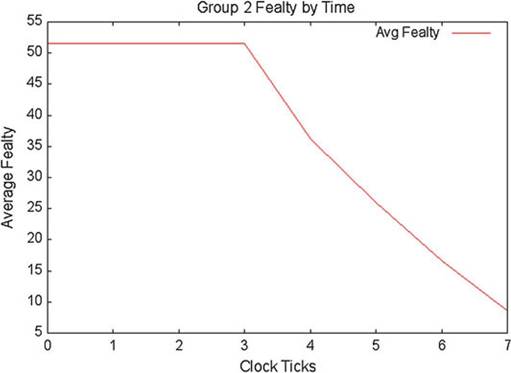
Fig. 13.14 Group 2 average fealty for individual fealty payoff = 0.25
not include dampening effects in regard to communications among group members and among groups. Archaeological and historical records show that long-distance communications take time. Moreover, the model can be extended to add activation and decay effects in the individual decision-making and behavior of agents, an embellishment totally compatible with the Canonical Theory, arguably making the slow process more realistically slow.
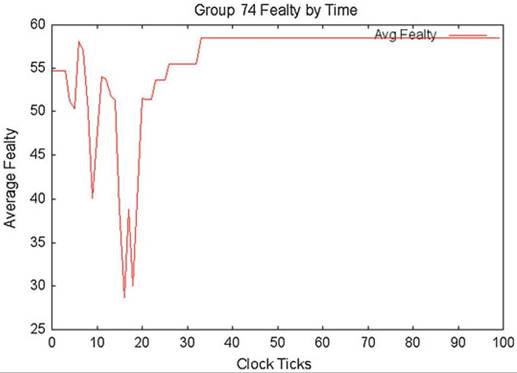
Fig. 13.15 Group 74 average fealty for individual fealty payoff = 0.25
Results also show that leadership is positively and strongly related to group size, but not to average fealty within a group. Preferred group size, by average fealty, is around 1,000 individuals, while average fealty is quite low when everyone is in one large group. Leadership scores continue to rise as groups become larger.
This is counterintuitive. Leadership is expected to vary in the same way as average fealty, given the link between leadership and positive group feelings. This is another area that would need to be explored as the model is extended. It may also highlight the possibility of collective action failure, even when leadership seems adequate.It is interesting that in most model runs, average fealty declines at the beginning of the model run, only to (sometimes) recover and rise. This is due to the fact that collective action succeeds only 25 % of the time with good leadership, and only 10 % of the time with poor leadership. This means that most individual agents and groups will experience failed collective action more often that successful collective action. As groups begin to disband to join stronger groups, group leader scores increase, in turn increasing the overall chance of experiencing successful collective actions.
13.4.2 Further Model Development
ZambeziLand could be developed further to extend the range of research questions and empirical features of the region. In the current version 1.0, the role of environmental factors is not taken into account, although the Canonical Theory includes detailed causal processes explaining how and why exogenous and endogenous types of situational change are generated in each society and environment. These can be (1) exogenous factors external to and beyond societal control (e.g., attacks by neighbors or natural hazards such as flooding, drought, or epidemics, among others), (2) endogenous factors internal to society (e.g., aggressive individuals, technological failures, miscalculation), or (3) a combination of both. Further, and independent of the type of situational change affecting a society (exogenous, endogenous, or combined), the environment may affect different groups in different ways, consistent with the Canonical Theory. The model can be spatially developed and extended by placing groups that are relatively homogeneous in size in locally distinct environments.
This is supported by work by Sinclair and Lundmark on the clustering of farming community sites in the Zimbabwean plateau. As they have noted: “[t]here remains a strong impression that environmental factors of topography, soils, and rainfall play an important role in the localization of southern clusters as a whole, but it seems clear that cluster spacing and internal organization within clusters are much more the result of social and political factors” Sinclair et al. (1993, p. 709). In terms of the Canonical Theory, this is a direct reference to causal anthropogenic triggers of situational change, which can be exogenous or endogenous. ZambeziLand 1.0 is more akin to a dynamic organizational network model, without geographic implementation on a biophysical landscape. However, as is true everywhere, geography plays a significant role in the prehistory of the Zambezi Plateau.ZambeziLand is an ABM that can be modified and applied to other pleogenic regions—such as Mesoamerica, the American Southwest, Andean Peru, and the Near East, among others—where polity cycling has been established Marcus 1998; 2012, Cioffi-Revilla (2014, Chap. 5). The Canonical Theory also applies to other regions and cases of politogenesis, given appropriate and sufficiently valid and reliable data for individual cultural attributes and features of commonly recurrent local fast processes.
13.5
More on the topic Discussion:
- Discussion
- Discussion
- Discussion
- Discussion
- Discussion
- Discussion
- Discussion
- DISCUSSION AND FINDINGS
- RESULTS AND DISCUSSION
- DEBATES AND DISCUSSION
- Framework for Discussion
- Results and Discussion
- Discussion of Dukali
- Chapter 51 Discussion of Putnam's Comments Noam Chomsky
- Model Analysis Results and Discussion
- Weber's Discussion of the Objects of the Social Sciences
- Chapter 4 What Makes a Hadith Transmitter Reliable? A Discussion from the Ghayat al-ma3mul of al-Kazimi (d. 1065/1655)