Mexico—the foundation of a ‘New Spain'
At the end of April 1519, an army of conquistadors landed near today’s Veracruz, on the coast of the Gulf of Mexico, under the command of Hernan Cortes, secretary to Diego Velazquez, the governor of Cuba.10 Cortes so far had little military experience,11 but he was one of the most influential settlers of Cuba.
He also had seen the gold that two captains had brought from their exploration of the Mexican coast. The governor’s secretary mortgaged all his assets and, together with his supervisor, financed an armada of over 600 foot-soldiers, sixteen horsemen and a bevy of cannon. What he built up was a remarkable force for the Caribbean. Cortes’ men were desperadoes. They did not receive wages and had to supply their own arms, though they hoped for a share in any prize won in battle. The conquistadors wanted to become rich with the treasures of Mexico—immeasurably rich and as soon as possible. Indians were all the same to them: weak, barbaric pagans without rights. Moreover the Indians of the Mexican mainland were believed—or, rather, were expected to be—especially despicable because they sacrificed humans or were cannibals. Moreover, they were thought to commit unnameable sexual sins and generally to make pacts with the devil.The chieftain of the Totonacs, living on the Gulf coast, told the Spanish that an inland ruler named Moctezuma possessed legendary amounts of gold taken from the Indians of Mexico. The Spaniards coveted Moctezuma’s wealth, and argued that he had to be a true tyrant if he was able to terrify all Mexico—their self-appointed mission would be to free the Indians from Aztec rule.
Unexpectedly, two of Moctezuma’s tribute collectors appeared at the Spanish camp, behaving arrogantly and refusing to recognise the Europeans. Although the Totonacs trembled in fear of the Aztecs, Cortes had Moctezuma’s two men captured.
But on the same night as they were taken hostage, Cortes visited and freed the men, assuring them that he was friends with Moctezuma and that he wanted to visit him in his capital city, Tenochtitlan, because he had a personal message to present to him from the Spanish king. This was a bald-faced lie, as Charles I, crowned in 1516, had never heard of Moctezuma nor indeed of Cortes. But in this way Cortes set up a situation of effective confusion that allowed him to play the Indian states of central Mexico off against each other.The political situation in Mexico at the time was complicated. The Aztec polity consisted of the three city-states of Tenochtitlan, Texcoco and Tlacopan.12 Tenochtitlan was America’s largest city, and no city in sixteenth-century Europe is likely to have had a higher population. But Texcoco, the most important ally of Tenochtitlan, had been weakened through a bloody civil war when the Spaniards arrived. Because of its exploitive character, the Aztec triple alliance faced several enemies. When Cortes proved the military clout of the Spanish conquistadors in the first battlefield encounters, many of the Aztecs’ enemies believed an alliance with the Europeans would provide a chance to free themselves from tribute to the hated Aztecs. Probably Moctezuma II (r. 1502-1520) underestimated the danger emanating from the small band of Spaniards. First he even sent Cortes rich gifts intended for the Spanish king, including several magnificent costumes made for the gods, and a large golden grommet portraying the sun as well as a small silver one, picturing the moon. These items were supposed to frighten the Spaniards, but, of course, they only stirred up their greed for gold.
The subsequent conquest of Mexico was not least a war between the Indian states that Cortes was able to master with luck and aptitude.13 The Aztecs knew neither horses nor firearms—but Cortes knew how to put them to successful and intimidating use. But his essential advantage came from a young Indian woman whom he received as a ‘present’ from a Mexican chieftain.
Malintzin (Malinche) learned Spanish within a very short time and became his interpreter;14 without her aid, the conquest of Mexico would not have been possible.After an exhausting trek up to the Mexican highland, bouts of bloody fighting and various pacts of assistance, especially with the Totonacs and Tlaxcaltecs, the Spaniards and their allies reached Moctezuma’s island capital of Tenochtitlan in November 1519. The Aztec ruler welcomed them and billeted them grandly. Despite the friendliness, the conquistadors realised that they were trapped in a city surrounded by water, like mice. Fearing for their safety and in an attempt to blackmail the state treasury, without further ado they took Moctezuma hostage,15 though for several months they allowed him to continue to reign from prison as their puppet.
In June 1520 the Aztecs chose a new tactic and attacked the Spaniards, whose situation was soon desperate as the Aztecs took control of the bridges of the causeways connecting the city to the mainland. The Spaniards’ allies suggested building portable bridges and undertaking a moonlight flight to reach the shore, but the Europeans could not get far without being discovered by their enemies, of course. The massacre that followed went down in colonial Spanish history as the noche triste, the sad night. Almost all of Cortes’ Indian allies and most of the Spaniards died. Cortes, who reached the safe shore, had a mental breakdown—the tree under which he supposedly sat crying can still be visited in Mexico City today. At least the necessary agents for continuing the war had survived: Cortes himself, the most important officers and carpenters, as well as the irreplaceable indigenous interpreter. The confederated Tlaxcaltecs maintained their loyalty to the alliance with the Spanish, and granted the decimated European troops a safe shelter. Moctezuma had died before the Spaniards were attacked, either killed by his own people while trying to make peace or (more likely) executed by Cortes’ men in fear that the Aztecs might free him.
In April 1521 the rested and reinforced Spaniards, together with new Indian support, managed to reach the Mexican lagoon and also besieged the island city of Tenochtitlan for three months. Thanks to his carpenters, Cortes had built a small fleet of brigantines that allowed him to take control of the lagoon. His Indian allies, eager for revenge, moved from across the embankments into the Aztec city and systematically destroyed it. The Aztecs’ courageous defence had been in vain. Meanwhile the first smallpox epidemic, which the Spaniards unknowingly introduced on their arrival, spread throughout Mexico, producing a terribly high number of fatalities among the Indians. The victims included the new Aztec ruler, who had been able to banish the Spaniards from Tenochtitlan. His successor, Cuauhtemoc, finally had to surrender to the Spaniards.
On the basis of the Aztec triple alliance, the Spaniards built their own new empire and called it Nueva Espana—New Spain. Although the Aztec capital was destroyed completely and befouled by thousands of corpses, Cortes (against the wishes of his officers) rebuilt Tenochtitlan, now called Ciudad de Mexico, appropriating the fame of the site for the new capital of New Spain.
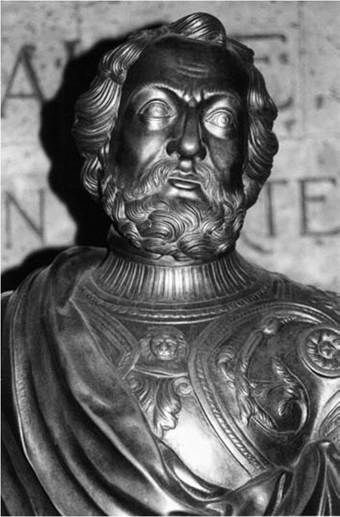
Figure 1.1 Hernan Cortes as Caesar and founder of the empire of New Spam. Bust by Manuel Tolsà (1757-1816), Hospital de Jesus, Mexico D.F. Photo: Xavier Lopez Medellin.
During the whole period of his conquest of Mexico, Cortes was considered a rebel by the Spanish king because he had parted company with his superior, the governor of Cuba, immediately after landing in Mexico. He acted on his own independent initiative with the complicity of his troops. To legitimate his action, Cortes initially had written three long, impressive letters addressed to King Charles.16 Moreover, he and his soldiers sent all the gold they captured to the Spanish court.
But it was a long and dangerous journey from Mexico to Spain and even with the conquest of Tenochtitlan, they had not received an answer from the king.Although many of his men were rather random adventurers, some possessed important and useful knowledge. One of them, for example, was able to produce gunpowder, with raw material from the volcano Popocatepetl, located directly on the lagoon of Mexico. Another soldier, who had knowledge about land measurement, was instructed to plan the new Spanish capital city on the ruins of Tenochtitlan. As was typical of such a Spanish colonial city, there was a grand central square in its middle where a well and a pillory were erected as signs of public authority. This plaza was framed by a church, guildhall (cabildo) and gaol, joined by the residences of the city’s elite—the noble families, and possibly the bishop or the Spanish governor. From this square four streets directly led to the cardinal points, the other sidestreets grouping themselves around it like a chessboard; the main streets of Cortes’ new capital followed the old Aztec causeways to the shores of the lagoon. Cortes built two palaces for himself directly on the central square, placed exactly on the site of two former palaces of Moctezuma and secured like small fortresses—even today the Mexican National Palace is found on one of those two sites. The monumental templepyramids embodying the bloody Aztec state religion had been razed, and their bricks mainly used for building the cathedral of Mexico City. The city’s canals were filled up to create broad boulevards. The central plaza, today’s Zocalo, was built on the location of the former Aztec ceremonial court.17 Around the rectangular-shaped city of the Spaniards spread the Indian city where the Aztec survivors were established. Since the Aztec elite was largely disempowered or had perished, the Indian city initially developed quite aimlessly.
Both the strategy of conquering Mexico and the organisation of the governmental structures of New Spain provided bases for further Spanish outposts and states.
In principle, both Europeans and Indians were free subjects of the Spanish Crown. The Spanish overseas empire was subdivided into the Spanish state (republica de espanoles) and the Indian state (republica de indios), which meant that the Indians had their own town hall and councils in Tenochtitlan-Mexico after the mid-sixteenth century. They were responsible for the administration of the Indian districts, but, despite repeated requests by the Crown, the Spanish councils refused to acknowledge the Indian councils as their equals: the equality between the indigenous people and the colonials was a matter of theory, not reality.18The Spanish presence in America was an urban one; the Spaniards mainly settled in purely Spanish cities, from which they controlled the surrounding areas. In the countryside they ruled through the encomienda system of landlords, managing the Indian population by demanding tribute and forced labour. Added to this was the control exercised through the Church, although the Church did not always share the same interests as the Spanish Crown or its local administrators. For instance, the intention of the Franciscan order was to establish a new, pure Christianity in America, preferably independent from Spanish authority. The Franciscans preached in Indian languages, and lived among their new converts. This deprived the Spanish authorities of control, while immensely empowering the Franciscans.19
There was one area in New Spain where the Spaniards could only intervene with special permission, the province of Tlaxcala. As mentioned earlier, the Tlaxcaltecs played a major role in the Spanish conquest of Mexico through their assistance to Cortes. Therefore they gained privileges and, instructed by the Franciscans, they built their own new capital city. The Tlaxcaltecs hoped to be involved in ruling New Spain, but neither the Spanish Crown, nor the conquistadores nor the missionaries were interested in their political equality. New Spain, larger and theoretically richer than any European state by this time and in fact an empire to itself, became a Spanish colony and part of a superior Spanish empire that was one of history’s largest. Over the Spanish overseas empire from the sixteenth through the eighteenth centuries, the sun never again set.20
More on the topic Mexico—the foundation of a ‘New Spain':
- The U.S.-Mexico War
- 1Human Genetics Unit, Department of Basic Medical Sciences. Universitat de Lleida. IRB-LLEIDA. Montserrat Roig, 2 25199-Lleida, Catalonia, Spain and 2Immunogenetics Unit, Faculty of Sciences, Universidad de Jaen, Pasaje Las Lagunillas s/n 23071-Jaen, Spain.
- Mexico
- The ‘Conquest of Mexico': ‘Some of Evil Disposition'
- Spain
- Chapter IX The Godmother as Mediator: Constraining Violence in a Zapotec Village of Oaxaca, Mexico
- Spain (Al-Andalus)
- Moral Foundation of Law
- Lex Irnitana 28—9 Irni (Spain), c.80—90
- Foundation
- Chapter 5 Determinants of Banking Profitability in Portugal and Spain: Evidence with Panel Data
- The Foundation of Jewish Demonology
- APPENDIX 2: Timeline of Major Events from the Foundation of Rome to Justinian I
- Religion: The Moral Foundation of Legitimacy
- 2 THE FOUNDATION AND DEVELOPMENT OF EUROPEAN MONARCHY
- Chapter V Believed and Not Believed: Community Reaction to Rape in Mexico and the United States
- 1950: The foundation of the IAHR and the defeat of science
- Phenomenology: A Philosophical Foundation for Instrumental Rationality
- In 2 CE, Lucius Caesar, the younger of Augustus’s two adopted sons, died en route to his first command Spain.1