Monolithic Renewal in Ancient Egypt
While the history of the monolithic obelisk goes back to the third millennium bce, it is with the Eighteenth and Nineteenth Dynasty pharaohs of the New Kingdom of Egypt in the fifteenth century bce that we associate the proliferation of these commemorative monuments.[442] They were often, but not exclusively, set up in pairs at temples where they marked out the sacred topography of the site, offering, along with an array of great statuary and pylons, punctuation for processional routes and the ritual life of temple precincts.
The approach to the temple of Luxor, for example, consisted of an avenue lined with ram-headed sphinxes leading to the first pylon that featured colossal sculptures of Ramses II, both seated and standing, and two great obelisks piercing the skyline (Figure 6.5). While one of his obelisks is today in Paris at the Place de la Concorde, the other still stands at Luxor, dominating the ruins of the complex and reminding visitors of the central role played by obelisks in the structuring of experience of sacred topographies. Indeed, the Theban complexes of Luxor and Karnak—both amalgamations of construction campaigns enlarged by successive pharaohs from Senusret I to Ptolemy VIII—are interlocked architecturally and ritually and are structured by the rhythmic interplay of arresting pylons, statues, and obelisks.These enduring monuments—some in situ and others collected and displayed as part of later imperial agendas—anchored the ceremonial renewal of royal charisma
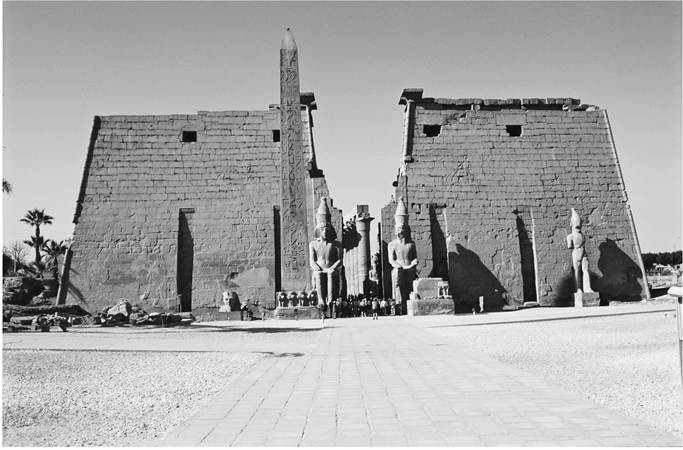
Figure 6.5. Luxor, first pylon with obelisk and statues of Ramses II.
Photo: Saskia Ltd. Cultural Documentation
in ancient Egypt. They lent unmistakable permanence to performances that were ultimately transitory in nature despite being repeated at regular daily, annual, and anniversary intervals.
Karnak was the site of daily rituals as well as the center of the larger festive calendar, all of which underscored the cyclical regeneration of divine kingship and, in turn, the renewal of divine favor more broadly.[443] The Daily Ritual was centered on maintaining divine approval and patronage by providing for the cult statues. More specifically, 36 separate daily ritual actions and incantations are described in papyri and depicted in temple reliefs.[444] The eastern interior walls of Karnak’s Hypostyle Hall, for example, represent Sety I performing these rites: he is shown breaking the seal and drawing open the door to Amun-Ra’s shrine, encountering the divine cult statue face to face, then kneeling to prepare offerings and pour libations. Although priests performed these ceremonies on a daily basis, the temple reliefs depict the pharaoh himself personally engaged in the daily ritual maintenance of his divine father. In this sense the images are less documentary than prescriptive in their idealization of the close and personal bond between the two, stressing the pharaoh as the son of Ra.The Daily Ritual of Karnak, in turn, inflected the ceremonial life elaborated throughout the year, especially the Opet festival celebrated annually and the Sed festival or jubilee that marked the renewal of the king's potency, traditionally after 30 years of rule. Whereas the Daily Ritual involved entering Amun-Ra's shrine to tend to his cult statue, the Opet festival featured a procession, and consequently took on a significantly more pronounced public role, proclaiming divine legitimacy through more attenuated ceremonial movement. This annual festival featured the procession on a gilded bark of the cult statues of the Theban triad from their temples in Karnak south to Luxor.[445] In the time of Hatshepsut (r. 1478-1438 BCE), the festival began in the bark chamber known as the “red chapel,” then moved through the hypostyle hall and the successive monumental pylons, whose liminal monu- mentality was accented by obelisks, reliefs, and statues, to the sphinx-lined avenue leading to Luxor.
At the conclusion of the ceremonies in Luxor, the barks returned home to Karnak by the Nile. The festival constituted, in essence, a sacred marriage of Amun and Mut and a commune of Amun and the pharaoh as a ritual confirmation of the transmission of the royal ka or life force.[446] It was a ceremony of union and reinvigoration aimed at ensuring order, or maat, the perfect harmony of the world essential for the survival and flourishing of sovereignty. The timing of the festival coincided with the end of the inundation period, when planting began as the Nile waters receded. In this way, the renewal of kingship was tied to the renewal of the land and people, crops and livelihoods.From the heart of Karnak along the north-south axis to Luxor, the Opet festival passed through monumental pylons anchored by statues and obelisks. Moreover, obelisks were also commissioned to commemorate the anniversary celebrations of the pharaoh's rule, that is, the Sed festival, arguably the most elaborately staged ceremony that involved processions, investiture with ritually charged objects and garments, thrones referencing Upper and Lower Egypt, and ritual running to display the renewed dynamism of the ruler. Collectively, these ceremonies stress the importance of successive ritual performance across timescales—daily, annually, on jubilee years—for the continual reaffirmation of divine rule and maat. The physical spaces for the ephemeral performance of ritual were structured by obdurate reliefs, pylons, statues, and obelisks, which, again, serve as punctuation for these symbolically charged liminal spaces, and they were occasioned by the royal ritual performed there, at least in the case of obelisks raised on the occasion of Sed festivals. Ritual, as performed repeatedly in time and over time, in other words, was commemorated by singular monuments that were designed to endure throughout time. The close correspondence between ritual performance (designed for reinvigoration) and monumental commemoration (designed to preserve and project memory) is signaled by the pictorial program of Hatshepsut's red shrine at Karnak
and at Deir el-Bahri, both of which feature detailed depictions of royal rituals such as coronation alongside the transport and elevation of obelisks, thereby placing monumental commemoration as among the pharaoh's great deeds.
While obelisks punctuate ceremonial spaces more generally, they are fundamentally historical monuments, tied by iconography and hieroglyphic inscriptions to specific rulers and moments in their rule.
The dedication of obelisks served as one of many means of proclaiming and competing for royal genealogy. Thutmose I is credited with dedicating the first pair of obelisks “to his father Amun-Ra” in the Festival Hall at Karnak, one of which still stands there today, just shy of 20 meters in height.[447] Thutmose II followed suit, dedicating a pair to the west of his father's; these were completed by his wife and sister Hatshepsut, who continued the tradition when as pharaoh she similarly installed two obelisk pairs at Karnak, one of which on the occasion of her Sed festival (Figure 6.6).[448] Testifying to the significance of the dedication, again, it is visualized on the walls of her red quartzite shrine, the sumptuous shrine built for the bark in the central court of the temple of Amun (Figure 6.7), as well as at her valley temple across the Nile at Deir el-Bahri.[449] The inscription on Hatshepsut's obelisk itself, as scholars have stressed, serves to legitimize her rule by underscoring succession and sacral rule—more specifically her devotion to the memory of her earthly father Thutmose I and to her divine father Amun: “I am his excellent [heir] beloved of His Majesty (Amun-Ra) who placed the kingship of Egypt, the deserts and all foreign lands under my sandals.”[450] The inscription continues to elaborate that land under her sandals, delimiting its border in the region of Punt to the south, “at the marshes of Asia” to the east, and “at the edge of the horizon” to the west. The expansive terrain of her rule is mapped on the obelisk that was installed as a visual statement of her divinely sanctioned authority in the great temple to Amun-Ra where her father's obelisks also stood. Raised to celebrate her Sed festival, its base voices the purpose and effect of raising “these two great obelisks”:Wrought with electrum by my majesty for my father Amun,
In order that my name may endure in temples, For eternity and everlastingness, They are each of one block of hard granite, Without seam, without joining together!
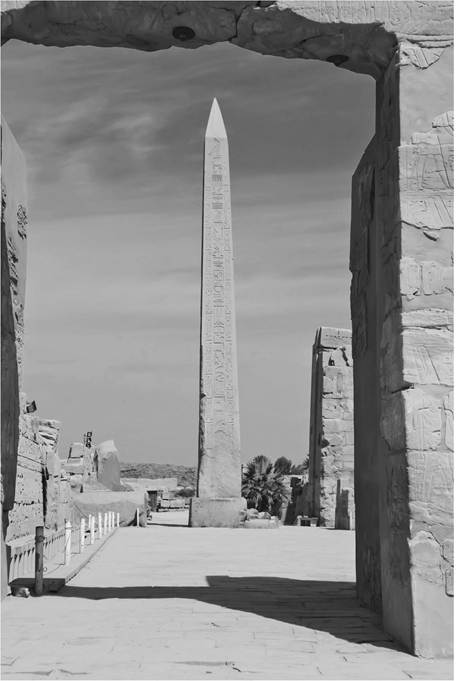
Figure 6.6.
Hatshepsut's obelisk at Karnak.Photo: Shutterstock
The inscriptions link material properties with sovereignty explicitly. They specify that hard granite comes from the south and that the glimmering electrum sheathing was “the best of all foreign lands” and was measured “by the gallon like sacks of grain.”[451] They also stress the feat of monolithic facture, boasting that the one single seamless block took “seven months of quarry work.” In addition to these hieroglyphs, Hatshepsut is pictured making offerings to the gods and kneeling at the feet of Amun-Ra, receiving his blessing on the pyramidion at its summit.
Thutmose III (r. 1481-1425 BCE) surpassed his grandfather and Hatshepsut when he rose to power: he raised seven obelisks at Karnak, three pairs and a single obelisk, and two further as a pair at Heliopolis.[452] Collectively these index his larger building program, which aimed to assert his royal legitimacy and, over
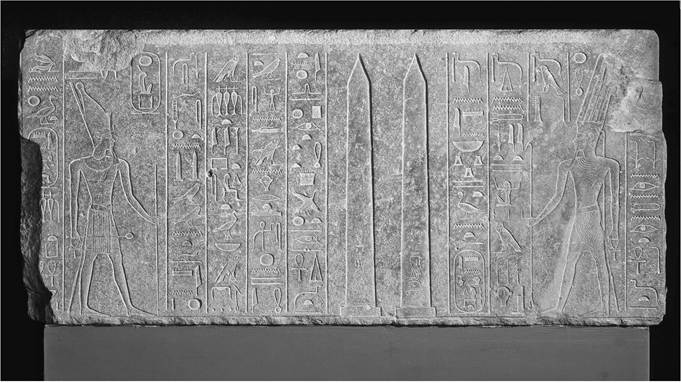
Figure 6.7. Hatshepsut with obelisks at Karnak, from red quartzite shine (now in the Luxor Museum).
Photo: Scala/Art Resource, NY.
time, to commemorate that legitimacy. At Karnak he expanded the area around the main bark temple and thus aligned himself through patronage with Thutmose I, just as Hatshepsut had before him. In addition to rebuilding the hypostyle hall of Thutmose, he completed Hatshepsut’s red bark shrine, the very monument that represented the dedication of her two obelisks on the occasion of her Sed festival, only to disassemble it piece by piece 25 years later as part of a systematic effort to erase the memory of his stepmother and regent.
Relief images and inscriptions celebrating Thutmose III’s accomplishments line the temple walls and pylons at Karnak. They adumbrate the names of the cities he subjugated, the tribute he received, and the obelisks he dedicated. On his third jubilee, an especially significant achievement as many pharaohs did not live to celebrate a single Sed, he raised a pair of obelisks at the seventh pylon of the Karnak complex, which marked the edge of the extension of hypostyle hall, adding further monumental emphasis to the north-south processional route through which the annual Opet festival passed.
The foundations of both still exist, as well as portions of the eastern one, while the western obelisk is now in Istanbul, set upon Byzantine emperor Theodosios’s marble base (Figure 6.1). Embodying the conception of royal renewal tied to conquest, the inscription hails him as “a king who conquers all the lands, long of life and lord of Jubilees”[453] and further elaborates his many titles and military accomplishments, notably his victorious crossing of the Euphrates. Thutmose III also commissioned a single obelisk just east of the central Amun-Ra temple. This was tallest obelisk in Karnak, rising to a height of just over 33 meters, and is presently in Rome.[454] In 1901 James Henry Breasted lamented the “surprising spectacle” that not a single obelisk of Thutmose III survives “in the land he ruled,” while “the modern world possesses a line of them reaching from Constantinople to New York.”[455] The travels of Thutmose III's obelisks from Thebes to Rome and New York was part of a much broader campaign of empire building that harnessed the symbolic capital of commemorative monoliths from Egypt.
More on the topic Monolithic Renewal in Ancient Egypt:
- Part One Ancient Mesopotamia and Ancient Egypt
- A Tale of Two Worlds: Peace and Peacemaking in Ancient Egypt
- Gods of Ancient Egypt
- 2 Peace in the Ancient West: Egypt, Greece and Rome
- Hunting and Warfare:The Ritualisation of Military Violence in Ancient Egypt
- In the sphere of controlled violence and state-sponsored ‘terrorism' (in its literal sense), ancient Egypt is a prime example and object lesson among the complex societies of the Near East.
- The Renewal Movement
- Collective Responsibility: Against Monolithic Agency
- THE MYTH OF THE MONOLITHIC GOVERNMENT
- Nationalism as a Renewal of Second World War Mythmaking
- 34 Renewal of the Permission to Collect Money in the West for the Patriarchs
- Rites of Renewal and Rites of Purification
- Egypt Invades Nubia