PART VII THE GLOBAL TURN
The Age of European Colonialism, Subjection of Old Agrarian Empires to the European-Led World Economy, and Nationalist Secessions (1750-1914)
Peter Fibiger Bang
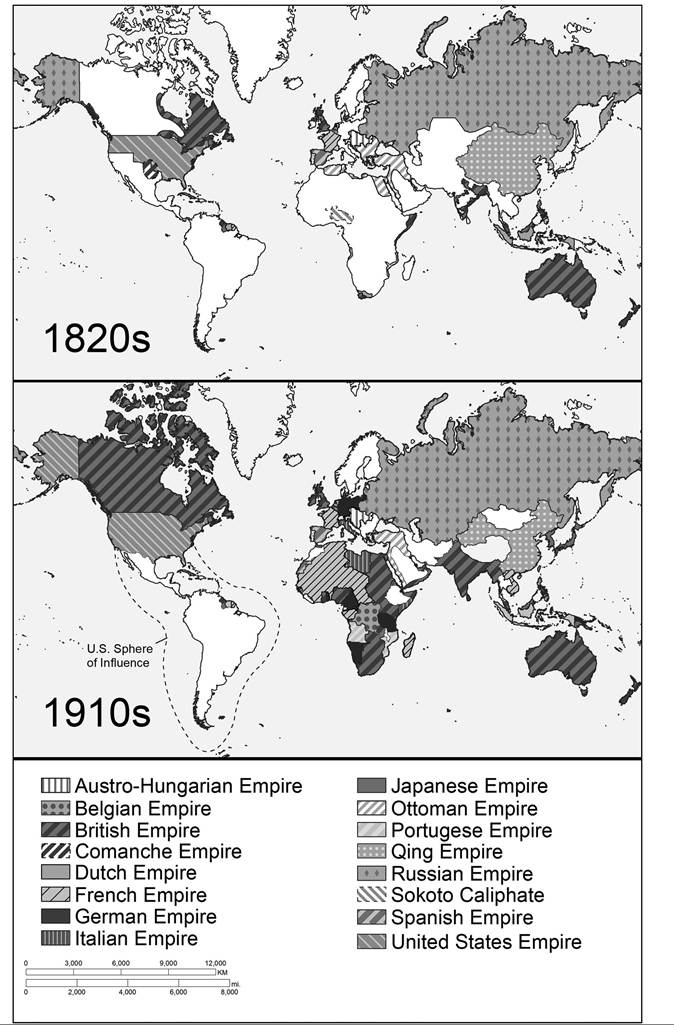
Map VII.
The Global Turn: The Age of European Colonialism, Subjection of Old Agrarian Empires to the European-Led World Economy, and Nationalist Secessions (1750-1914).
The long 19th century saw the rise of European colonialism to global dominance. In the history of empire, even of European expansion, this was a late development, but all the more dramatic in impact. Spearheaded by the British Empire (Bayly, Chap. 33), markets everywhere were prized open and the world forcibly pressed into a unified economic system under the self-contradictory banner of free trade. Eventually, even global time came to be set in relation to the Royal Observatory at Greenwich outside London. Meanwhile, industrialization transformed the economies of the EuroAtlantic and began to promise emancipation from the narrow constraints of the agrarian conditions that had originally enabled the formation of empire. The modern world, the result of radical transformation and conflict, was born in a complex intertwining of these two processes: industrial production and imperial globalization.
The commercial and colonial imperialism of the sixteenth-eighteenth centuries had developed as part of a set of strategies, often referred to as mercantilism, that European states employed to generate more revenue and strengthen themselves in the competitive struggles and resulting arms race of the continent. As the colonial economic network of the Atlantic and the commercial arteries of the Indian Ocean grew thicker and gained in strength during the eighteenth century, the ceaseless rivalries of European powers acquired global momentum.
The so-called Seven Years' War, from 1756 to 1763, constitutes a watershed; it announced the high age of colonial empire. The confrontation of the European great powers now came to play itself out on a planetary scale. On the continent, France (Todd, Chap. 34) had taken the lead from Spain (Fradera, Chap. 36), while Britain had eclipsed the Dutch on the high seas. And while the brunt of the military action still took place in Europe, the two powers were engaged globally, from their North American colonies to India. Britain emerged victorious from the debacle and established a naval hegemony of the oceans, while the French where forced to give up most of their holdings in North America.British triumph, however, was short-lived. A tax was introduced to make the North American colonials help defray the huge expenses incurred for the war effort. The fighting had, after all, in part been undertaken to defend the interests of the colonists against their French economic rivals. But these considerations fell on deaf ears in colonial society and rebellion ensued in 1775/1776. Eager for revenge, the French monarchy did its best to support the colonial rebels, who could declare victory in 1783 and establish themselves as an independent entity, the United States of America. Anti-colonial struggle, self-determination, and nationalism were becoming important forces in the politics of empire. Intense competition among the great powers of Europe saw the destruction of overseas empire and prompted waves of decolonization in the name of autonomy, sovereignty, and the nation. Next came Spanish America. As the French-British rivalry dragged on into the wars of the 1789 French Revolution and the Napoleonic era, Spain was drawn into the maelstrom. When the European metropole fell under the domination of France, it was cut off from the overseas colonies by a British naval blockade. After the final defeat of Napoleon at Waterloo in 1815 and the return of peace, it proved impossible to restore control.
Inspired by the example of the United States and the idea of the Nation, most sections of Spanish America, in quick succession, declared independence during the following decade.This was a pattern that has been repeated over and over again. The failure of any one of the major European powers to extend a stable hegemony across the continent and to conquer most of their neighbouring rivals consolidated a statesystem of enduring and intense competition. Eventually, any status quo would be put to the test. Forces were recurrently matched in grand military contests pitting all the leading powers and their allies against one another. Every major confrontation of this sort has invariably been followed by the dismantling of empire. At the end of the two world wars of the twentieth century, and at the end of the Cold War, vast imperial blocks and territories have been broken up to make room for the claims of regional elites and their successor polities (See Chase-Dunn and Khutkyy, Chap. 3 of Vol. 1). Out of the wreckage of empire, nation-states have multiplied to become the global norm. But if that is so, it is because competition and confrontation not only undermined empire, they also generated new empire in a process that came to engulf the globe. Instead of a succession of dynasties, the historiography of European colonial empire is punctuated by numbering: the first empire, the second empire, even the third empire. At the same time that Britain was losing its hold on the American colonies, it was already in the process of conquering a new dominion. Formed in the early seventeenth century, the British East India Company had been unable to challenge the Dutch in its monopoly of the most lucrative spices, gathered from the islands of the Moluccas (in present-day Indonesia). Instead, the company had shifted its interest to cotton and gained a leading position in the export to Europe of calicoes from the vast weaving communities of Bengal. From the 1750s and particularly 1760s onward, the company was transformed into a military entrepreneur and a tax collector as it became heavily involved in the politics of Bengal and the subcontinent.
Decade by decade, its armies expanded the territory held by the company until, by the 1830s, all of India had effectively been subjected.The transformation from trading company to colonial territorial government was, in the first instance, a reflection of the intensity of military competition in Europe, that had forced states continuously to ratchet up their military strength and organizational capacity. In the confrontation with the Amerindian population during the sixteenth century, the advantages enjoyed by the conquistadors would have been characteristic of state-based societies across Afro-Eurasia in general. By the mid-eighteenth century, however, European war-making was beginning to gain an edge in relation to the other great societies of the vast landmass. While the British were expanding in India, the Russians were pushing back the Ottomans in the Black Sea and the Caucasus region. And soon Napoleon would follow up by briefly conquering Ottoman and Mamluk Egypt before being forced out by a British naval intervention. Colonial empire in Asia was becoming possible.
In the second instance, however, European advantage was reinforced by a historical conjuncture. The great Muslim universal empires of the Ottomans and the Mughals were going through one of the phases so familiar from previous imperial history (e.g. Bang, Chap. 9; Marsham, Chap. 12)—that is, of weakening central government and regionalization of power. Their vast imperial societies had become more vulnerable to outside penetration, and European empire builders found it easier to press home their marginal advantage, particularly in India. Regional dynasts here worked hard to raise revenue and had resorted to tax-farming. This provided the East India Company with an opening. The acquisition of tax-farming contracts, a hardened mercantilist system of war-finance, and European-style drilling made the company's army—composed mainly of locally recruited Sepoys—a winning combination. As in all imperial projects, European colonial enterprises depended not simply on metropolitan society, but on successfully tapping into the resources of the conquest zone.
Alliance had to be sought with local groups and elites that could gain from co-operating with the new rulers. Anything else would have been too expensive, and so the British East India Company came to depend on a combination of Indian manpower, the cooperation of commercial groups, and the help of some princely dynasties of the subcontinent in forging the order of the Raj. When territorial control of India was established, this “jewel in the crown” itself served to strengthen the network of European power as it became a stepping stone for further expansion and penetration of the societies of Asia. Next in line was China.Tea, silk, and porcelain from “the Middle Kingdom” had been a growing import line to Europe during the eighteenth century. The need to pay with silver for the goods, however, was a limiting factor. To cure this perennial headache, European merchants had been searching far and wide within Asia for potential substitutes. Now India was harnessed for the cultivation of opium, a substance that, as it turned out, could be exported to China in such quantities that it would serve as a real substitute for silver and thus finance the growing import of the goods that were so much in demand on the European market. The Qing dynasty had confined European traders to Canton or Guangzhou in Southern China. When the imperial authorities understandably decided to block the import of the addictive narcotic, due to its damaging effect on the population and its negative impact on Chinese silver supplies, the British took up arms in the name of free trade. Never mind the objection voiced in their Parliament, that never had there been “a war more unjust in its origin, a war more calculated in its progress to cover this country with permanent disgrace.”[2183] The two Opium Wars, in 1839-1842 and 1856-1860, were pursued to “afford” Britain and its Western partners “a larger access to the people of China.”[2184] The independence of the Chinese authorities would not, the minister of the government waxed lyrical, be “invaded if free commercial intercourse were established between us.”[2185] Yet this was exactly what the British aimed for.
To be sure, by the mid-nineteenth century, the old mercantilist beliefs in privileges and the concession of monopoly rights to groups of merchants were on the wane. Laissez-faire was the new catchphrase; but free trade, to the British government, was still trade conducted on British terms, and the state was an instrument to advance mercantile interests abroad. In China, that meant opening a large number of harbors to European merchants, granting them extraterritorial rights so they could go about their business according to their own rules under the protection of their European governments, and creating concessionary European zones.The British and their Western allies were able to push through this program as they were beginning to reap the rewards of industrialization. During the Opium Wars, the first steam-powered iron ships of the British navy spread havoc among the wooden junks of their Chinese opponents and could therefore venture inland up the great rivers with impunity. The humiliation was complete when a British-French expeditionary corps marched up to Beijing, forced the court to flee, and imposed a humbling peace. To add insult to injury—or infamy to disgrace—the occupying force under Scottish Lord Elgin opted to torch the magnificent complex of palaces and gardens, today referred to as the Old Summer Palace or Yuanming Yuan, in an act of wanton destruction—much as Alexander the Great and his men, in a drunken stupor, had burned down Persepolis, the palace of the vanquished Achaemenid rulers, two millennia before (see cover of Vol. 1). In addition to the opening of the Chinese market, here was an opportunity—one not to be missed—to teach the lofty Qing court a lesson and demonstrate the sheer might of British and Western power, a symbolic assertion of superiority. Just before this, a similar message had been delivered in India after quelling the Great Uprising in 1857. Here the army of Sepoys, the key instrument of empire, had rebelled and been defeated only with the greatest of efforts. Up to that point, the Red Fort in Delhi had remained the palace of a Mughal prince in whose name the British pretended to rule. But as he had become a symbolic rallying point for the rebellion, this arrangement was brought to an abrupt end. The princely family was exiled to Burma and much of the Red Fort completely demolished. A string of barren barracks for the army were erected where once there stood exquisite chambers for the imperial harem and beautiful courtyards. The callous arrogance behind such acts of demonstrative destruction seems to have been born of the confidence that, from now on, the world would have to dance to a tune set in the metropoles of Europe. But it was, in equal measure, a product of anxiety, a ruthless affirmation of authority in societies where the representatives of European power were vastly outnumbered and heavily dependent on local assistance (see Wagner, Chap. 12, Vol. 1, for further discussion of imperial repression and colonial resistance).[2186]
Everywhere, the power of European or Western societies was expanding. The age- old process of the slow spread of agro-literate societies was kicked into a higher gear for the final acceleration. Settler colonists were pushing back the frontier of more thinly inhabited areas all around the planet, at great cost and loss of lives to the aboriginal populations—from west to east across Russia and into Siberia and from east to west across the North American continent (Lieven, Chap. 35 and Greenberg, Chap. 37). South of the Equator, the process was repeated in Australia, New Zealand, and on the Argentinian Pampas. Yet, this movement did not take place into a void. By the opening of the 19th century, for instance, Muslim scholars of the West African Savanna rose successfully to issue a call for Jihad. Following in the footsteps of the past empires of Songhay and Mali, small contingents of soldiers fanned out under the new Caliphs in Sokoto to reenergise the Muslim networks across the thinly scattered societies and reinforce the order of Islam (Last, Chap. 40). Similarly, to name but another example, a coalition of Comanche horse-riding Indians managed to establish their own proto-imperial hegemony along the expanding frontier of American and Mexican settlers by hunting, trading, and raiding (Hamalainen, Chap. 38). Over the long term, however, they were overrun by an inexorably expanding United States.
The world seemed as though it were about to be refashioned in the image of Europe. Progress in tropical medicine, combined with the invention of the machine gun, finally made it possible for European and state-building enterprises to penetrate Sub-Saharan Africa. Territories could now be conquered and dominated with relatively little personnel, though it must be remembered that the small contingents of Europeans were at all times assisted by greater numbers of local hands, hired as well as conscripted. A virtual scramble followed, with both major and a few minor European states competing for a slice of the cake that a motley vanguard of Christian missionaries, explorers, and merchants had laid open and, via the press, brought to the attention of Western publics. In the end, things were settled “peacefully”, at a conference in Berlin in the mid- 1880s, carving up the vast continent among the contenders. Access to raw materials and the prospect of export markets certainly played a role in motivating this, but no less important was the assertion of national prestige. Greatness demanded the acquisition of colonies. The unifications of Germany and Italy, two new nations in Europe whose formation had been prompted by the shock of the Napoleonic Wars, were soon accompanied by aspirations toward overseas possessions. These were perceived as a sign of arrival to membership in the club of major international players, a marker of status. Finally, in the struggle for power, the drive to colonize might be spurred on by geopolitical considerations, the need to maintain a strategic advantage, or simply a desire to prevent rivals from gaining one. The web of European colonial empire was woven into a complex pattern consisting of all three threads.
The global extension of colonial empire, fueled by the interstate rivalries of the Euro-Atlantic world, marks a dramatic turn in the history of empire, a disruption. Steamships, railroads, and telegraphs, the fruits of industrialization, made it possible to open up inland territories, mobilize resources, circulate people, and intensify communication on a scale hitherto unseen. Under the aegis of colonialism, the planet was tied together in a vast interconnected economic system in which Euro-Atlantic metropoles were joined by cities such as Bombay, Calcutta, Singapore, Hong Kong, and Shanghai to serve as nodal points in the thickening net of global capitalism. Traditional society was freed up from old constraints and progress was the watchword. Slavery, a scourge of human society for millennia, was abolished in a global—if at times hard-fought— campaign. The plantation slave population on Saint-Domingue led the way when they joined the French revolution to claim their liberty, fought down the expeditionary corps sent to quell the rebellion, and successfully announced the independent Republic of Haiti in 1804. “God is on the side of freedom,” Frances Ellen Watkins would later proclaim in a striking speech. The words of this African-American woman continue to resonate and remain as an admonition to our own time: “May I not... ask every honest, noble heart, every seeker after truth and justice, if they will not also be on the side of freedom. Will you not resolve that you will abate neither heart nor hope till you hear the death-knell of human bondage sounded.”[2187]
The achievement of the abolisionist movement stands as an enduring paradox for an age that otherwise saw a dramatic rise in the technologies and means of domination. Western colonialism may, on occasion, have celebrated notions of liberty and self-determination, but it also instituted a social order in the colonies based on an increasingly firm racist hierarchy between white rulers and colored subjects (see further discussion by Burbank and Cooper, Chap. 11, Vol. 1). Colonialism saw a rise in the use of indentured labor and perpetrated the mass-killing horrors of the Belgian Congo. Modernization might, in some places, have been no more than a euphemism for a journey into the “heart of darkness,” to borrow the famous and scathing metaphor of Joseph Conrad. In this transformation (as dynamic as it was disorienting, chaotic, and violent) the predominant pattern of the previous ages— that of a league of universal monarchies—was broken up. Where elites had formerly looked to a range of great courts and their ecumenic cultures, they now had to reorient. The world was made to center on Europe; its forms of military, statehood, economy, and science became the standard against which everything else was measured. Misled by their success, people of the Euro-Atlantic world began to portray the rest of the world as inert, stagnant, and simply “without history,” while the colonial project opened societies around the globe to be studied, recorded and ranked in the name of science and progress.[2188]
But for these societies, inertia was not even an option. The world was pulled more forcefully together and the competitive pressures to conform became stronger than ever. Reactions were manifold but immediate. The challenges and crises confronting the Ottomans and Mughals quickly sparked movements for religious reform. Courtly and mystical Persian idioms were pushed back to make room for a more austere, purist, and rationalist Arabizing version of Islam.[2189] On the Arabian Peninsula, a Wahhabi-inspired rebellion set out to purge the holy cities of corruption and the cult of saints. In China, the legitimacy of the Qing dynasty was seriously weakened by defeat in the First Opium War. Impotence helped pave the way for the massive and grueling Taiping Rebellion when a failed entrant to the imperial examinations responded to the inspiration from Christian missionaries and declared himself the “brother of Jesus.” In the person of Hong Xiuquan, that was his name, the stresses of European influence combined with mounting demographic pressures to form an explosive cocktail. The Qing dynasty had presided over a long period of unprecedented population growth and the peasantry was increasingly hard pressed over access to land. This enabled the desperate scholar to tap into the age-old reservoir of aspirations for millenarian justice harboured among the broad masses and make them rise in violent rebellion. With the Taipings approaching, the business community of Shanghai financed the first European-style regiment in Chinese history to ward off the threat, the so-called Ever Victorious Army. Among its leaders was Charles Gordon, the man who would later be raised to iconic status by the British press as he died trying to hold Khartoum in Sudan against another messianic army. Long before, however, he had joined the Anglo-French expeditionary force occupying Beijing and was then hired on to the Ever Victorious Army, where he would end up receiving honors and a yellow gown from the Qing emperor.[2190] His career also took him into the service of the Ottoman Khedive of Egypt.
Colonial imperialism was a transnational phenomenon, entangled and boundarycrossing. Out of the old, centered aristocratic cosmopolitanisms grew a culture of internationalism. State-elites across the globe quickly engaged in programs aimed at increasing the strength and capacity of their states. It is a history, often tortured and volatile, that is dotted with tragic heroes like Tipu Sultan of Mysore in India (r. 1782-1799) and Muhammad Ali in Egypt (r. 1805-1848), and programs such as the Ottoman Tanzimat, the Suez Canal, the Self-Strengthening reforms of the Qing dynasty (Mitter and Reynolds, Chap. 39), or the fledgling efforts at centralizing modernization of the ill-fated emperor of Ethiopia, Tewodros II (on which, see Humfress, Chap. 7, Vol. 1). Across colonial society, a diverse array of groups seized on the many opportunities afforded by empire to engage in business or find employment in new professional and administrative occupations. From here they joined their European counterparts in debates about reform, modernization, and the role of the nation.[2191] Soon the prospect of independence began to appear on the agenda, and the world of colonial empires came to harbor its own international set of revolutionaries and anti-imperialists.
Bibliography and Guidance
Bayly (1989 and 2004) changed the way historians understand the long nineteenth century: modernity developed not solely as a European phenomenon, but from the beginning as a global process. The formation and expansion of colonial empire, helped along by an episodic weakening of the great Muslim empires of the Middle East and India, tied the world together into a global network of power, trade, and communication that affected Europe and North America as much as Asia and Africa. Revolutions, such as the American and the French, resonated everywhere. The ideology of nationalism, as Anderson (1991) has pointed out, circulated between societies in reaction to empire and revolution. In this dialogue, Edward Said (1978) was right to argue, western ideologies and concepts rose to global hegemony. But agency and response nevertheless came from all sides, and strong groups in colonial society were able dynamically to seize the opportunities of the new regime, not to mention deflect and resist its powers (Cooper and Stoler 1997; Bayly 1983). Sometimes this led to surprising results, when viewed through a lens shaped solely by the expectations of European modernity. Thus calls for reform across the far-flung societies of the Islamic world, according to Alavi (2015), ushered in a new Muslim cosmopolitanism, one based on puritanical Arabic models rather than the Persianizing courtly idioms of the past.
Colonial empire had still, as in previous ages, to rely on vast numbers of local people to staff and perform its functions. Only a relatively small number of European administrators and soldiers moved from metropolis to colony, as Etemad (2007) has shown. Osterhammel (2014) and Kumar (2017), among others, have developed this position further, insisting that globalization and empire must be considered parallel to the nation-state as a characteristic feature of the nineteenth century while Fradera (2018) provides a sweeping history of how metropolitan nation and colonial society were shaped by each other. Kennedy (1988) remains central in identifying the crucial importance of interstate competition in undermining the position of the leading powers, while Hobsbawm (1987) wove in both nationalism and the competition for power as factors in an attempt to restate a marxissant, fundamentally economic explanation of the drive to colonial empire. Lieven (2000) placed the rise of Russia and the eventual decline of the Soviet Union into a global, competitive context of empire.
Bibliography
Alavi, S. 2015. Muslim Cosmopolitanism in the Age of Empire. Cambridge, MA.
Anderson, B. 1991. Imagined Communities: Reflections on the Origin and Spread of Nationalism. London.
Bayly, C. A. 1983. Rulers, Townsmen and Bazaars. North Indian Society in the Age of British Expansion 1770-1870. Cambridge.
Bayly, C. A. 1989. Imperial Meridian. The British Empire and the World 1780-1830. Harlow. Bayly, C. A. 2004. The Birth of the Modern World. Malden, MA.
Bayly, C. A. 2012. Recovering Liberties. Indian Thought in the Age of Liberalism and Empire. Cambridge. Cooper, F. and L. A. Stoler 1997. “Between Metropole and Colony: Rethinking a Research Agenda.” In idem eds. Tensions of Empire: Colonial Cultures in a Bourgeois World. Berkeley: 1-57.
Dalrymple, W 2006. The Last Mughal. The Fall of A Dynasty, Delhi, 1857. London. Drescher, S. 2009. Abolition: A History of Slavery and Antislavery. Cambridge.
Etemad, B. 2007. Possessing the World: Taking the Measurements of Colonization from the 18th to the20th Century. Translated by A. Everson. New York.
Fradera, J. 2018. The Imperial Nation: Citizens and Subjects in the British, French, Spanish, and American Empires. Princeton.
Hanes, W. T., III, and F. Sanello. 2002. The Opium Wars: The Addiction of One Empire and the Corruption of Another. Naperville, IL.
Hobsbawm, E. 1987. The Age of Empire, 1875-1914. London. Kapila, S. ed. 2010. An Intellectual History for India. Cambridge. Kennedy, P. 1988. The Rise and Fall of the Great Powers. London.
Kumar, K. 2017. Visions of Empire: How Five Imperial Regimes Changed the World. Princeton, NJ. Lieven, D. 2000. Empire: The Russian Empire and Its Rivals from the Sixteenth Century to the Present.
London.
Meyer, J. H. 2014. Turks Across Empires. Marketing Muslim Identity in the Russian-O ttoman Borderlands, 1856-1914. Oxford.
Osterhammel, J. 2014. The Transformation of the World: A Global History of the Nineteenth Century. Translated by P. Camiller. Princeton, NJ.
Said, E. 1978. Orientalism. London.
Trench, C. C. 1978. Charles Gordon: An Eminent Victorian Reassessed. London.
Wagner, K. A. 2010. The Great Fear of 1857. Rumours, Conspiracies and the Making of the Indian Uprising. Oxford.
Wilson, A. [1868] 2010. The ‘Ever- Victorious Army’: A History of the Chinese Campaign under Lt. Col. C. G. Gordon and of the Suppression of the Tai-Ping Rebellion. Edinburgh (reprint Cambridge University Press 2010).
Wolf, E. 1982. Europe and the People without History. Berkeley.
More on the topic PART VII THE GLOBAL TURN:
- Part VII IMPERIAL CULTURES
- PART III THE ECUMENIC TURN
- PART VII REPRESENTATIONS AND CONSTRUCTIONS OF VIOLENCE
- Part I MAPPING THE IMPERIAL TURN
- Part I British Imperialism and the Global Order
- This chapter provides conceptual toolsto account for the rise and decline of European global dominance. Chapters 3-7 in part 2 are largely descriptive.
- “I would never want Ukraine to be a piece on the map, on the chessboard of big global players, so that someone could toss us around, use us as cover, as part of some bargain.” —Volodymyr Zelensky (2022)
- This section focuses on the new technologies and investment strategies that have become a prevalent part of Banking, Finance, and Accounting in the wake of the recent global economic crisis.
- Global Fiscal Policies Implemented Within the Scope of Fight Against COVID-19, a Global Public Bad
- CONCEPT 18.2 Global patterns of species diversity and composition are influenced by geographic area and isolation, evolutionary history, and global climate.
- Part IV of this handbook applies theories and accounts of collective responsibility to real-world problems, including collective responsibility for: war, global poverty, climate change, conspiracy theories, environmental injustice, and institutional racism.