Santiago in the Americas
The first case we will analyse is that of the variegated constellation of religious images and symbols, of narratives both oral and written, of sacred objects and military paraphernalia, of rituals and ceremonies, and of religious and legal ideas that revolved around the figure of St James the Apostle, known in the Iberian Peninsula as Santiago Matamoros, or the Moor Slayer.
This is a perfect example of an intercultural emblem, since it combined these disparate elements to embody and reproduce compelling representations of the battles, massacres, sacrifices and executions carried out by the Spanish conquistadors and their native allies as they subjugated the native empires of the Mexica and the Inca.In April 1519, when the Spanish expedition led by Hernan Cortes disembarked in New Spain (today's Mexico), they were accompanied by this powerful saint, who protected them in their battles against the ‘infidel' Indians. In their first important battle, at Centla in south-eastern Mexico, some soldiers claimed that a miraculous apparition of this warring saint had carried the day, though others flatly denied that this had taken place. In any case, the conquistadors usually cried out before battle ‘jSantiago, y a ellos!', ‘Santiago and charge'.[900]
Since at least the eleventh century the Apostle James, supposedly buried in the Galician town of Santiago de Compostela, had become a rallying figure for Christian warriors engaged in military confrontations, as well as longstanding alliances and fruitful exchanges, with the Muslim and Jewish inhabitants of the Iberian Peninsula. As the saint gained popularity as the patron of Christian warriors in their fight against Muslim ‘infidels', his cult provided ideological unity and purpose to the struggle between Christendom and its religious ‘enemies'. His miraculous apparitions, always mounted on a horse and trampling the defeated infidels, a banner in one hand and a sword or a lance in another, were painted and sculpted, endlessly narrated and ritually re-enacted.
The saint played a central role in the dances and rituals meant to commemorate the struggles against the Muslims, known as ‘Danzas de Moros y cristianos', dances of Moors and Christians. He also became a compelling representation of the power of the Castilian kings. As late as 1538, Emperor Charles V commissioned a portrait of himself in which he assumed the attributes of Santiago, mounted on a steed that stepped on the dead bodies of ‘Moors', in this case, the Ottomans he had defeated during an assault on Tunisia. In this way the complex of images, narratives and rituals around Santiago became an emblem of the victory of Christianity through holy war. After the Spanish conquest of Mesoamerica and the Andes, this emblem enjoyed an unexpected success among the indigenous peoples, both those that established military alliances with the victorious Spaniards and those that were subjugated by them.In November 1519 Spanish troops and their recent allies, the powerful Tlaxcalans of central Mexico, carried out the massacre of hundreds of unarmed persons at Cholula. The Spanish-Tlaxcalan historian Diego Munoz Camargo reported that after this ‘victory' the Tlaxcalans started invoking the name of Santiago, like their allies: ‘Thus they understood and comprehended that the God of the white men had greater virtues and that his sons were more powerful. And the Tlaxcalans invoked our Lord Santiago, and even today, whenever they are in dire straits they call upon our Lord Santiago.'[901] We have abundant testimonies of the continued devotion of the Tlaxcalans to the conquering Spanish saint. To this day the feasts commemorating Santiago are popular in most communities of indigenous origin throughout Mexico, a continuation of the medieval tradition of the ‘Danzas de moros y cristianos'. Interestingly, just like the Tlaxcalans in the sixteenth century, most of the dancers identify explicitly with the Spanish conquering saint, and thus place themselves on the side of the victorious Christians, while they relegate their neighbours or traditional enemies to the defeated camp of the Moors or infidels.
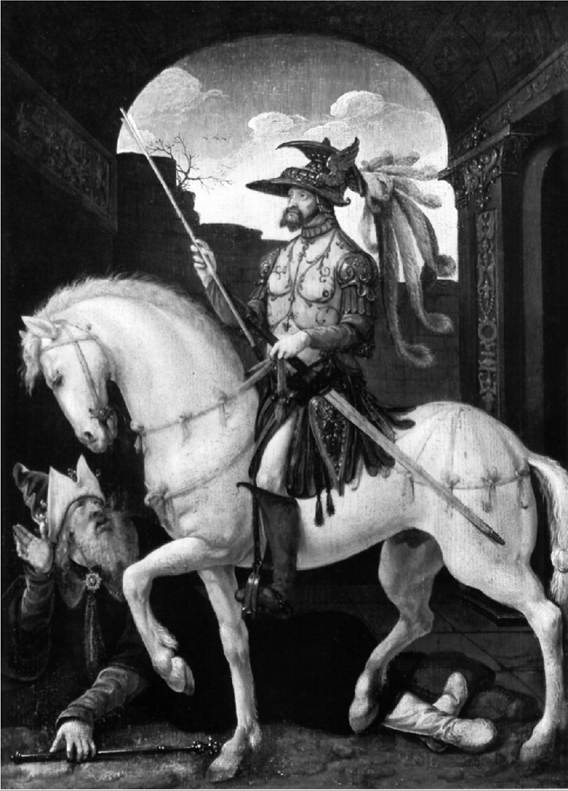
Figure 30.1 Jan Corneliz Vermeyen, Charles V as Santiago Matamoros, Spain, oil on canvas, 1538.
The popularity of Santiago among the indigenous peoples of Mexico, and the related adoption of key Spanish symbols and rituals of conquest, does not imply a total identification with the conquerors, and the inevitable ‘loss' of their indigenous identity. Santiago is worshipped because he is foreign and different from his worshippers, and this allows them to appropriate some of the prestige and the power of the Spanish conquerors. After 1533, when the Spaniards conquered the Inca Empire in the Andean region of South America, what today is Peru, Bolivia and Ecuador, the figure of the warlike apostle also enjoyed great success among the indigenous populations. In 1535 a faction of the Incas rebelled against the recently established Spanish rule. According to both Spanish and indigenous chronicles of the period, their armies had laid siege to their former capital Cuzco, now the Spanish capital, and were about to overwhelm the conquistadors when Santiago and the Virgin Mary appeared miraculously to rescue the Spaniards and their allied native troops.
The intervention of these divine figures was celebrated by Indians loyal to the Spanish side as a proof of their true Christianity and of the protection they enjoyed from them. Santiago Matamoros, the Moor slayer, was rechristened Santiago Mataindios, the Indian slayer. His portrait trampling on Indian rebels dressed in pre-Columbian garb became a fixture of colonial Andean Christian iconography. This emblem confirmed the close alliance between the Christianised Inca elites of Cuzco and the Spanish regime. In the region, the figure of Santiago also came to be identified with the Inca god Illapa, deity of thunder and patron of the imperial conquests of the pre-Columbian Incas. This identification is commonly attributed to the thundering sound made by the firearms of the Spanish conquistadors, though Santiago was associated with swords and lances, the traditional weapons of the war against the Muslims.[902] The cult of Santiago-Illapa remains widespread among native communities throughout the Andes, a proof of the continuing importance of this figure in the cultural tradition of the region.
Intercultural Emblems
The emblems of violence built around the figure of Santiago Matamoros became a key part of public life, public rituals and commemorations in both indigenous communities and Spanish society. As we have seen, they functioned as significant sources of legitimacy for the Spanish authorities and for Christianity, and also for the local native elites that reproduced them. As such, they were also open to delicate and sometimes covert political and cultural negotiations between the parties involved. The emblems were intercultural because they were produced through collaboration between Spanish warriors, priests and officials, and indigenous
authorities, artists and writers. They were also adopted by the indigenous ‘masses', both city dwellers and peasants, who employed and interpreted them in their own particular ways. This was possible because they combined Amerindian religious and political concepts and practices with European Christian ones in a multilayered discourse. They could be read in diverse ways according to the cultural and political backgrounds of participants and spectators. Thus different parties could share a public adherence to the religious figures or political representations while at the same time maintaining contrasting, even contradictory, interpretations of their meanings.
This intercultural nature was fundamental to the capacity of these emblems to function as sources of legitimacy, since they confirmed and also modified Spanish and indigenous notions of power, violence and religion. In an overt, very public way, as they were displayed in churches and palaces, related in official histories and enacted in public squares during important feast days, these emblems asserted the central values of Spanish political and religious domination. As such, they served as powerful tools of Spanish power and as clear signs of indigenous subservience and cultural assimilation.
However the multiplicity of media included in the emblems allowed for the conveyance of ‘private transcripts' regarding power and legitimacy, following the definition by James Scott.[903] Images combined Spanish and indigenous iconography and could be read differently by those versed in each tradition.
Oral and written narratives were also open to diverse interpretations. Ritual and public performances allowed the actors that participated in them to adopt the identities of other actors, so that the Indians dressed as conquistadors could actually become them and thus appropriate some of their charisma and prestige. In this way, the emblems became not only representations of the events of the past, and symbols of the prevailing order, but also powerful ceremonies that re-enacted the founding violence and allowed participants to partake in the power that flowed from it. Public discourses that confirmed allegiance to the colonial order could thus be accompanied by private transcripts that represented and defended the particular agendas of indigenous elites and emphasised their key role as political mediators between the colonial powers and the rest of the Indian population. Also, they could be used to transmit and confirm popular indigenous readings of these events that differed from those of the elites. Following Michael Taussig, we can propose that, as powerful images, texts and performances, the emblems were capable of triggering creative interpretations by indigenous subjects, and of being used for different ends through the centuries.[904]
More on the topic Santiago in the Americas:
- The Iberian Example
- Emblems of Violence in Other Regions of the Americas
- Emblems of Indigenous Origin
- This chapter analyses the way in which extreme, destructive violence between different societies has been transformed by historical memory into the foundation of a new colonial order which integrates the groups that perpetrated it and those that bore its brunt.
- Piracy in the Americas
- Acknowledgements
- Paraguay
- Antony Robert, Carroll Stuart, Pennock Caroline D. (eds.). The Cambridge World History of Violence. Volume 3: AD 1500-AD 1800. Cambridge University Press,2020. — 710 p., 2020
- Museums with Maritime Collections
- 32 A New Atlantic