The Land
Lying completely within the tropics, and north of the Equator, mainland Southeast Asia is subject to a strongly pronounced monsoon cycle: a season of heavy rains that
1 Sinopoli 1995, 160.
Michael D. Coe, The Khmer Empire In: The Oxford World History ofEmpire. Edited by: Peter Fibiger Bang, C.A. Bayly, Walter Scheidel, Oxford University Press (2021). © Oxford University Press. DOI: 10.1093/oso/9780197532768.003.0015. runs from late May and June through the middle of November, followed by a dry season from late November until the monsoon rains begin anew. The rice farming, on which nearly all inhabitants of this vast area depend, and the freshwater fish resources of the rivers are tied to this annual climatic pulse. However, the arrival of the rains is by no means a certainty, for there are occasional years in which droughts— sometimes severe—may occur, with devastating results. As we shall see, this was a phenomenon that the Khmer rulers strove to overcome by great public works.
This is a land of rivers, the most important of which is the Mekong, Asia' s longest waterway (see Map 15.1). Originating in the Tibetan highlands, the Mekong flows through southern China, touches upon Burma, passes between Laos and northeast Thailand, and crosses Cambodia to empty through myriad branches in the Delta of
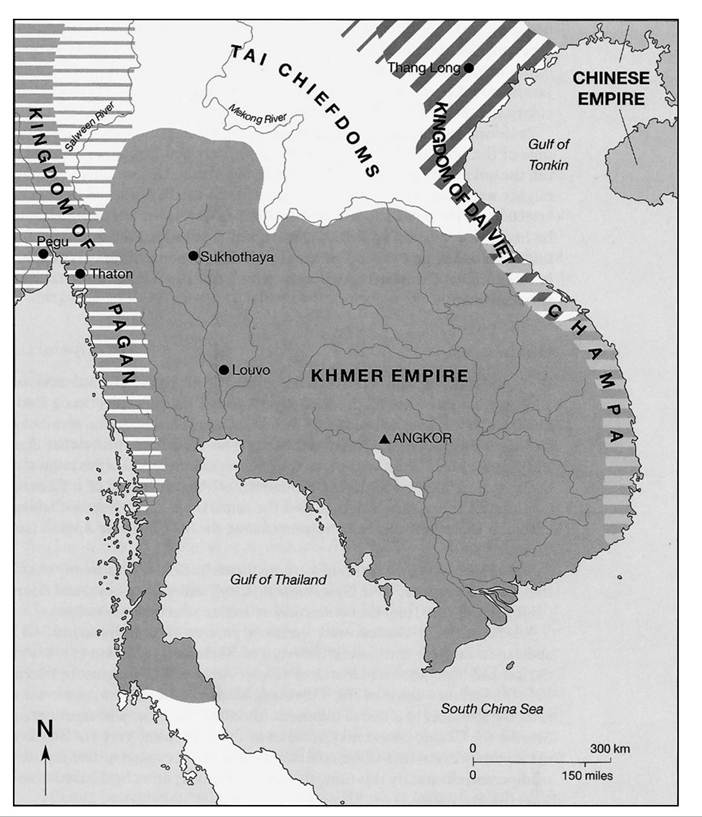
Map 15.1. The Khmer Empire under Jayavarman VII.
Source: Coe, 2003, Angkor and the Khmer Civilization, figure 63. Copyright: Michael D. Coe.
Vietnam. The Mekong is virtually a lifeline for the Khmer, and its annual cycle of flooding then falling continues to have strong effects on their livelihood.
Modern Cambodia is a lowland tropical basin. Within it is the Tonle Sap, the largest lake in Southeast Asia. Because it is very shallow, and connects to the Mekong by its own river, the Tonle Sap's size varies with the larger river's annual pulse.
As the Mekong rises during the rains, so much water is flowing through it that the Delta's channels cannot handle the runoff, and the Tonle Sap river backs up and empties into the lake, swelling it in area to four times its dry season size. The inundated forest then becomes a virtual spawning ground for fish, with the result that this great lake is recognized as the richest freshwater fishery in the world, and for at least 2,000 years has been the major source of protein for the Khmer people.The Khorat Plateau of northeast Thailand was once an important part of the empire, and is divided from Cambodia by the Dangrek range, which really forms an escarpment looking south over the Cambodian basin. Because of Khorat's relative aridity, wet rice agriculture is severely limited, the most productive land being the valley of the Mun River, which is a tributary of the Mekong. Today, Khorat is Thailand's poorest province.
Beyond Cambodia's present-day western limits lies the Chao Praya river system, which drains most of modern Thailand to the west of Khorat Plateau. Subject like the Mekong to annual flooding—which might be very severe in some years—it nevertheless supports very productive wet rice farming. Until the invasion of the Thai dislodged it, the Khmer state had incorporated all of this region into their empire.
More on the topic The Land:
- 5.04 By virtue of s 1(1) of the 1986 Act, an ‘agricultural holding’ is defined to mean the ‘aggregate of the land (whether agricultural land or not) comprised in a contract of tenancy which is a contract for an agricultural tenancy’
- II THE USE OF LAND
- 3 Agricultural land
- Certification/land titling
- 1 Aggregate of agricultural land
- 1 Land Use Planning and Nature Conservation
- The Fiscal System and the Land
- 2 Land Tenure and Management Agreements
- Georgism’s Pragmatic Land Value Tax
- 8 The Agriculture EIA Regulations – Rural Land Projects
- Chapter 43 Explaining International Land Transactions in Africa
- Governance of land rights
- 3 Land use and the Environment within the CAP
- Core natural areas should be buffered by compatible land uses
- 12.01 Many agricultural land uses are outside the Town and Country Planning legislation.
- THE LAND AND THE PEOPLE
- The twice-promised land
- Adapting to the Land: Nogai and Orthodox State Peasants
- 2 Sub-tenancies of Agricultural land