The Portuguese Empire
The Portuguese were the first European nation to use transportation as a means of populating colonial possessions. As they were also among the last to end the practice, the Portuguese state’s involvement in transportation spanned 539 years.
Convict soldiers and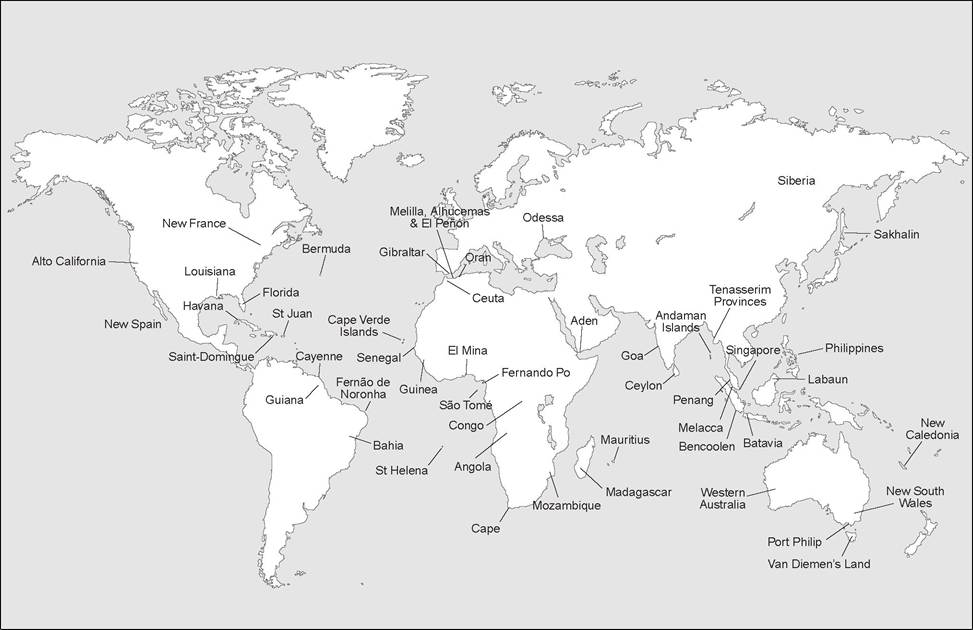
Map 7.1 European convict transportation sites, 1415-1954.
sailors were employed in the conquest of Ceuta in 1415. Thereafter convicts, or degredados, featured in the colonisation of Sao Tome as well as Angola, Mozambique, Goa and Brazil.12 Degredados were also used to man fortifications and factories in West Africa, notably El Mina.13 Those colonies associated with particularly high disease rates received large numbers of degredados; this applied particularly to Portuguese possessions in sub-Saharan Africa.14
Once the Portuguese had established an overseas empire, minor flows of convicts between their various colonial possessions augmented the transportation from the metropole. In the late seventeenth and early eighteenth century a three-way trade in convicts, vagrants and gypsies developed between Portugal, Brazil and Angola.15 Thus, among convicts in Angola in the early twentieth century, one in five came from other Portuguese colonies—notably Mozambique, the Cape Verde Islands and Goa.16 Unlike other transportation systems, the labour of degredados does not appear to have been generally used on public works projects, at least not before the latter half of the nineteenth century. Convicts were, however, commonly employed as soldiers.17 In seventeenth- and eighteenth-century Angola those that did not succumb to disease often moved into the interior, where they attempted to establish themselves as petty slavers in the Luso-African controlled trade.18 Similarly in Mozambique convicts freed upon landing frequently drifted into the interior to become sertanejos or backwoodsmen.
Others set themselves up as craftsmen and retailers or occupied petty administrative positions—a necessity caused by the dearth of alternative sources of European labour.19About 400 of the 1,000 or so colonists sent to Bahia in Brazil in 1549 were degredados.“20 As with every other Portuguese colonial possession, Brazil continued to receive drafts of convicts. As well as deporting degredados to Angola, from the 1740s onwards the Brazilian colonial authorities also shipped them to the island of Fernao de Noronha.21 Transportation to Brazil ceased only when the colony gained independence in 1822.
There is some evidence that other Portuguese settlements followed the Australian lead and set up anti-transportation movements. Penal reforms in 1852 at first limited transportation to India for less serious offenders, and then from 1869 onwards restricted the shipping of convicts to African colonies. The exile of degradados to Cape Verde and Sao Tome ended in the early 1880s and to Mozambique in 1885. Angola, however, continued to receive convicts, partially because the small size of the Portuguese population fuelled concerns that the colony would fall prey to British, French, German or Belgian imperial ambitions. In 1883 a series of purpose-built institutions (depositories) were constructed for fresh imports of degradados. At the same time agricultural penal settlements were set up in the interior, although they were soon closed because of high death rates. In 1894 an alternative plan set up a series of militarised agrarian outposts staffed by convicts. These also proved failures. Despite this, and the collapse of other agricultural schemes, it took until 1932 for transportation to Angola from metropolitan Portugal to be abolished. Even then the colony continued to receive convicts from Sao Tome, Cape Verde and Guinea until the complete abolition of transportation in 1954.22 The best estimate of the number of convicts transported by the Portuguese is 100,000.23
More on the topic The Portuguese Empire:
- Bibliographic Essay
- EUROPE’S COLONIAL EMPIRES: DISTINCTIVE FEATURES
- 39 Nations Afloat
- COMPETITION AMONG WEST EUROPEAN STATES
- PART VI THE GREAT CONFLUENCE
- Commerce, sport and empire
- Introduction
- 29 Other Routes to the Indies
- A clash of races
- Multilingualism and Hybridity