What We Do and Do not Know About the Jomon- Yayoi Transition
Before we move on to the simulation program and its outcome, we would like to summarize what we know about the Jomon-Yayoi transition from the archaeological evidence. The Jomon-Yayoi transition can be considered as a long-term process which started in the Late Jomon period with sporadic interactions between the southern part of the Korean peninsula and some areas in western Japan (Matsumoto 2002a), but the Jomon tradition of a basically hunter-gatherer lifestyle and material culture was maintained until the 10th-8th centuries BC when many aspects of Korean Bronze Age culture were adopted in northern Kyushu.
The time frame of the Jomon-Yayoi transition has been hotly debated for more than a decade since the National Museum of History released new radiocarbon dates that pushed the date of the beginning of the Yayoi period 500 years earlier than previously thought (National Museum of Japanese History 2003). While the radiocarbon dates presented by the National Museum team distribute around the 10th century BC, a number of archaeologists insist that the start of the Yayoi period cannot be earlier than the 8th century BC based on comparative analysis of archaeological evidence between the continent and the Japanese archipelago (Nakamura 2012). It is difficult to determine the exact date of the beginning of the Yayoi, but most archaeologists agree that it should be much earlier than 500 BC as had been previously proposed.This recent reexamination of the dating has made archaeologists reconsider the speed of the socio-cultural transformation from the Jomon to the Yayoi. Under the traditional framework, in which the Incipient and Early Yayoi periods are squeezed into less than 300 years, the spread of agriculture and the continental phenotype must have been quick. But with the same time periods extending more than 500 years in the new timeframe, the process can be slower.
Although migration of significant numbers of people seemed likely under the former assumption, it may be unnecessary with the latter.11.2.1 Archaeological Evidence and Questions
We have considerably rich archaeological data thanks to the huge number of excavations in Japan, most of which have been conducted by governmental institutions as a form of rescue archaeology. This wealth of archaeological information tells us that the actual process of the transition, i.e., the nature and extent of migration, adoption, or rejection of cultural information, etc., varied from region to region even in western Japan, where it had once been suggested that the spread of Yayoi culture was quick and uniform.
We will briefly introduce the following critical points of the Jomon-Yayoi transition. Although there are considerable differences regarding the details, most archaeologists agree that Yayoi culture first developed in northern Kyushu under strong influence from Korean Bronze Age culture, then spread eastward to the rest of the Japanese archipelago (Fig. 11.1). Except for some leap-frog diffusion to the Tohoku region during the Early Yayoi period, the spread of Yayoi culture halted in the middle of the archipelago for several hundreds of years. The Jomon tradition remained much stronger in eastern Japan.
Critical points of the Jomon-Yayoi transition which have been reconstructed based on archaeological data can be summarized as follows.
(1) There was a certain amount of migration from the Korean peninsula to northern Kyushu at the beginning of the Yayoi period (Nakahashi and lizuka 1998).
(2) Yayoi culture was formed by integrating traditional Jomon culture and Korean Early Bronze Age culture in northern Kyushu (Matsumoto 2002b).
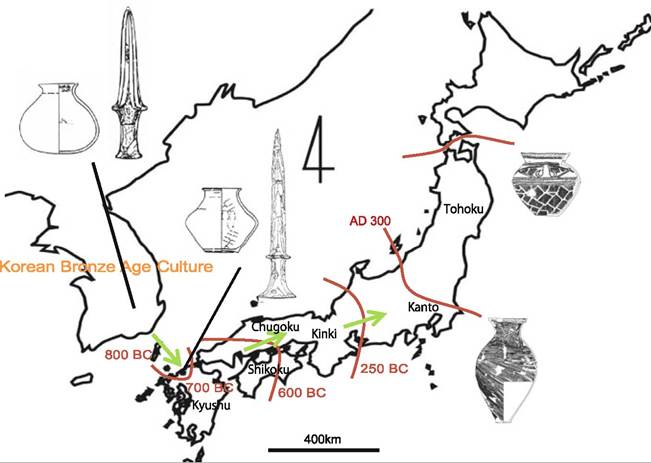
Fig. 11.1 The formation and spread of Yayoi culture. Yayoi culture was formed in northern Kyushu under strong influence from Korean Bronze Age culture, and spread to western Japan (Kyushu, Chugoku, Shikoku, and Kinki) while maintaining a certain level of uniformity.
The dates beside the red lines indicate when each border was crossed. Adapted from Kobayashi (2013)(3) Major components of Yayoi culture in northern Kyushu consist of wet rice agriculture, Itazuke type (Ongagawa-style) pottery, polished stone tools similar to those of Korean Bronze Age culture, and new burial customs also similar to those of the Korean Bronze Age.
(4) Immigrants from the Korean peninsula and indigenous Jomon groups lived in the same settlements in northern Kyushu.
(5) The spread of Yayoi culture to other parts of western Japan was achieved probably by both migration and acculturation, but actual conditions remain unclear.
(6) Several cases of the discovery of skeletal remains with a Jomon phenotype accompanied by Yayoi cultural traits indicate that indigenous adoption of new cultural elements was not rare.
(7) Some of the cultural elements such as placing stone weapons as burial goods were dropped in the process of diffusion from northern Kyushu to the Chugoku and Kinki regions (Nakamura 2011).
(8) Wet rice agriculture and Ongagawa-style pottery spread from northern Kyushu to the Chugoku and Kinki regions, a span of about 500 km, with considerable uniformity.
We can assume a certain amount of migration from the Korean peninsula to northern Kyushu at the beginning of the Yayoi period, based on systematic similarities in artifact style, technology, house structure, and burial customs. Yayoi culture was formed by integrating traditional Jomon culture and Korean Early Bronze Age culture in northern Kyushu. The earliest Yayoi pottery inherited stylistic and technological traditions from Mumun pottery of Korean Bronze Age culture, but was not the same as Mumun pottery. It represents the creation of a new tradition.
While wet rice agriculture and Ongagawa-style pottery spread uniformly from northern Kyushu to the Chugoku and Kinki regions, it is not a simple task to calculate the speed of the neolithic transition for the case of the Japanese archipelago as a whole.
In addition to the difficulty in estimating distances due to the complicated geography of the islands, defining the earliest dates for each region can be problematic as the adoption of agriculture predates that of Yayoi material culture in a number of cases in Kyushu, Shikoku, and the Chugoku region. However, even when direct evidence of agriculture, such as paddy remains and agricultural implements, is not available, the first appearance of Ongagawa-style pottery in an area can be used as an indicator of the arrival of agriculture.However, the absence of some burial customs beyond Kyushu indicates that parts of Yayoi culture were not transmitted, or intentionally rejected. Partial transformation and/or rejection of new culture are evident in eastern Japan as well, where the contents of Yayoi culture turned out quite different from western Japan.
Cultural continuity from the Jomon is evident in many aspects of finds at northern Kyushu settlements occupied by both Korean immigrants and indigenous Jomon groups, such as chipped stone tools, pottery style, and the custom of tooth ablation. Accordingly it is reasonable to assume that immigrants from the Korean peninsula did not exceed the indigenous population in number at these Incipient Yayoi settlements.
As the sociocultural processes were significantly different in western and eastern Japan, we made the heuristic decision to conduct our simulation taking the processes in western Japan as target. Also, while recognizing that decisions concerning cultural integration, and transformation and adoption/rejection of cultural elements, are certainly important factors in the Jomon-Yayoi transition, for the sake of simplicity we chose to focus only on the matter of transmission in this paper.
11.2.2 Physical Anthropological Evidence and Questions
As noted above, discoveries of skeletal remains with a Jomon phenotype accompanied by Yayoi cultural traits suggest that indigenous adoption of new cultural elements was commonplace.
In the Incipient and Early Yayoi periods, skeletal remains with a so-called continental phenotype have only been found in a restricted area of northern Kyushu, while a number of individuals with a Jomon phenotype have been found in the context of Yayoi culture. At the Shinmachi site in Fukuoka prefecture, a middle-aged woman with a Jomon phenotype and Jomon-style tooth ablation was found buried in a grave covered with a dolmen, a custom newly adopted from the Korean peninsula. At the Shinpo site in Hyogo prefecture, three burials from the Early Yayoi period were excavated, each containing male skeletal remains with a Jomon phenotype along with Jomon-style tooth ablation. One of the graves yielded 18 stone arrowheads, indicating that the man might have been shot to death (Katayama 2000). The burials were accompanied by Yayoi pottery and stone tools.It should be noted that skeletal evidence for this transitional period is rare, and it is very difficult to estimate the size and timing of the migration from the peninsula. But we do know that continental phenotypes are dominant in the Middle Yayoi period in northern Kyushu, as we have many skeletal remains from that period thanks to the practice of jar burial, which protected the bones from decay.
11.2.3 Prior Simulation Studies on the Jomon-Yayoi
Transition
Prior applications of simulation to the study of the Jomon-Yayoi transition have mostly been restricted to demographic calculations. Hanihara (1987) proposed that more than a million people must have migrated from the continent to the Japanese archipelago during the Yayoi and Kofun periods based on his simulation of population increase, assuming that the population increase from the Final Jomon to the early historical period is inexplicable without a massive influx of population. Hanihara assumed that the annual population increase rate of the indigenous Japanese population did not exceed 0.2 %. The massive migration theory of Han- inara has been criticized on two points: it does not fit very well with the archaeological data, and his assumption of the population increase rate may be too modest (Imamura 1996).
In order to clarify the mysterious gap between the modest estimation of the scale of immigration at the beginning of the Yayoi period and the dominance of continental physical features in the Middle Yayoi, Nakahashi and Iizuka carried out palaeodemographic simulations in which a higher population growth rate was assumed for immigrants (Nakahashi and Iizuka 1998, 2002, 2008). Nakahashi and Iizuka's study demonstrates that even a small number of immigrants from the Korean peninsula can lead to the dominance of continental physical features in the Middle Yayoi population in northern Kyushu that is evidenced in excavated skeletal remains. Thus they conclude that the immigrants were mainly responsible for the drastic cultural change.
While Nakahashi and Iizuka's model may provide a possible scenario concerning population dynamics in northern Kyushu, its assumptions on demographic processes may be too simple to understand the real dynamics of intermarriage and resulting genetic spread, as their simulation takes immigrants and the indigenous population separately. They do consider intermarriage of the two, but the mixed population is treated as a third category of population to which a separate rate of increase is applied. As pointed out above, however, archaeological evidence shows that immigrants and indigenous people basically cohabited the same villages and shared many cultural assets. Therefore, it seems unlikely that social categories of “immigrants” and “indigenous people” were maintained for hundreds of years and thus different population increase rates should be applied to each. In order to achieve a better understanding of the transition, we need to examine both the transmission of genetic traits and cultural skill to see how they are different but interrelated. An agent-based simulation would be one suitable method for this type of investigation.
Sakahira and Terano's approach (Sakahira and Terano 2014, Chapter 10 in this volume) is the first application of agent-based simulation to obtain new theoretical insights into the complex relationships between immigrants and indigenous people in the Jomon-Yayoi transition. Their main concern is the same as that of Nakahashi and Iizuka (1998, 2008), but they succeeded in providing a new possible scenario in which the dominance by the continental phenotype can be achieved. Their scenario posits that immigrants lived closely together in the first stage, that agriculture spread quickly, and that immigrants and their descendants were polygamous. The latter two points are highly speculative, and the first is not supported by archaeological evidence, as Sakahira and Terano have noted.
11.3
More on the topic What We Do and Do not Know About the Jomon- Yayoi Transition:
- Chapter 11 Cultural and Genetic Transmission in the Jomon-Yayoi Transition Examined in an Agent-Based Demographic Simulation
- Chapter 10 Revisiting the Dynamics Between Two Ancient Japanese Descent Groups: What Happened from the Jomon to the Yayoi Periods in Japan
- This chapter examines the origins and early history of violence in the Japanese islands, focusing on the Jomon (c. 14,500-900 bce) and Yayoi (c. 900 bce-250 ce) periods.1
- Transition to Inpatient PFCC
- Transition to Inpatient PFCC
- Period of transition, 1340-1387
- The Oslo transition: advocacy and protest
- Political Protest and Collective Violence: Models of Transition
- The U.S. demographic transition
- 30 The Troubled Transition
- Transition to the Plantation
- The Imperial Transition
- FETAL TO NEONATAL TRANSITION
- Transition of Interpretations, 1992-95
- Transition of Interpretations after 1995
- Transition of Care to Adult Services
- Policy episodes and transition paths
- PART THREE VIII A Period of Transition
- The Troubled Transition to 30 Years of Peace
- Interim inequalities and features of the transition