Bhopal Gas Tragedy
On the night of 2nd December 1984, the world’s worst ever industrial disaster took place in Bhopal, India. It is also known as the Hiroshima of the chemical industry because of the death toll and the suffering it caused, 27 tonnes of methyl isocyanate and other deadly gases were released from the Union Carbide’s pesticide manufacturing factory in Bhopal.
The methyl isocyanate was used in the manufacture of the insecticide carbaryl which was marketed under the commercial name Sevin. The sequence of the reactions involved is as follows.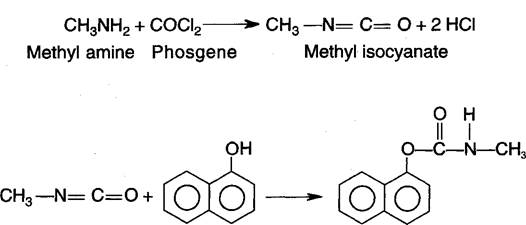
Methyl isocyanate, which was stored in the tanks, leaked and the cloud of the gas gradually spread over a large area of the city killing about 4000 people and affecting thousands of others. Approximately half a million people were exposed to the leaked gases and at least 22,000 have died so far because of the effects of the exposure. It is estimated that about 120,000 people are suffering from serious long-term health effects. The number of deaths as reported at that time is much below the actual number because the deaths continued to occur due to the long-term effects of the exposure to the gas. In fact, one person dies per hour because of these long-term effects of exposure.
The leakage of the gas caused irritation in the eyes, nose and mouth of the people. The people felt the burning sensation and some of them felt as if some one was frying chillies. They started coughing and froth streaking up with blood from their mouths. They started running here and there. Some had convulsions and died while the others lost control over their senses and urine and faeces fell from their legs while they were running. Even, the people ran over the dead bodies of the others.
It seems that water had entered into the largest tank containing methyl isocyanate (MIC).
Unfortunately, none of the six safety systems were operational and the plant siren had been turned off, see Fig. 15.1. The vent gas scrubber was also turned off otherwise the leaking gas could have been detoxified. The pipe connecting to the Flare tower had also been removed for maintenance. The refrigeration system for cooling liquid MIC was shut down in June 1984 to save money. Out of the three storage tanks, tank E 619 was empty while the tank E 610 contained 40 tonnes and E 611 contained 15 tonnes of the gas. On that disastrous night, water entered into the tank E 610 and an uncontrollable exothermic reaction began. The tank was blown out of its concrete sarcophagus and a deadly cloud of MIC, hydrogen cyanide, monomethylamine and other chemicals spread out over the city of Bhopal, see Fig. 15.2.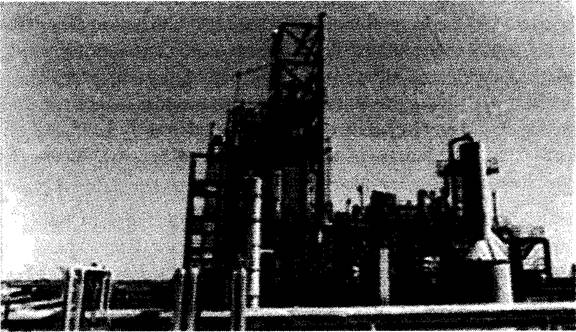
Fig. 15.1: Union Carbide Plant
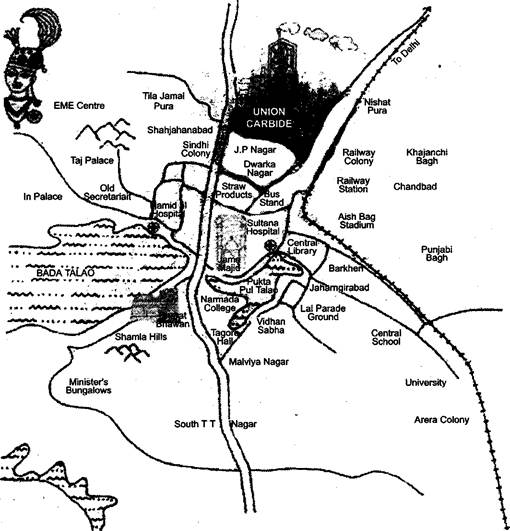
Fig. 15.2: Area affected by Gas Leak
Fig 15.2 shows that the toxic gas affected major part of the city. Out of the 56 wards, 36 wards were affected. Out of the total estimated population of 8,94,539 Hving in 56 wards in 1984,5,559,835 people were affected. The Hvestock were also killed in large numbers. The reHef operation were started immediately. Both the State and the Central Governments came into action. The NGOs also helped a lot. It was soon realized that exclusive administrative machinery would be needed to tackle the situation arising out of this disaster. The ad-hoc administrative machinery was immediately created and a Department of Bhopal Gas Tragedy ReHef and Rehabilitation was created in early 1985. It is under the charge of a Cabinet Minister of the State Government. A Directorate of Gas Relief and Rehabilitation has also been set up.
The State Government provided an immediate relief of Rs 1 crore. A compensation of Rs. 10,000 per person was paid to the family members of the deceased victims which amounted to Rs.
3.78 crores. Ex-grαtiα payment for the death of animals costed Rs. 0.25 crores. A total of Rs. 36.03 crores was spent by the State Government.As on March 2003, 10,29,515 cases for claim and compensation were registered. About 1529 crores were spent for the compensation. The claim applications were filed in two phases. Their details are as follows:
Table 15.1 Details of Claims
| S.N. | Category | No. of Claim Applications Yearwise | ||
| 1. | Claim filed for personal injury (01) | 1985-89 | 1996-97 | Total |
| 5,97,908 | 4,03,815 | 10,01,723 | ||
| 2. | Claim filed for loss of Live stock (02) | 612 | 46 | 658 |
| 3. | Claim filed for losses suffered by commercial/ business establishments (03) | 4,745 | 156 | 4,901 |
| 4. | Claim filed in Death cases (04) | 15,310 | 6,839 | 22,149 |
| 5. | Claim filed for losses incurred by Central/ State/ Governmental/ Non- Governmental Organizations (05) | 84 | - | 84 |
| Total | 6,18,659 | 4,10,856 | 10,29,515 | |
The Union Carbide took moral responsib∏ity but never the legal IesponsibHity since the plant was operated by a separate Indian subsidiary, Union Carbide India Limited (UCIL)ZUnion Carbide owned 50.9% of UCIL’s shares at the time of the accident.
UCIL did some clean up work but the job was not completed. The plant site was later bought by another Indian company, Eveready Industries India Limited. The site is now under the legal responsibility of State Government. In 2001, a US Multinational company Dow Chemical acquired Union Carbide, thereby acquiring its assets and liabilities. However, the Dow Chemical has refused to clean up the site, provide safe drinking water, compensate the victims or disclose information about the health effects of the leaked gases. The Union Carbide agreed to pay $ 470 million as compensation in 1989. However, the victims were not satisfied by this compensation of $300-$500 or about 5 years worth of medical expenses. Since the victims were not consulted in the settlement discussions, they felt cheated by such small compensation.Even after about 20 years of the accident, thousands of tonnes of toxic waste abandoned by the Union Carbide in and around the plant continue to contaminate the environment. The poisonous and cancer causing chemicals leach into the ground water sources which supply water to about 20,000 people. A study in 2002 by the Fact Finding Mission on Bhopal revealed the presence of dangerous toxins, 1,3,5-trichlorobenzene, dichloromethane, chloroform, lead and mercury in the breast milk of mothers living around the area. The soil samples were also found to contain lead, nickel, copper, chromium, hexachlorocyclohexane and chlorobenzenes. In some samples, the mercury was found to be 6 million times the expected level.
According to some of the workers of the factory, massive amounts of chemicals formulated in the factory such as solvents, catalysts, wastes and pesticides were routinely dumped in and around the factory grounds. These included dangerous substances such as aldicarb, carbaryl, mercury, chlorinated chemicals and poisonous organic substances. The Union Carbide constructed Solar Evaporation Ponds (SEP’s) over 14 hectares of area where the toxic effluents and wastes were routinely dumped.
Later, a study in 1990 revealed the presence of di-and tri-chlorobenzenes in the water samples taken from the wells near the factory area. The soil samples from the SEP’s also showed the contamination by phthalates, chlorinated benzenes and aromatic hydrocarbons. The contaminated ground water and soil is posing a lot of threat to the people of the Bhopal city. Recently, the task of conducting a survey for the disposal of toxic wastes lying in the factory has been assigned to the Engineers India Limited (EIL). Similarly, the State Government will conduct a fresh survey to test the presence of contaminants in drinking water supply.
The contamination in the soil and water is found to be ten times higher in the area near the factory as compared to rest of the places. Since the contaminated ground water is heading towards the north, in contrast to the movement of MIC towards the south because of the wind direction, the population which was not much affected by the MIC is at a complete risk due to toxic substances present in the ground water. The long-term effects of the accident have also started appearing as the new generations of children with various defects are being bom.
Although the civil suit was settled in 1989 for the lump sum of $ 470 million, a criminal trial against the company and its officials is pending for decisions even after 15 years. The process has taken so long that the settlement fund has nearly doubled in the value and amounts to $ 33 million as the interest.
The charges against the Union Carbide’s then Chairman Warren Anderson, other top officials and the Corporation were filed in 1991 but they failed to appear in the trial proceedings and have been proclaimed absconders by the Court of Chief Judicial Magistrate (CJM) in Bhopal. After more than 10 years, Anderson was found in August 2002. The Indian Government then submitted an official request for his extradition in May 2003 which was rejected by the US government in July 2004. The request, however, can be resubmitted.
Also, on 21 July 2004, the Chief Judicial Magistrate of Bhopal dragged Dow into a criminal case by asking its Indian subsidiary to answer the summons. The Dow Chemical maintains that the liabilities, if any, would still belong to the Union Carbide. However, the settlement with the Union Carbide solely dealt with the disaster related damages caused to the residents of Bhopal and not the environmental liabilities and the pollution caused by the toxic chemicals.On March 17 2004, the Second Circuit Court of Appeals in the United States sanctioned further property damage, environmental remediation and personal injury claims against the Union Carbide in the lower court. On June 28 2004, the Indian Government in its official letter asked the Court to hold Union Carbide liable for environmental remediation at the site.
This case of hazardous gas leak was not the first in the history of operation of the Union Carbide plant in Bhopal. Right from the beginning, the Company did not manage the affairs properly. It decreased the proposed amount of $28 million to $20.6 million and used unproven and untested technologies. Since the plant did never attain its full capacity, it ran into losses and the Company systematically cut cost by compromising on the safety and maintenance systems.
Several incidents of leaks were reported from time to time. On 25th December 1981, the leakage of phosgene killed one worker while another leakage on 9th January 1982 led to hospitalization of 25 people. Yet another leak on 5th October, 1982 affected hundreds of nearby residents leading to the hospitalization of many people. These issues were raised in the State Assembly and were also brought to the notice of the officials of the company. The State Government at that time decided to shift the plant to a less polluted area. Various reports about the potential dangers from the leakage appeared in the press from time to time but nothing was done seriously and the accident actually happened leaving its trail for decades to come.
Such incidents of accidental release of hazardous and toxic substances due to improper handling, lack of safe operations and poor technical maintenance of the plant raise several issues related to the liability for compensation, management of the long term effects of such disasters on human health and environment etc. Although the wheel of time cannot be reversed as those who died cannot come back. Various families lost their earning members and face both economic and social crisis. There are yet thousands of people who are not able to earn their livelihood because they cannot move and work properly. They still wait for justice and are there to face the pain throughout their lives.
15.3