“life was a little better for us locals”
In Sharhorod today, there remains a myth that those who survived in the town did so thanks to the spirits of the two holy men buried in the cemetery. When we visited, the gravestones of Naftali-Herts ben Aaron and Avrom ben Meir were singled out for special honor—their trim had been painted blue and a blue fence surrounded them.
In the years since, Hasidic pilgrims from Israel have erected a chapel around the graves to better shelter them from the elements and protect them from marauders. Asya Barshteyn told us that people used to come from all over the world to visit the cemetery and seek protection from the righteous ones buried there. She told us that the government had wanted to remove the graves of the tsadiks. “Go ahead,” the Jews said, “we won't stop you.” But the officials were too frightened of the spirits, and left the graves in place. Most of the residents we spoke to dismissed the role the tsadiks played in protecting the town as a fairy tale, but all agreed that with respect to the types of mass killings that took place in hundreds of Ukrainian towns during the Second World War, in the words of Feyge Rivelis—“there was none of that here.”Abram Vaisman does not know why neither the Germans nor the Romanians killed the Jews en masse. Many believe, he told us dismissively, that the city was spared because of the holy men buried in the cemetery, but he insisted they were saved because of the kindness of their Ukrainian neighbors: the “Ukrainian people” (Ukraynishe ment- shn) or the “uncircumcised,” he tells us using the Yiddish areylim rather than the more familiar goyim (nations). Although goyim had long been the normative term used by Jews to refer to Ukrainians, some of those in the younger generation had come to regard it as pejorative. Born in 1940, Vaisman was among the younger of those we interviewed, and was more sensitive to the term's usage.
As a result, he sought other terms to describe the Christians who helped Jews during the war. One woman in particular—Ksenia Vasilovna Loyanich—helped Jews by bringing them food every day. He repeated her name again for us, very slowly, to be sure that we recorded it accurately. Certainly, he told us, many Romanian Jews deported into Sharhorod died of hunger during the war, but the Romanians did not kill the Jews in Sharhorod: “Life was a little better for us locals.”The Sharhorod ghetto was established in September 1941 and immediately became a refugee center for approximately 3,000 Bukovinian Jews, mostly from Suceava and Dorohoi, who were transferred into the city in October. The Jews of Suceava, led by Dr. Meir Teich, had arrived in Sharhorod in better condition than many other deportees, as they had managed to bribe Romanian officials at the crossing into Mohyliv- Podilskyy to take them the rest of the way in a truck and wagons rather than by foot.25 The influx of refugees swelled the Jewish community of Sharhorod from the 1,800 people who had originally lived there to a high of 7,000 in December 1941. The community developed a reputation for being relatively welcoming to the new refugees. According to witness testimonies, when Jews from Dorohoi were passing through the city, the Jewish community appealed to the Praetor to allow the Dorohoi Jews to stay rather than be sent further north to an unknown fate. The community even took in Jews who had fled across the Bug from the Reichskommissariat Ukraine, despite the knowledge that the entire community would be at risk if these refugees were discovered. When searches took place, those in hiding were concealed in the catacombs underneath the city. Remarkably, even local Ukrainian peasant women interceded on behalf of the refugees from Dorohoi: “Many of the Ukrainian peasant women who had come to the market crowded around the deportees and gave them food for the journey. Arriving in front of the Praetor's office, the women knelt down and blocked the road...
the peasant women cried and screamed, raised their fists against him [the Praetor] and shouted: ‘... How can you be so hard against human beings?'”2® In the end the Dorohoi Jews were permitted to stay. Seven thousand people huddled into 337 houses and settled down for what was to be an exceptionally cold and disease-ridden winter.The Romanian Jews who had been transplanted into the ghetto brought with them their religious traditions, leading to a revival of spiritual life. Asya Barshteyn explained, “During the time of occupation, people came from Romania and from Poland, who were sent here. They were sent here from their towns. Among them were people—a rebbe and a rov—who prayed in the Great Synagogue.” The Great Synagogue of Sharhorod, which had been closed by the Soviet government before the war, was reopened for the High Holy Days of 1942 and remained open for the duration of the occupation.27
The Romanian Jews also brought money and valuables that they used for bribing Romanian occupation authorities, saving individuals from forced labor and deportation to concentration camps. Klara Kurman remembered, in particular, Meir Teich. He died, as she put it, in “Yid- dishland, or what do they call it—Palestine.” According to Teich, who published his own version of events after the war, “In the case of lighter local labor service we allowed people to buy themselves off. We thereby created a fund with which we provided well-paid jobs for volunteers. But no buying off or furnishing of substitutes was allowed under any circumstances for heavy labor, especially when it involved working outside the area.,,28
The Romanian deportees, who had arrived after enduring forced marches and living in squalor along the way, also often brought disease with them into the ghettos. Within these towns, a massive typhus epidemic began to spread as the winter of 1941 set in. Epidemic typhus was always a threat in overcrowded conditions; the disease ran rampant in Nazi concentration camps, claiming the lives of thousands of prisoners, including famously Anne Frank and her sister Margot.
The disease is caused by the Rickettsia prowazekii organism that spreads through lice. As the louse feeds on the human who carries the bacillus, the bacillus grows in the louse's stomach and is excreted in its feces. When an infected louse bites another human, the disease is spread when the bite victim itches, releasing the feces into the wound. The disease begins as a rash on the chest that spreads to the trunk and extremities, accompanied by a high fever. In its late stages, victims often become delirious. Inadequate hygiene thereby contributed to the typhus outbreak in Shar- horod: the small town's population had quadrupled in six months: there was inadequate sanitation and overcrowding, and the ground was too frozen for the dead to be buried properly. About a quarter of the inhabitants of Sharhorod-ι,449 people, according to official figures—perished, mostly of typhus, during the winter of 1941-1942.29 Similarly, about ten thousand people—half the ghetto population—perished in the Bershad ghetto during the winter of 1941-1942, mostly from hunger and typhus. Asya Barshteyn remembered that there were so many people dying in the ghetto that a man would come around once or twice a day with a horse-drawn cart to collect the frozen bodies that had been laid outside the houses.The disease was finally brought under control with the spring thaw. In Sharhorod, a Jewish burial society buried the victims of the winter epidemic. In addition, the Jewish community set up a hygiene and delousing service and a soap factory; they also cleaned the wells and distributed antibiotics that arrived from Jewish aid organizations in Bucharest.30 Thereafter, the death toll in the Sharhorod ghetto declined significantly. During this time, the overcrowding in the ghetto was brought under control as about 1,000 people were relocated to neighboring settlements in June 1942, and in May 1943 another 175 Jews were taken to work camps near Mykolaiv. In September 1943, a total of 2,971 Romanian Jews remained in the city, in addition to the local Jews?1
“no one knew where to, where we were going”
Romanian authorities panicked at the typhus epidemic of late 1941, and, in some regions where the epidemic was already rampant, responded with extreme violence: in the last weeks of 1941 and first months of 1942, some 48,000 Jewish prisoners, mostly deportees from Bessarabia and Bukovina, were massacred in camps set up in Bogdanovka and Domanevka, in the Golta region of the southeastern part of Transnistria.
The authorities justified the massacre as a means of preventing the spread of the disease and of protecting supply lines to the north. The massacre was also the culmination of a eugenics and purification mentality that had pervaded Romanian political and social LhoughtThIn northwestern Transnistria, the Romanian authorities sought to protect their soldiers and supply lines from the spread of the disease, and so decided to isolate the Jews, whom they believed were its carriers. In December 1941, the Jews of Tulchyn, who had been languishing in the city's ghetto for the first months of the war, were ordered to report for disinfection and relocation. Pinia Golfeld explained: “On December 7, 1941,33 they gathered everyone on one street and took them into a school and said that the Jews were carrying disease.” They were kept there for three days. Yente Kolodenker described the situation in the school:
When we were brought into the school—what can I say? There was nowhere to stand. Imagine fitting all of Tulchyn into one courtyard, is that possible?! But they were pushing everyone inside. People wanted to drink something. It was raining then, and between the puddles there were little streams. We went outside the school, because they allowed people to walk around. We scooped up the water from the puddle and drank it. And the children were whining because they wanted to eat. There was such a tumult and screaming. The Romanians would shoot every minute.
Sasha Kolodenker described the experience as having been like sardines packed together, one lying on top of the other: “They gathered everyone in the Ukrainian school. They threw us out of our homes and stuck us into different streets in Tulchyn. Then they took us in into the school. [Then] they needed to bathe us, to disinfect us. Some people escaped; some stayed in the bath. From there they drove us into the camp.” Others told of how the Jews were counted and their names were recorded before they were forced into the school.
One eyewitness wrote that before they were put into the school, the Jews were forced to hand over their valuables as a “redemption.’^4 Nisen Yurkovetsky told us that some of the men of means were able to hide their valuables in cellars and then left for the camps in rags.After they were gathered together and counted in the school, 3,005 Jews from Tulchyn were taken to the city's baths to be disinfected?5 According to Golfeld, “There they gave us injections. There was this doctor, Biletsky, a Christian, and he said to the Germans that the Jews were all carrying infections. They gave us injections in the bath and then led us again into the school.” Pesia Kolodenker added:
They set up a clothes boiler. They made everyone undress, naked. There were no men because they were all in the army. But there were children of thirteen, fourteen years, very old people, and women. They stood there and they were embarrassed in front of each other. So, they covered each other up so that nobody saw their nakedness. The Romanians and the police stood there and laughed at the Jews.... Afterward they took out their clothes and they were left entirely in rags. They didn't have anything to wear. They [The Romanians] had burned them [the clothes].... Whatever they could get, they put on; otherwise they would have been left entirely naked.
Rita Shveibish, a child survivor herself and local amateur historian, attributed the typhus epidemic that later spread through the region to the injections: “They made it so that we would become sick with typhus,” she told us, alluding to a theory that the Romanians purposely infected the Jews with typhus.36 In fact, the Romanian authorities were alarmed by the typhus epidemic and were adamant in their desire to create a typhus- free corridor through Transnistria as a military supply line. It was, in part, out of fear of the spread of typhus that the decision was made to further isolate the Jews from general society and therefore to liquidate the ghetto of Tulchyn. A group of 118 artisans—bakers, tailors, cobblers, and others with specialized skills—were kept in the ghetto while the rest of the Jews were driven out?7
Gerhard Schreiber, a deportee from Chernivtsi, arrived in Tulchyn sometime after the liquidation of the ghetto and in a written memoir described what the largely emptied town looked like:
The Jewish ghetto, as it was called, comprised one street with small individual houses, about 250-300 yards long. Our group, about 100-120 people, found shelter in either empty houses with windows and doors, or with the local Jewish families. These were the few remnants of a larger Jewish community, who had survived the mass killings, which occurred when the Germans occupied the city.38 They were retained by the Romanian authorities, because of their skills, since most skilled craftsmen had left with the retreating Soviet troops. There was a dentist, a dyer, a watchmaker, a capmaker and a few others. The dyer was the most prosperous of them, his business extended over two houses, one could see the colored fabric being hanged out to dry from afar.39
By 1943, the community in Tulchyn began to receive some aid from the Central Jewish Board in Bucharest and, according to Schreiber,
With some help from the authorities, an empty schoolhouse, located at the end of the street the ghetto was located on, was transformed into a crafts center. There were workshops for various trades, such as locksmith and metalworking, tailor, watchmaker, capmaker, dyer, housepainter, carpenter, and a few others. When the center was officially opened, the Romanian civilian authorities brought along all the German and Romanian military brass, who apparently were quite impressed. Many of them later patronized these shops.40
After the majority of the Jews of Tulchyn had been taken into the baths and counted in the school, they were forcibly marched through the town along the village road—“no one knew where to, where we were going,” recalled Pinia Golfeld. “Whoever wasn't able to continue walking, was shot right away,” Pesia Kolodenker added. Rita Shveibish told us that there were policemen with large dogs guarding them on motorcycles and horses. They marched for two days, spending the night in the village of Torkiv. Golfeld remembered “they drove us into a kolkhoz where there had once been cows and horses, into a stable, and we spent the night there. And in the morning, there was a tumult. The first people already died there. It was also cold and wet. They passed away. In a word, they buried them there on the road.”
The three thousand Jews of Tulchyn eventually arrived in the town of Pechera, where, set on a cliff overlooking the Southern Bug River and surrounded by parkland was a three-story Romanesque palace that had once belonged to the Potocki noble family, but had been used as a sanatorium for tuberculosis patients by the Soviet government. It was an ideal isolation ward for quarantine purposes. Pinia Golfeld explained, “They led us to a place. They opened a gate, there was an iron gate. And there had been a sanatorium there in Pechera, a tuberculosis hospital. They forced us through the gate, and the Jews ran like mice into the hospital wards. They didn't heat the wards. And they lay down on the floor; that's how the people slept.”
The Jews of Tulchyn and surrounding towns were dumped in the building and left to their own devices. This was not a labor camp nor technically a death camp—although death rates were exceedingly high. Rather, it was simply a de facto concentration camp, a place where the Romanians could quarantine Jews to prevent the typhus epidemic from spreading. Over the course of the next months, additional shipments of Jews were brought into the camp, including about 750 Jews from Bratslav who were brought to the camp in January 1942, and several hundred more who arrived over the next few days from Ladyzhyn and Vapnyarka. Sporadic deportations into Pechera continued over the summer and fall: about 3,500 Jews from the Mohyliv-Podilskyy ghetto were deported to
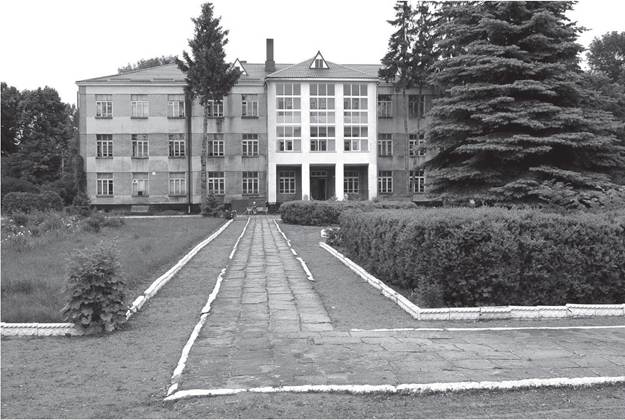
The sanatorium that was used as the Pechera concentration camp during the war as it looked in 2009. The building is back in use as a sanatorium. Photo by Artur Fmczak.
Pechera in two waves in July and October-November 1942. Many inmates of the camp were Bessarabian and Bukovinian Jews, whose long forced exodus from their homes in Romania finally ended here. In total about 9,000 Jews were held in Pechera.41
“she was still twitching”
Frida Pecherskaia, together with her mother and two sisters, was brought to Pechera from her native Bratslav. Her brother and father had both been drafted into the army before the Germans arrived in town. Her brother died at the front at the age of seventeen; her father survived. Her youngest sister, who was only six months old when they were taken to Pechera, died within a week of their arrival in the camp. Her other sister, Rivele, was also dying of hunger but had not yet succumbed when she was taken to be buried. The Jewish inmates charged with collecting the dead took her alive and threw her onto the cart of corpses: “They took her—she was still alive—our people, the Jews, they took her by the hand and threw her onto a pile of corpses. My mother and I were screaming so loudly. She was still twitching. They closed it [the cart] and there was nothing we could do.”
The Bessarabian and Bukovinian Jews who sometimes arrived with valuables were initially better off and able to trade their jewels for food. This created resentment between the two communities, some of which persists to this day. Rita Shveibish told us, “The Bessarabian Jews and the Bukovinian Jews were a little better off than us, and so they supported the people. People shared. There was a Judenrat, but they were not good at all. They were only for themselves. They didn't treat the people well at all. The only people who saved us were the elderly non-Jews.” Sasha Kolodenker has a kinder interpretation of the Romanian Jews who worked with the Germans, recognizing that they were working under compulsion: “They were forced to. They were taken to work and killed as well.”
Once the Romanian Jews ran out of valuables, the local Jewish communities had the advantage of knowing the terrain and the local language. Pesia Kolodenker cited her memory of a particularly beautiful young Bukovinian girl she encountered in Pechera:
A very beautiful girl came into the chamber. She was no more than sixteen years old. What a beautiful girl and so well dressed. It was obvious that she belonged to a wealthy family. But she didn't speak any Yiddish, only Russian. She said to us: “Have mercy on me. Give me some bread. I don't know if I can even eat any bread, but I just want to try once. Give it to me please.”
Nobody gave.
“Where's your mother?”
“My mother already died of hunger,” she said.
When they went looking for the girl sometime later, she had already died. Those without family to protect them and to share the little bread and potatoes they could acquire were condemned to starvation. The wealthier Bukovinian Jews may have had the advantage of having something to trade, but once that ran out, they were worse off than the locals, who had more “of their own” to rely upon and were more accustomed to living with starvation.
Throughout 1942-1943, the death rate in Pechera rose. Yente Kolo- denker's father was forced to work as a gravedigger: “They forced my father to bury the dead people. They gathered people to work as gravediggers; he would go out to the field where they had to bury people. The non-Jews brought him food. He would bring it home.” She paused at the irony of calling the camp home: “‘home'—to the camp,” she spat out. Pesia Kolodenker told us, “They transported the corpses in a hay cart to the place where they were buried. They threw in the corpses. Somebody's hands or somebody's hair would fall through the slats. The wheels rolled and the corpses moved back and forth.”
Thousands succumbed to hunger and disease: “There was no food, nothing to drink. Nothing. I don't know how we survived,” recalled Pinia Golfeld. Pesia Kolodenker remembered one time when the potato peels she had painstakingly foraged were stolen from her: “We suffered from such hunger. We were so proud and really looked forward to having those peels fried,” she lamented. Yente Kolodenker told us that her father had three sisters and seventeen nieces and nephews with him in the camp—“What a joke!” she said, “How could he possibly have given food to everyone?” She described how they would fight over how to divide a potato between them. Once, her sister managed to get two potatoes: “She wanted to eat it herself, but she shared it.” She divided it not only among the family but also with a stranger, a “woman with a coat,” who approached, begging for a bite.
Stories of cannibalism recur throughout testimonies of Pechera. Pe- sia confided: “A woman was lying there [next to] a dead person. She was holding something—I thought maybe a small child. I went closer. She was right next to the dead person. She ran after me like a dog, so I escaped. She was eating him.” She told us that when a verification commission came to take testimonies after the war, the officials refused to believe that the hunger had reached such levels.
One great irony of the camp was that it was so scenically situated, on a cliff overlooking the river as it flowed past rapids around a bend. The sound of the water rushing past the rocky bend could be heard above in the barracks. The river taunted those in the camp with an abundant source of fresh water and fish, which were denied to the prisoners. The river divided Romanian Transnistria from the German Reichskommis- sariat, and German soldiers stood watch on the other side of the river, well within bullet range. Donia Presler told us about how difficult it was to obtain water, about how people would scour the camp for any type
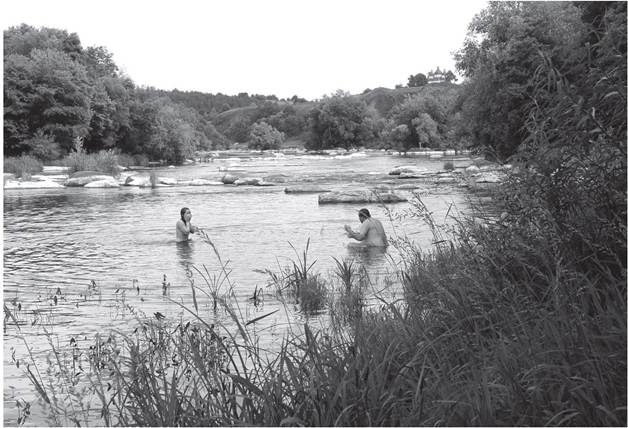
The Southern Bug River at the base of the Pechera concentration camp. The camp was on the right bank, which was under Romanian rule, and the Germans were stationed on the left bank, opposite the camp. The starving and thirsty inmates of the camp were not permitted to drink from the river. Today, it is a site of leisure for bathers. Photo by Artur Fmczak.
of container—a jar, a can, a broken pot—and sidle down the cliffs to the water in the darkness of night. German search lights from the village of Sokilets across the river, would watch the prisoners. The Germans shot at anyone they saw on the Romanian side. Pinia Golfeld told us “people would go down to the Bug to get a bit of water, but the German police stood on the other side and shot. Whoever they saw, they shot.” Pesia Kolodenker told us of one woman who had somehow obtained a piece of bread from the German side for her two starving children and was trying to cross back over. From the hill above, Kolodenker and the other prisoners could see the woman's body floating in the water. “Her white undershirt was full of blood—she had been shot in the heart.” A gendarme came and told them to get the body out of the water and bury her. Kolodenker told us that the woman's children survived two more days before dying. “I saw it myself,” she concluded.
Some Ukrainians collaborated willingly and stood out among the inmates for their cruelty. A Dr. Biletsky, who oversaw the initial deportations from Tulchyn, is remembered as being particularly callous. Yente Kolodenker told us about one episode: “a doctor came, Biletsky, and he asked how many people died. They told him... and he said ‘that's not very many.' It was the big frost. We didn't have heat. That year it went down perhaps to forty degrees below zero. He took a stick and broke the windowpanes so that more people would freeze to death. He was that kind of bandit.” Sasha Kolodenker remembered the same story, but added that the death rate before he broke the window was about three hundred people per day. In her telling of this act of cruelty, Yente was particularly enraged that the doctor “was one of ours,” a Soviet citizen, who was working for the Germans. After the war, though, she was consoled that he was tried and imprisoned for his collaboration.
Donia Presler told us that at one point her older sister, Tsirl, who was about eighteen at the time, managed to get out of the camp and make it all the way back to her native Tulchyn. Presler and her sisters would occasionally sneak out at night and beg for food in the village. She told us that Tsirl didn't look Jewish and when she put on a Ukrainian scarf could pass for a Christian. Once, sometime in 1942, her sister decided to flee together with another girl, Roza, back to Tulchyn, where they figured they could obtain some alms from the better-off Jews in the ghetto. Presler told us that when Tsirl and Roza arrived in Tulchyn, “they [the Jews in the ghetto] didn't even want to let them through the door.” Tsirl and Roza could see milk and bread on the table, but the Jews in the ghetto were not willing to help the girls other than give them some pocket change—“50 kopeks, a half mark.” Nobody was willing to take them in: “They'll kill us because of you. Why did you come here? Go, go, go!” was all they heard. Reflecting upon this episode in her interview with the Shoah Foundation, Presler commented that “those who lived in the ghetto didn't know the camp. They didn't suffer like we did.” Tsirl decided to turn instead to an ethnic German, Zhenya Malina, who had been a close friend of the family's before the war: she was “with the Jews,” in Presler's words. Malina took the girls in, washed them, and fed them. Presler related to us that Malina went to the ghetto to rebuke the Jews, telling them they should be ashamed of themselves for failing to help the girls from the camp. In the end, Malina helped the girls collect some more money from the Jews in the ghetto, and led them to the village of Tarasivka, on the way to Pechera, where she left them on their own. The girls started to make their way back to the camp, but were captured by a Romanian brigade of police in the village of Bortnyky. According to other testimonies, the police officer stationed in Bortnyky, a man by the name of Mukha, was particularly evil.42 The police, who had also captured some Romanian Jewish men who had escaped from Pechera, executed the men, but took the girls back to the camp.
At this point, Presler continued the story as an eyewitness. She remembered the police coming into the camp and gathering all the prisoners to tell them that the next day there would be a “show trial:”
We saw how they brought in my Tsirl and Roza and led them into the camp. This is how they brought them: they took a horse from [the village of] Bortnyky. And they tied both of them to the horse. The horse went off at a gallop and they ran after the horse. The Romanians drove. One or two Romanians in a horse-drawn machine gun platform, and the police were on the horse. And the horse stepped on Roza's foot and her entire leg was ripped open up to her shin. And she was running in the sand like this and the blood was spurting out like a fountain into the mud. They brought them into the camp. She quickly collapsed. After two hours, she died. And they interrogated my Tsirl. They asked her who her mother and her sister were.... They didn't bother with me. I was only twelve years old, but I could pass for five.... They took my mother and they laid her down. And they began to whip her. One whipped from one side; another whipped from the other side. Blood was running from her mouth, from her body. Blood was gushing from everywhere. Then they took my older sister. My older sister became a little [crazy] from the camp.... They beat my older sister as much as they could. Then they took out coals and forced her onto her knees And they gave her a stool that she had to
hold up like this. And then they pummeled her.... They forced her onto her knees and poured out coarse sand with pebbles, and then they forced her onto her knees. And Tsirl was no more: no face, no head, no hands, no feet.... She was spurting blood for a half-year. And that was her ordeal.
More on the topic “life was a little better for us locals”:
- Life tables can be based on age, size, or life cycle stage
- Birth is a water-shed event in human life, necessitating various physiological changes to adapt from intrauterine to extrauterine life.
- The Role of the Form of Life
- Form of Life
- The Ascetic Life
- The Life of the Buddha
- African Religions as a Way of Life
- Life cycles are often complex
- Individuals within species differ in their life histories
- THE ANSWER TO LIFE, THE UNIVERSE, AND EVERYTHING
- Quality of Life
- Jainism as a Way of Life
- THE WHOLE TREE OF LIFE
- Extensive life table data exist for people
- Life
- The Qur’an in Daily Life
- Life-Cycle Rituals