Regimental Cities of the Hetmanate in the Second Half of the Eighteenth Century: Governance, Economy, Demography
IHOR SERDIUK
The frontier location of the Hetmanate resulted in a distinctive course of urbanization processes in the region, different from those in other parts of Central and Eastern Europe.
At the beginning of the sixteenth century, much of this territory was still part of the so-called Wild Field (Dyke Pole) and was devoid of cities, the resettlement of which, in the form of an intensive “reconquest” of the sites of the former outposts of Kyivan Rus', only began at the end of the sixteenth century. Due to this late start, the cities of the Hetmanate had practically no stone buildings or narrow streets with two- and three-story buildings, clustered around a central square. Instead of the austere wall of the medieval castle, the Hetmanate city protected itself with an earthen fortress, around which were scattered peasant clay-walled cottages and gardens. These characteristics of “urban landscapes” unquestionably affected the worldview of their inhabitants (just as these inhabitants themselves shaped the environment in which they lived), so that a Poltava townsman had a different view of the city than a resident of Lviv. To these differences in landscape we can also add the availability of timber, building stone, and, most important, access to good drinking water, whose shortage had a marked effect on the life of large European cities of the early modern period.1Then again, the number of inhabitants of Cossack cities was also small; thus in the eighteenth century, the largest of the region's 137 cities and towns numbered five to eight thousand residents. These settlements were highly diverse in terms of legal status, organization of self-government, and economic development, but they all functioned on the basis of a combination of the traditions of the Polish- Lithuanian Commonwealth (with respect to urban legislation), the Hetmanate (which still retained a certain degree of autonomy), and the modernizing initiatives of the Russian Empire.
The authors of fairly numerous urban studies and general research have not made up their minds to this day regarding the appropriateness of the use of the term city, even with respect to the largest regimental centers of the Hetmanate. Different criteria for defining their status urge regarding such settlements as large villages, or, conversely, practically classic European cities. These approaches are based on the study of the functioning of self-government, economic development, administrative functions, and the city's residents and their daily life. In view of the experience of Western European historical urban studies, the number of residents in the settlement is not a determinative criterion of urban status. More indicative are a specific worldview and an “urban” lifestyle, which we can try to trace, in particular, in the demographic behavior of the population. Thus, the latter can serve as a marker in the assessment of a settlement. In this respect, questions like “Were there cities in the Hetmanate?” smack of rhetoricalness. It is definitely not to be examined from the standpoint of present-day criteria; it is better to “ask” the people of the period for the answer. As Mariana Dolynska has noted, “the space of a city is inextricably linked with a human being who lived somewhere - in a specific building inside the ‘walls' of the city or in a suburb, with a human being who had a workshop or garden somewhere in this space, who walked along the city streets and roads of the suburb.”2
On the other hand, the space of a city exists in the mind of its residents or guests: they are the ones who see it as either magnificent or shabby, rich or poor, and so forth. Only they can explain to us what made the urban (including regimental) center different from other settlements in the Hetmanate, but the majority of these people remain a mute, anonymous mass. However, slips of the tongue are sometimes very revealing, as, for example, the following verse written by the monk and poet lakiv (1764):
Enough lying around in the village, go to the cities!
Don't be shy, even if you don't find a brother
If anyone asks you: “What has driven you to the city?”
Tell him: there is little to benefit me in the village.3
The Regimental City as the Seat of the Local Administration
Scholars refute the universality of the definition of a city for all periods of its existence; at the same time, there is a search under way for a complex criterion for defining the role of the urban settlement through an examination of its relations with its surroundings.
The Ukrainian researcher Tetiana Portnova distinguishes two basic views of the problem of the interaction between a city and its surroundings. The first emphasizes the parasitical nature of urban settlements, asserting that the city oppresses the village, swallows up its resources, and underscores its privileged status in relation to the latter, giving almost nothing in return. The second view is becoming increasingly popular and places emphasis on the existence of reciprocal influences. According to the advocates of this latter point of view, the city performs certain functions - economic, military, political, and social - which the village cannot fulfill, and in return enjoys certain privileges. In Tetiana Portnova’s opinion, this description best fits the cities of the Dnipro Region (Naddniprianshchyna) up until the Industrial Revolution.4The scholar regards the administrative function as one of the main functions of the premodern city. That is to say that in the period under study, the dialogue, or interaction, between the city and a given territory was carried out through its administration. The city, as the center of the company (sotnia) administration, performed administrative functions on the territory of the regimental company, and as the center of the regimental administration, on the territory of the regiment. Among the Left-Bank cities, Hlukhiv stood out in this respect. It was the seat of the hetman and the General Military Chancellery. The Hlukhiv company was not under the jurisdiction of the regimental city of Nizhyn, and the Cossacks of five more companies, which protected the hetman and performed guard duty, were also not under the authority of the colonel.5
The main military and administrative-territorial unit of the Hetmanate in the middle of the eighteenth century was the regiment. Accordingly, the regimental city was the local seat of military and administrative authority on the territory of the regiment, and also the center of the bureaucracy of the day.
The localization of government bodies in the regimental city distinguished it from the rest of the settlements with the status of city or town. Colonels and the starshyna had a considerable number of Cossacks to perform various services, as well as permanent “staff” members, who lived in the city. For example, mention is made on the regimental quartermaster’s staff of a regimental artillery aide-de-camp (osaul, osavul), a flag-bearer (khorunzhyi), otamans of the regimental artillery, and cannoneers (harmashi), and gunners (pushkari).6 For example, in 1734, the Pryluky regimental artillery had two cannon, and included on its staff a regimental aide-de-camp, a regimental flag-bearer, two gunners, four cannoneers, a blacksmith, two loaders (pyzhovshchyks), four buglers, and a kettledrummer.7 The staffs of the regimental chancelleries were even larger. According to Opanas Shafons'kyi, they could number as many as ten to sixteen people,8 while the personnel of the Poltava chancellery in 1734 totaled forty-seven people.9 There were even more such staffers in Starodub: the list of “employees and others” in the General Census of 1765-69, contained fifty-nine people, of whom eighteen were regimental clerks.10The chancellery was responsible for all paperwork, so the city was the center of recordkeeping on the territory of the regiment. Documents that concerned the justice system, economic issues, or administration passed through its bureaucracy and part of them ended up in the archive. The regiment’s landowners, who needed copies or extracts from documents, traveled to the city with numerous “gifts.” The fact is that gifts from pleaders and widespread bribery were the main source of income for the clerks, even though a fixed fee for these employees had been set in 1732 by Hetman Danylo Apostol’s universal.11
The regimental city was the center for all court proceedings on the territory of the regiment, with the administrative and judicial functions not yet fully separated.
The administration of justice was in the hands of the starshyna, which served as the recruiting ground for members of the court and its head. The regimental court was under the jurisdiction of the General Court and turned to it for clarifications and instructions. The former was simultaneously the city court, inasmuch as cases were heard by regimental and municipal officials jointly. It was composed of the judge, quartermaster, aides-de-camp, and secretary from the starshyna; as well as the otaman, town reeve (viit), and mayor (burmistr) from the city administration. Named in the case documents as participants in the proceedings were so-called “notable persons,” who were representatives of the city’s nobility.12 Among such persons in the Poltava court, Viktor Horobets' found city and regimental officials, who had previously served as judges.13The sessions of the regimental court most often took place in the city hall. This was because complicated cases required seeking guidance from the laws and citing references from various documents, and the legal codes and collections were found in the city hall. This is where the clerical staff and the city hall jail (it could have been called a koloda, ostroh, or sekvestr) were located. Less frequently, the courts sat in the colonel’s house or in the houses of the regimental starshyna. For example, in Starodub, in the second half of the eighteenth century, the court held its sessions in the house of General Standard-Bearer Borozna.14 Finally, courts could sit in a tavern or inn, as indicated by surviving reports from the first half of the eighteenth century.
As a result of Hetman Kyrylo Rozumovs'kyi’s reform of the judicial system, after 1763 the regimental courts were replaced by courts that were more customary for the old Polish-Lithuanian Commonwealth. Castle courts (hrods’ki) in ten regimental cities examined criminal cases. Land courts in twenty counties heard cases on a variety of matters, and subchamberlains’ courts (pidkomors'ki) settled disputes concerning land ownership.
The city courts were headed by colonels, while the judges, deputy judges, secretaries, and subchamberlains of land courts were elected by the nobles of the respective districts.15People suspected of serious crimes were brought to the regimental city, so the city needed a jail. According to the General Census, the Pereiaslav regimental jail (ostroh) was on the territory of the fortress next to the Kyiv tower.16 The source has nothing to say about the appearance of this jail, but at the time the Poltava jail was described as follows: “surrounded by a rickety fence, inside of which there are two wooden houses, and one earthen hut to hold important offenders sentenced to the pillory (kolodnyky)”’17
The existence of a jail (sekvestr) and the number of prisoners in it can serve as one of the indicators of a city's “status.” For example, in 1751, Hetmanate jails held 347 prisoners (kolodnyky), and the highest number of them - 85 - were in the “capital” Hlukhiv (this was more than in each of the ten Hetmanate regiments individually). The distribution of prisoners on the territory of the regiment is indicative. Thus, thirty prisoners “sat” in the Lubny regiment jail at the time, of whom nineteen were held in the regimental capital of Lubny, and the rest were distributed among the company centers as follows: six in Romny, three in Pyri- atyn, and one each in Sencha and Lukoml. It must be noted that the sekvestr facilities of the time were analogous to today's pre-trial detention centers, and their contingents waited a long time (often three to five years) for their case to be tried.18
The procedure of punishment was public: it was administered in the town square. This practice was typical of most of the cities of the Hetmanate in the seventeenth and eighteenth centuries. One form was the pillory. Thus, in Poltava, the post traditionally stood in the market square - on Cathedral Square in front of the cathedral, across from the city hall. The public nature of the punishment was meant to warn others against committing crimes, and it also made spectatorship at such events a typical form of urban entertainment. For example, in 1753, the residents of Poltava had the opportunity to witness the execution of lev- dokiia Shcherbanivna, who was tortured in the city's market square before that.19 The publicity of the punishment allowed the crowd to participate in the process, and large gatherings of people are prone to impulsive decisions and their immediate realization. Thus, in 1713 in Poltava, a dragoon and a local widow, Hanna Nazarova, were to be punished. The man was executed, but when the executioner turned to deal with the woman, whose nose he was to cut off, “the people shouted and took her out of the hands of the executioner.”20
The regimental court got involved in judicial proceedings across the entire territory of the regiment and eagerly adjudicated numerous cases from which it could derive financial gains. This was facilitated by the legalized mechanism of imposing charges on criminals, a mechanism whose functioning in the form of monetary fines (vyna, vina) has been traced in materials from the end of the seventeenth to the beginning of the eighteenth century by Viktor Horobets'. The courts had in their arsenal fines for all occasions: the wergild (holovshchyna), a fine for robbery, a fine similar to the wergild (naviazka), the appeal (peresudy), sureties (zaruky), and the settlement (zmyrshchyna), and they accepted “gifts and expenses” (poklony i naklady) - in other words, legalized bribes.21
The last, in Oleksii Sokyrko’s opinion, was the result of the low pay of court officials, and so the plaintiffs’ financial resources were directed at them. A landowner who decided to seek justice would have had to incur considerable travel expenses, rent a place to live, pay for the services of secretaries, couriers, guards, court officers, investigators, land surveyors, convoys, and so forth. He would have had to bribe the clerks, “make friends” with the judges, and secure the support of the regimental starshyna. Finally, the road home after triumphantly winning the case also lay through the households of the colonel and local captain.22
A generalized (and exaggerated) image of such a captain was portrayed in the poem “Satirical Carol” (Satyrychna koliada). The author joked that the captain welcomed every crime, because it would be possible to get money from every perpetrator:
The lord captain rejoices, like a guardian angel,
Whenever a thief or rapist appears. [...]
But this does not require a large fee:
Let each bring ten rubles.
Then ask them if there’s anything worse?
Because then you can charge them even more.23
From this perspective, the regimental city did look like a “parasite” that swallowed up resources, sucking them out of the inhabitants of the subordinate territory. However, administration was not only a privilege; it was also a relatively burdensome duty. Thus, in Pryluky, up to thirty guards were needed to guard the prisoners (kolodnyky, who were brought in from the entire regiment) and to maintain order in the city. The city produced hay for the regimental artillery’s horses, postmen, and officials. These same people and the city institutions had to be provided with firewood, housing, and so forth. Regimental recordkeeping required paper, wax, and inks. These expenditures were partly paid for by levies imposed on guilds and revenues from the city council’s villages and city mills. These was also the source of financing for the gifts “to notable Great Russian persons,” without whom “it is quite impossible to manage in a regimental city.”24
Billeting was especially burdensome for the townspeople. Decrees issued by Empress Anna Ioannovna set the standards for dividing up living space assigned for billeting - approximately one square sazhen per person, and one quarter of a sazhen for a soldier's child under thirteen years old.25 Even the highest city officials (reeves, mayors, councilors) were exempted from billeting only in 1785, and until then they had to endure the presence of soldiers in their households.26 The troops caused the population material losses and created problems. Infectious and venereal diseases spread, there was violence, and cases of rape. At the same time, billeting stimulated city trade and crafts, especially in the case of sparsely populated settlements.27
The townspeople had to provide lodging for various officials who were traveling through regimental cities or were staying there on business. This obligation was even used as a means of revenge or to settle personal scores. In 1756, the Pereiaslav regimental secretary Kanevs'kyi, taking advantage of reeve Savonov's official mission in Hlukhiv, lodged Prince Shcherbatov in his house, thereby evicting the Savonov family from the property. After Savonov complained, the secretary was ordered not to do so. However, during the reeve's next absence, another Russian officer was lodged in his house, and his family was evicted once again.28
The regimental city was the intermediary between the territory it administered and the central government. A decree issued by Petr Rumiantsev on 31 May 1765 introduced a postal service. In accordance with a relevant table, each regimental city had a few postmen: Myrhorod - two; Hadiach, Kyiv, Pereiaslav, and Starodub - three each; Lubny, Nizhyn, and Pryluky - four each. In the largest cities, the postal service was run by postmasters. In total, only fifteen such jobs were established on the territory of the Hetmanate, nine of which were in regimental cities.29
Among a regimental city's important attributes were its roads, over which population migrations took place. Merchants, travelers, officials, and Russian officers traveled along these thoroughfares. These roads were also used by soldiers, who brought with them, in addition to the usual urban problems, diseases and epidemics. Combating the latter and preventing them was also the responsibility of the regimental authorities. This job was performed by the regimental physician, and not only on the territory of the regiment. For example, when rumors of the plague at the Zaporozhian Sich spread in 1766, two regimental doctors were sent to verify them; significantly, one was from the Starodub regiment, which was the farthest away territorially from Zaporizhzia.30 Nor must we forget about the barbers, who, among other things, treated wounds, syphilis, boils, and the like.31 A regimental city could also have a pharmacy; for example, a pharmacy in Poltava was owned by a retired former regimental doctor.32
The above review of the special features of a regimental city as the seat of local administration shows that the performance of the administrative role was very important for the functioning of a city. In fact, some of the regimental cities stood out from the rest precisely because of the presence in them of the regimental administration.
The geographical description of Little Russia by Gerhard Müller, in which the court historian named cities “worthy of notice,” is telling in this regard. Accordingly, in the Pryluky, Hadiach, and Poltava regiments, only their “capitals” merited mention, and that was precisely because that is where their regimental administrations were located. Nearly analogous was the case of Myrhorod - “known only for the fact that the name of the regiment is derived from it.” In the Kyiv regiment, in addition to Kyiv, mention was made of two cities with Magdeburg Law - Oster and Kozelets (the latter as the place where the regimental administrative center was located). In the Nizhyn regiment, Müller listed Nizhyn, followed by Hlukhiv and Baturyn, as the former seats of the hetman. Economic considerations dictated the naming of Krolevets, Borzna, Novi Mlyny, and Konotop (as the top towns in the regiment). The Starodub regiment stood out to some extent among the regiments described by Müller, in that five cities at once were deemed worthy of mention: Starodub, Mglyn, Pohar, Novhorod-Siverskyi, and Pochep.33
The performance of administrative functions by a city influenced its evolution, and its economic and demographic potential. In the words of Olena Kom- pan, the higher the level of the government body, the larger and richer was the city in which the body was located.34 In the opinion of French researchers, justice and administration in the early modern period was a sphere that had no unemployment. The cities of the province of Dauphine are cited as an example: Valence had a university, Grenoble - “its parlement, its chamber des comptes, its intendance, and the seat of government of the province”; Vienne - “its archbishopric and cour des aides”.35 They attracted large numbers of those who were in litigation, lodging appeals, or studying, while their neighbor, the city of Romans- sur-Isere, made futile efforts to develop its industry. The city of Nancy became poor because it was abandoned by its wealthy residents when the system of bail- liage was abolished.36
The loss of administrative status had a negative effect on a city. A telling example was the fate of Poltava, from which thirteen southern companies were taken away in 1765 and made part of the New Russia gubernia. In addition, the city was no longer a frontier outpost, which is why in 1774, Academician Johann Güldenstädt saw Poltava as a dying regimental city, which no longer had artillery, a commander, or a garrison. The following year, the city finally lost its regimental status.37 On 20 October 1775, Poltava regiment’s last five companies, along with Poltava, were transferred to the New Russia gubernia.38 From 1784 to 1796, the city served as a county center of the Katerynoslav vicegerency (namistnytstvo), and from 1796 to 1802, of the Little Russia gubernia.
The fateful day for the remaining nine regiments was 16 September 1781, when the formation of the Kyiv, Chernihiv, and Novhorod-Siverskyi vicegerencies was announced. Of the Hetmanate's regimental cities, one became the center of the vicegerency (not counting Kyiv), while the rest continued to function as county centers. Eleven counties were created on the territory of each of the newly established vicegerencies, and all county centers automatically became cities. This placed the regimental centers of Pereiaslav, Nizhyn, and Lubny on an equal level with nearly thirty towns (which now had to be “renamed cities”) and the villages of Zasukha and Surazhychi.39
The loss of regimental status had a marked effect on cities: they lost population, revenues, and authority. As subsequent events showed, only Poltava and Chernihiv were favored by chance: in the nineteenth century, they obtained administrative status and even expanded their influence at the level of the vicegerency, gubernia, and the governor-generalship. In contrast, Lubny, Myrhorod, Nizhyn, Pereiaslav, Hadiach, and Starodub remained insignificant provincial county towns.
Thus, the regimental city as the center of local administration had a number of advantages over other urban settlements. The performance of administrative functions required a considerable number of government officials and office workers, who were fairly well-to-do people. They built houses and enlarged their households, had many servants, workers, and hirelings. An administrative center needed office workers, aides, secretaries, barbers, painters, guards, investigators, judges, couriers, and postmen. A regimental city had to build and maintain the premises of a chancellery, jail, court, storage facilities, postal stations, an artillery yard, forge, and apothecary. Such cities attracted money and material and human resources from the territory under their control. In 1782 they lost their regimental status and became county centers, which meant a drastic reduction of the boundaries of the administered territory and of the scope of administrative powers.
Municipal Self-Governance
“Municipal self-governance in medieval Europe was one of the means of biting off and taking away powers from the state by self-governing entities.” This thesis, proposed by Natalia Iakovenko in the documentary film European Traditions of Municipal Self-Governance in Ukraine, vividly conveys the essence of municipal self-governance in general and its Magdeburg version in particular. All that remains is to explain the small range of self-governing rights, even in the largest cities of the Hetmanate, in comparison with their counterparts in the Polish- Lithuanian Commonwealth.
One of the reasons for this was the relatively late arrival of Magdeburg Law on the territories of the Dnipro Left-Bank. In fact, municipal self-governance appeared in the region only in the 1620s, when it was granted to Nizhyn, Starodub, and Chernihiv. The inviolability of the self-governance privileges granted by the Polish kings and Lithuanian grand princes was confirmed in the March articles of 1654. The subsequent development of Magdeburg Law was determined by the hetmans' universals, which granted Magdeburg Law to more than thirty cities on the territory of the Hetmanate in the second half of the seventeenth century.40 By the middle of the eighteenth century, these privileges had been confirmed for Kyiv, Pereiaslav, Nizhyn, Kaniv, Chernihiv, Pochep, Hadiach, Starodub, Kozelets, and Oster.41 In addition, in 1752, Hetman Kyrylo Rozumovs'kyi issued a universal granting Magdeburg Law to Poltava, and in 1758, to Novhorod-Siverskyi.42 The abovenamed cities were privileged, while the rest were under municipal administration (ratushni).43 This division was also recorded in the “Laws by Which the Little Russian People are Judged.”44 Thus, in the second half of the eighteenth century, of the 137 cities and towns of the Hetmanate, nearly the absolute majority were governed by municipal administrations.
Of the regimental cities of the Hetmanate, six had Magdeburg Law. The levels of their self-government differed and depended on their economic development and traditions. The highest level was found in Nizhyn, Starodub, Chernihiv, and Pereiaslav. These cities were headed by elected reeves, mayors, and councillors (raitsi), and the judicial functions were performed by members of the municipal court (lavnyky).45 Structurally, the city council (magistrat) was composed of two collegiums: administrative and the collegium of assessors (lavnyky) headed by the reeve (viit); government by the city council also required so-called “municipal servants.” In Poltava there were twelve officials, although attendance was mandatory only for the reeve, mayor, two councillors, two assessors, and a secretary, or the reeve, mayor, two councilors, one assessor, and the secretary. In addition, there were three “municipal servants: artillery guard, castle gatekeeper, and aide (os- aulets) in the town council.46
Obviously, the maintenance of the abovenamed officials was the city council's main item of expenditure. The General Census of Starodub indicated that the revenues received by the city council from two mills, households, and the weigh station (vazhnytsia) were spent on various needs, and “especially on the salary of the city council's secretary, officials, and employees,” and also to pay for the purchase of sealing wax, paper, and ink.47 The city councils of even large cities found it difficult to find all the necessary funds. After the fire in Pereiaslav in 1748, in which most of the administrative premises were destroyed, the city council was housed for at least another ten years in a rented house. A portion of the money and city property could be used by officials for their own needs; in Pereiaslav, when shortages in municipal property occurred, they were blamed on the fire.48
The governing bodies of cities under municipal administrations (ratushni) consisted of a reeve and three mayors (burmistry). The regimental cities with this type of municipal government in the second half of the eighteenth century were Hadiach, Lubny, Myrhorod, and Pryluky. Obviously, the range of the rights of self-governance in cities governed by municipal administrations also depended on their economic development, demographic potential, and status. For example, according to Oksana Kovalenko’s research, Poltava in the seventeenth to the first half of the eighteenth century did not have the legal right to be governed by a municipal administration. Yet, in reality, after the city was no longer privately owned and had gained the status of a regimental city, it acquired the attributes of a municipally administered city.49
The powers of the heads of the bodies of municipal self-government were defined in collections of Magdeburg Law, as well as in chapter 26 of the “Laws by Which the Little Russian People are Judged.” The reeve’s responsibilities included administrative and judicial authority. He, along with other municipal officials, had to resolve the city’s most important matters: deal with quarrels, fights, regulate prices, monitor the accuracy of weights and measures, clamp down on games of chance, arrest vagrants, maintain the city walls, roads, and bridges, and prevent fires. For the purposes of the latter, fire brigades were formed, and the guilds had to provide barrels, buckets, hooks, ladders, and so forth.50 Nonetheless, the wooden buildings were often damaged by fires, and therefore a “police office” was created in the cities to prevent them.51
All the officials of the city council took part in performing judicial functions - reeve, mayor, and members of the collegium of assessors. The most important criminal cases were heard by the regimental court with the participation of city officials. The jurisdiction of the city council court encompassed all the residents of the city who were governed by the city council, and peasants; other city residents were subject to Cossack and Church courts. A separate court for the Greek community existed in Nizhyn. The appellate institution for the city council courts was determined by the degree of privilege possessed by the city council: if it was under the jurisdiction of the regimental chancellery, appeals were sent to the regimental court. Following the judicial reforms instituted by Hetman Kyrylo Rozu- movs'kyi in 1760-63, the decisions of the city council court could be appealed to the General Military Court. After the creation of the second Little Russian Collegium, from 1768 to 1771, the city councils of the Left-Bank cities were subject to it. The extension in 1785 of the “Statute on the Provinces” (Uchrezhdenie o gu- berniiakh) to the Ukrainian lands was instrumental in establishing the Russian judicial system in the cities as well, but there was a partial restoration of municipal self-governance in keeping with Magdeburg Law during the reign of Paul I.52
The individual features of the functioning of self-governance in regimental cities were determined by the character of the relations between the city councils (magistraty) and municipal administrations (ratushi) with the Cossack administration. In general, the latter did not treat municipal self-governance with due respect. In numerous conflicts with the starshyna, the townspeople looked to the hetmans and the tsarist administration for protection, but these confrontations were conducted with mixed success. The objects of confrontation differed: for example, these could be villages and lands belonging to the city council, which the starshyna sought to seize. For instance, at the end of the seventeenth century, there were thirty-six villages under the control of the Starodub city council, eighteen in 1730, and only seven in the 1750s.53 This phenomenon was typical not only for Starodub: reports from fifteen city councils and municipal administrations to the General Military Chancellery in 1751 testified that city assets had been reduced by the seizure of city lands, hayfields, and other property by private persons.54
In Pereiaslav, starting from the 1740s, there was an ongoing conflict between Colonel Sulyma and the city council over the suburb of Zamostianski Pidvarky, which the colonel used as rank estates (ranhovi maietnosti), while the town council regarded it as its property. In 1752 the dispute was decided in the latter's favor by a special order issued by Kyrylo Rozumovs'kyi. However, Sulyma was in no hurry to carry out the order, and the legal foot-dragging over the suburban land continued until at least 1766.55
There was also a struggle for control over guilds, city trade, and alcohol distillation. Both sides tried to bring order to the transition from townspeople to Cossack status and vice versa. Each city had its own traditions of relations between townspeople and other (above all, Cossack) estates and the company or regimental administration. The southern cities of the Hetmanate, except for Pereiaslav, by virtue of the special aspects of their development, were, in fact, under the authority of the Cossack-starshyna administration.56 The situation in other cities is illustrated by the instructions to the Legislative Commission of 1767. For example, the townspeople of Starodub (the city's largest social class) requested confirmation of the old liberties, which benefited only them, including the privilege of Sigismund III, thanks to which only members of the townspeople estate were permitted to reside in Starodub. At the same time, they complained that their reeve Petro Hrozyns'kyi, being a military fellow (viis’kovyi tovarysh), served as the reeve not “as [someone] elected by the townspeople and a trueborn town dweller.” They asked that a reeve be elected from among them, a person worthy of the office.57
The residents of Chernihiv had privileges exempting them from labor and inkind obligations but complained in their instruction about constant violations of their rights. They were recruited as drivers, forced to cart ice, supply the troops with various materials and tools; their oxen, wagons, provisions, and fodder were taken away. The transition of many townspeople families into the Cossack estate was viewed as a violation. Such transitions reduced the city's economic potential, since those leaving the townspeople estate stopped paying taxes and performing their obligations. These were then redistributed among the remaining townspeople, while at the same time the newly fledged Cossacks continued to engage in trade and crafts, although no longer paying taxes and thereby causing losses. Consequently, all the city instructions contained the demand that all the old townspeople families that had moved into the Cossack estate be returned under the jurisdiction of the city council. The townspeople also requested that Hetman Rozumovs'kyi's 1761 universal prohibiting them from engaging in distilling alcohol and keeping taverns be cancelled. This prohibition was seen as perhaps the greatest violation of Magdeburg Law and the old privileges. They also asked that the billeting obligation be regularized.58
In Pryluky the nobility and the Cossacks considered it beneath their dignity to work together with the townspeople on a joint instruction, and in Lubny the townspeople were barred outright from participating in drafting the instruction. And in Hadiach, when instructed by the general quartermaster Kochubei to prepare lists for the election of deputies to the commission, the townspeople responded that Hadiach had no municipal administration, no city council, and no townspeople. The people living there, they said, were subject peasants of Kyrylo Rozumovs'kyi and members of the military.59
The instructions were not implemented, and the urban life of the Hetmanate was not reformed until later, in the 1780s. In 1780 the urban settlements of the nine60 regiments of the Hetmanate included: ten cities governed by city councils, twenty-seven Crown towns, seventeen archdiocesan towns, and sixty-seven privately owned.61 One of the first decrees that changed their status was issued on 26 October 1781. It abolished the right of cities to own property outside their boundaries, and all foreign colonists lost their special rights. Finally, on 15 April 1785, Empress Catherine II granted the “Charter on the Rights and Benefits for the Towns of the Russian Empire” (Gramota naprava i vygody gorodam Rossiiskoi imperii). It uniformized the status of urban settlements, contained articles aimed at protecting the townspeople estate, specified the circle of people who could engage in urban crafts, and regulated trade. The document established the electivity of municipal officials and specified who their electors were, and it created new bodies, such as: the orphans' court and the six-man council (shestiglasnaia duma). By then the former regimental cities on the Left Bank, except for Chernihiv, were already county centers.
Economic Development
The traditional view is that the economy (primarily trade) is an important component of city life and that, in fact, it is what gives a settlement its urban aspect. As the Ukrainian historian Andrii Zaiats' notes about city life in Volhynia in the seventeenth century, market days and fairs were then the most important instruments of economic life, its indicator.62 We cannot be as categorical about LeftBank cities. Nonetheless, Gerhard Müller defined the specific character of some of them precisely through the prism of economic criteria. Thus, Poltava was known for its “notable bull trade”; Pohar, for trade in hemp and flaxseed oil; Romny, Krolevets, and Horodyshche, for their fairs; while Mglin, conversely, for its inconvenient location and the “poverty” of its people.63
Fairs in seventeenth-eighteenth-century Poltava were held in the city's central Soborna (Cathedral) Square four times a year: the first, in February; the second began on the feast of the Translation of the Relics of St Nicholas on May 9th; the third began on the Feast of St Illia on July 20th; and the fourth, on the Feast of the Elevation of the Holy Cross on September 14th.64 In Starodub there were two fairs according to the General Census. In contrast to Poltava, the dates when they were held were tied to religious feasts: the first fair was conducted in the second week of Lent, and the second, “on the tenth week after the Resurrection of Christ.” The fairs lasted two weeks each.65 In Nizhyn, according to 1756 data, there were three fairs a year.66
Such fairs were centers of periodic trade and were geared primarily to an exchange of goods with foreign markets. Somewhat later, Academician Güldenstädt came across European, Turkish, Crimean, Russian, and Siberian goods in the shops of Nizhyn, since this was the transshipping point of trade between Russia, on the one hand, and Crimea, Moldavia, Wallachia, Turkey, Gdansk, and Leipzig, on the other.67
In the opinion of Fernand Braudel, the city exists only by providing the surrounding region with the services of its market, its shops, weights and measures, moneylenders, and so forth. This interaction produced a “surrounding countryside” - a territory concentrated around the city, which represented a certain economic whole, as well as a cultural reality.68 It can be assumed that the territories over which regimental cities had economic and administrative influence did not coincide. In particular, Poltava played the role of an economic and trade center of a microregion that reached somewhat beyond the boundaries of the regimental territory.69 Exchanges with the surrounding territory occurred not only through fairs, but also through city trade. In Nizhyn, in 1756, market days were held twice a week.70 To conduct them, cities had appropriate commercial structures: taverns, shops, merchants’ rows, and stalls.71 The city needed permanent trade, since a large part of city residents did not have the ability to buy products for several days in advance and store them in the warm weather. On this basis, Vitalii Ku- lakovs'kyi deduced a diverse assortment of goods and a large number of permanent structures for conducting trade that belonged to private owners, city councils, or monasteries. Regular trade stimulated the leasing of premises and the construction of new ones, goods turnover between individual cities and towns and their districts, and an increase in the number of peasants who sold their produce in the market.72
Fernand Braudel built the model of economic interaction between the early modern city and its surrounding area on French materials. It consisted of several concentric circles - zones of supply and influence: dairy and vegetables, grain, grapes, livestock, forest products, and a zone of distant trade relations. These circles included intermediary markets and, accordingly, intermediary cities. Thus, the city was surrounded by an area of dependent towns, each of which connected it with the rural microcosmos. At the same time, the concentric model also provided for “city to city” relations.73 Such relations were characteristic of regimental cities as well, but in different degrees, depending on their economic development and specialization. Thus, while Guldenstadt regarded Nizhyn as a significant trade center - the intermediary between the northern and southern regiments of the Hetmanate, in Lubny he noted only the monastery, which owned vineyards, fruit orchards, and several forests, which sold their wood in the city.74 Meanwhile, a regular trade in textiles (krasnyi tovar) from Nizhyn, Kyiv, and Poltava was conducted in the shops of Pereiaslav.75
The regimental cities were also centers of artisanal production, but this was mostly restricted to the activity of guilds and artisans working outside the guilds, and to the distilling of spirits; it was concentrated in guild buildings, artisans’ workshops, kilns, brickworks, smithies, copper works, bell-casting factories, wax refineries, slaughterhouses, mills, distilleries, malt houses, and breweries.76 Manufacture was poorly represented in the cities. Even in Nizhyn, in the 1770s, there were only two manufacturing enterprises: a “hattery” operated by a German colonist and his wife, and a weaving factory. Moreover, the latter was located in the village of Filovka, two versts from the regimental city.77 In the seventeentheighteenth centuries, in the opinion of Western European scholars, there was an outflow of urban manufacturing in various regions, including Russia, to rural localities in search of cheap labor and a place beyond the control of guilds.78 Obviously, similar processes were also taking place in the Hetmanate, where saltpeter works, cloth manufacture, and the only canvas producer were located in villages.79 A similar situation existed regarding the paper manufactories in the Chernihiv region. Of the ten that are definitely known to have operated there up to 1782, only two were located in towns, while eight were found in villages and outlying homesteads. In addition, some of these manufacturies had a relatively large number of workers: for example, in 1782, the Pakul manufactory employed 63 workers.80
Thus, the main form of production in regimental cities was artisanal rather than manufactural. It was typically centered on guilds. The number of guilds and artisans in a given one of them reflected the state of the city's craft industry and depended on the level of the city's economic development and the region's special features. For example, in 1766, there were 195 artisans in Poltava; the most numerous was the shoemakers' guild, which numbered 53 craftsmen, followed by the blacksmiths' guild, with 38 craftsmen, and the tailors' guild, with 37 craftsmen. There were also 67 merchants in the city.81
The artisans needed protection from the arbitrariness of the starshyna, as evidenced by a large category of universals issued by hetmans prohibiting Cossack officers from compelling guild craftsmen to perform work for the regimental and company starshyna. The hetmans extended its protection to artisans who left the guilds.82 The milling and distilling industries were also a bone of contention in the cities. With the exception of the peasants, all the estates proclaimed their overwhelming or exclusive right to engage in these forms of production. Exercising this right came into conflict with tradition (this was an old right of the townspeople estate), actual authority (taking advantage of it, the Cossack starshyna appropriated this right for itself), and the objective need to provide oneself with the means of subsistence.83 In the eighteenth century, the guilds had problems created by incompetent craftsmen who lured away apprentices (pidmaistry), causing several depopulated guilds to unite into one.84
However, artisanal production outside the guilds and unsanctioned trade increased the number of people who did not earn a living by agriculture. For example, in 1766 in Nizhyn, there were 480 craftsmen (together with members of their families, 2,045 people). They employed 207 workers and servants and had 105 students. People engaged in trade numbered 285 individuals (794 together with the members of their families). The tradesmen had 360 employees and servants. On the basis of these calculations, Vitalii Kulakovs'kyi concluded that 64.8% of the population of Nizhyn were engaged in artisanal production and trade.85 However, these numbers should not be regarded as absolute, because a part of the city's population was simultaneously engaged in artisanal production, trade, and agriculture.
In the eighteenth century, large Western European cities also preserved various kinds of agricultural activity. According to Fernand Braudel, the crack of the cattle driver's whip could be heard outside the city council and pigs wandered free in the dirty streets. Thus in 1747 it was necessary to ban raising pigs in the city and in monasteries even in Venice.86 There were no such bans in Left-Bank cities, and cattle freely roamed the streets in the very center of gubernial Poltava as late as the beginning of the nineteenth century.
Crafts, trade, construction, and the market of early modern cities attracted the residents of rural areas. Even a poor city was richer than the surrounding villages and thus made it possible to earn money.87 In 1766, in Pereiaslav, only 12.3 per cent of all newcomers came from other cities, while 87.7 per cent came from villages and towns (the absolute majority were from the Pereiaslav regiment). The migrants from the villages were primarily engaged in the lowest-paying jobs: 67 per cent of them worked as hired laborers, 16 per cent were involved in artisanal production (mostly fur dressing, tailoring, and weaving), 8 per cent in trade, and only 2 per cent in grain cultivation.88
However, hired workers were not the only once to migrate to regimental cities. The richest people in Nizhyn were Greek merchants, of whom at least fifteen had from 10,000 to 100,000 rubles in capital.89 Merchants from Russia, Wallachia, Moldavia, and Turkish and Polish-Lithuanian Commonwealth lands also migrated to this and other cities. Retired Russian officers and soldiers from the garrisons, and former hussars from Serbian regiments acquired city residences.90 An Italian merchant and his family settled in Nizhyn in 1762.91 Lukian Stashevs'kyi, the son of the Chernihiv cantor, settled in Starodub and lived there on the salary that he received “from various Starodub residents for teaching their children Russian and foreign languages.”92 Such people moved to the city because there were more potential clients there, and thus, greater opportunity to earn a living.
City life created a demand for rather specific services and, indeed, made them possible. Thus, in the spring of 1768, charges were brought in Hlukhiv against the city resident Tkachenchykha, who treated venereal diseases illegally. These diseases (especially syphilis) were the inseparable companions of the troops quartered in the cities, and therefore motivated charlatans to make money on treating them.93 The specific character of the urban population with its large share of unmarried men (or such who had left their wives at home) was responsible for the prevalence of sex for money. This phenomenon also reduced the tension connected with the presence of soldiers, who were quartered in the cities. The traditional place where women “of easy virtue” were found was in taverns, which were generally regarded as dens of sin and depravity. During the reign of Empress Anna loannova, special orders were even issued demanding that innkeepers not keep girls in the inns. Obviously, this practice was so widespread that it inspired Klymentii Zinoviiv to write a poem “About women in taverns in the cities, and especially where in the fields in the taverns they fornicate.” The poem states that prostitutes live in taverns in the cities; the author calls their activity “bread” - in other words, this was not simply fornication, but a means of livelihood; and that “others” come to the tavern not so much to drink as for the sake of that “business,” and there is rarely a tavern without this.94
In summary, I should note that the urban settlements in Left-Bank Ukraine in the second half of the eighteenth century had different legal statuses. Researchers separate them into cities governed by town councils (magistrats'ki) or municipal administrations (ratushni), and those that were Crown, archdiocesan, and privately owned. In a way this division is hypothetical, and Magdeburg Law in each of the “privileged” cities was defined by a specific set of privileges. These normative legal acts regulated relations between the municipal authorities and the Cossack company and regimental administrations and divided up the spheres of influence of their powers. Two tendencies can be observed in this period: on the one hand, the territory of the city grew owing to the expansion of its surrounding areas, and, on the other hand, the number of villages under the jurisdiction of cities governed by town councils or municipal administrations decreased. Sources from the second half of the eighteenth century portray the city as the arena of confrontation between the Cossack and townspeople estates, with the latter's economic and political positions losing ground.
From the standpoint of the economic development of the Hetmanate's cities in the eighteenth century, these settlements were primarily centers of trade and not production. The main forms of periodic trade were fairs and market days, which could be viewed as city privileges. Periodic trade was oriented toward ties with the outside market and provided the city with foreign-made goods, large shipments of grain, and so forth. Permanent trade, on the other hand, attracted the residents of surrounding villages. Municipal production existed in the form of artisanal output; the few existing manufactories were not the prerogative of the city, and, on the contrary, were mostly located in the villages, outside the control of the guilds. The economy of regimental cities was of an agrarian nature, a common characteristic of all cities of early modern Europe. I believe that the described features demonstrate that the administrative function was the most important factor in the evolution of the Hetmanate's cities. It promoted the utilization of economic and human resources, which were recruited mostly from among the residents of surrounding villages. In the city, they performed the role of hired workers and servants, and they worked on the staffs of regimental and city services. The migrants were predominantly active-age unmarried men, which, accordingly, shaped the specific features of the sex and age structure of a city's population. The regimental city also attracted a considerable contingent of temporary residents, people who had dealings with the regimental administration, participants in legal proceedings, tradesmen, hired workers, travelers, vagabonds, thieves, beggars, and so forth.
The above portrayal of the functioning of cities in the Hetmanate is somewhat idealized, inasmuch as the traditional society of the time had not yet created the classic (in the European sense) urban milieu. However, we must not forget about the social changes that were gradually taking shape in the second half of the eighteenth century. Under the influence of modernizing transformations (the introduction of the passport system, increased mobility of the population and interethnic relations, expansion of church control over family life), the patriarchal social culture was showing cracks. Such breaks with tradition appeared first in the cities, to which the modernizing initiatives of the capital were transported by the main postal roads. Consequently, in this mixture of control and freedom, the corridors of the individual's behavior (including demographic) were becoming blurred, and its variations much more diverse. This had to be reflected in the population's demographic characteristics, which are briefly described below.
Aspects of the Demographic Portrait of the Urban Population of the Hetmanate in the Second Half of the Eighteenth Century
As stated above, as an important urban criterion, the specific (urban) way of life and world view of its residents, in other words, the city, has to change the behavior of a person who becomes a resident in it. Moreover, the behavior not only of the individual but also of the majority of the members of the society in question is changed.
Needless to say, the concepts of “majority” and “minority” have to be based on more concrete and serial data, and, from this standpoint, historical demography, which uses well-established methods and speaks about the behavior of the population in the uniform language of “demographics and other changeable numbers” understood by the historians of various countries, can help.95 Operating with established definitions and numbers has a number of advantages; in particular, it makes it possible to concentrate on an analysis of recurring events and “stable social structures,” and it offers opportunities for making comparisons.96
So let us look at the cities of the Hetmanate through the prism of the demographic behavior of their residents, especially such aspects of it as sex-age composition, nuptiality, birth rate, death rate, and migrations. The majority of coefficients are given on the basis of the data from the General Census of Little Russia of 1765-69, in which, in contrast to earlier surveys, the population of both sexes, indicating age, social background, and state of health, were registered. The 969 volumes of the census (300-1,200 folios each) encompass more than 3,500 population settlements of the Hetmanate. Our main focus will be on the largest regimental centers - Nizhyn, Pereiaslav, and Starodub.97
The study of the demographic characteristics of a given society traditionally begins with an analysis of the sex-age composition of the population, which in historical demography means the division of the population into men and women. Usually, three key indicators are determined in this context:
1) absolute numbers of men and women,
2) age distribution,
3) correlation of the sexes, both in the population as a whole and in individual age groups.
A slim lead in numbers for women is typical of a traditionally closed agrarian society and is the result of the action of natural mechanisms. Thus, the sex ratio of newborns is a biological constant (it is called the “secondary sex ratio”) and equals 106 boys for every 100 girls. But as they mature, females begin to predominate by virtue of a higher death rate and shorter life span of males.98 This theory also applies to some degree to the urban population of the Hetmanate (table 12.1). In 1766, the populations of Pereiaslav and Starodub numbered more women than men: 52.3 per cent and 51.2 per cent, respectively. However, in the then existing population of the large cities of the Polish-Lithuanian Commonwealth men predominated. Thus in Warsaw, at the end of the eighteenth century, they accounted for 55.6 per cent. Polish researchers explain this disproportion of sexes in the population as the result of the migration of people to the cities, in particular, the inflow of noblemen, workers, merchants, physicians, fortune tellers, charlatans, hypnotists, artists, and so forth.99
The sex ratio of the population is not a bad indicator of the openness of a society to migration. Of course, representatives of both sexes could migrate to the cities, but traditionally the most mobile in this respect were men of active age (which is why there were so many of them in Warsaw). That being said, in Star- odub there were relatively fewer men, probably because the city was the center of a non-agricultural regiment, where seasonal work was widespread, and also
Table 12.1 Sex ratio of the population of the cities of the Hetmanate according to the General Census of Little Russia of 1766 (percentage)
| 0-14 | 15-59 | 60 and older | Total population | |||||
| City | Men | Women | Men | Women | Men | Women | Men | Women |
| Pereiaslav | 47.5% | 52.5% | 50% | 50% | 43.2% | 56.8% | 48.8% | 51.2% |
| Nizhyn | 51.9% | 48.1% | 50.4% | 49.6% | 50.8% | 49.2% | 50.9% | 49.1% |
| Starodub | 49.1% | 50.9% | 48% | 52% | 41.2% | 58.5% | 47.9% | 52.3% |
Source: TsDiAUK, f. 57, op. i, kn. 39, 148a, 278, 341.
there were such alternative cities to the regimental center as Novhorodka, Mglin, Pohar, and Pochep, as well as numerous Old Believers’ villages (slobody), which may have drawn off a part of active-age men. In Pereiaslav, on the other hand, their share was higher, because there were no relatively sizeable cities around the regimental center, and, moreover, the regiment was regarded as one of the principal agricultural regiments in the Hetmanate. In Nizhyn, in contrast to Pereiaslav and Starodub, men predominated (table 12.1), and the “uniqueness” of this regimental city was the presence of a large Greek community, which in the eighteenth century was being actively replenished by migrants (primarily men) and had a substantial influence on the city’s demographic image, in which men predominated even among the elderly, contrary to the rules of mortality.
To confirm that it was the incomers who could change the wavering balance between the sexes, let us look at the residents of Pereiaslav once again (table 12.1). Boys made up 47.5 per cent of the children in this city, with the presence of the “strong sex” among the adults increasing to 50 per cent, precisely because of migration processes.
The next important parameter is the age structure of the population, the analysis of which in historical demography is based on large age groups: children, people of active age, and the elderly. This division makes it possible to determine the proportion of the active, able-bodied population. According to the data of the General Census, the major portion of young people in the cities of the Hetmanate began active and permanent work at 14-16 years of age. A large part of hired workers, natives of villages and towns in the Pereiaslav and other regiments, were of the same age. Indications that the age of 13-14 years was the boundary between childhood and the active age also appeared in the legislation of the time.100 People of sixty and above were regarded as old. Accompanying the records of the absolute majority of the elderly were comments such as “of advanced age,” “doddering,” “weak because of old age.” In the opinion of lurii Voloshyn, the best reflection of the source and notions of the day about childhood and old age was the following division: children (0-14 years), active population (15-59 years), and the elderly (60 and older).101
In accordance with this division, the major portion of the urban population was represented by people of active age, who accounted for 61-63.5 per cent, the second age group by size was that of children - 31.3-34.1 per cent, and the smallest group consisted of the elderly - 5-7 per cent. The difference in the age structure of the population between the city and the village lay in the correlation between adults and children. The rural population of the Hetmanate contained substantially more children - 42 per cent and, respectively, fewer adults - nearly 52 percent, while the number of old people was the same in villages and cities. That is to say, a certain portion of the active population moved to regimental centers, and, at the same time (and this is very important), there were significantly fewer children in the urban population, but a larger number of people who could father children (table 12.1).
This brings us to the birth rate, whose level is usually presented in the form of a special coefficient (per mil). According to my calculations, the total coefficient of births in 1757-66 was: 40.7%o in Pereiaslav, 41.5%o in Starodub, and 45.9%o in Nizhyn. These indicators correspond to an ultrahigh birth rate,102 but they are significantly lower than the coefficient established by lurii Voloshyn for the rural population of the Starodub region in 1758-67 - 60%.103 The general coefficient calculated by Boris Mironov for the cities of European Russia in the eighteenth century equaled the same level - 60%.104 According to the calculations of the Soviet historian laroslav Kis', the birth rate in Lviv was 46%.105 A much lower birth rate was characteristic for Western European cities in this period, measuring 39%.106
According to the research of Kazimierz Gorny, the birth rate coefficient in Torun107 in the 1760s was 35.7%. The Polish historian concluded that the indicator depended on the size of a city's population. For example, for the small town of Daleszyce, with a population of 1,109, it measured 47.9%, while for Warsaw, Cracow, and Poznan, it ranged from 35% to 38%. In his view, the larger cities had a larger percentage of poor people, for whom it was difficult to contract a marriage, and this was reflected in the total birth rate.108 Making up a significant share of the population of a large city were migrant workers, who came in search of work and not to father children. It is likely that this category of population had a more conscientious attitude toward the birth of a child. In Boris Mironov's opinion, the 50% birth rate coefficient attests to the appearance of control over it.109 The question arises whether any control existed in the cities under study, where the birth rate coefficient measured 4o%o-46%o.
According to demographers, contraception methods were quite widespread in eighteenth-century England and France. For example, from 1765 to 1789, one- quarter of all married couples in Melun, a small town located 47 km from Paris, used birth control.110 Methods of preventing pregnancy (for example, prolonging the period of lactation) or terminating it were also known in Ukraine in the early modern period. To abort the fetus, women lifted heavy objects, used various kinds of herbs, or turned to magic. However, women turned to sorcery not only to terminate pregnancy but also for the opposite reason - in an attempt to cure infertility.111 Such practices show that demographic behavior was subjective and was determined by individual needs. As to the data cited above, I believe that by no means can contraception be regarded as the main reason for a reduced birth rate, because it is difficult to imagine that there existed a difference in the way sex was practiced between the cities and villages of the day. But the marriage strategies of the residents of urban and rural settlements could differ significantly, and this indirectly affected the number of newborns. To understand this effect, let us examine marital behavior.
The act of marriage was the most important conscious event in the life of a person in the early modern age and occupied an important place in his strategies of behavior. According to the General Census of 1766, married couples made up the largest share of the active urban population. Thus, married individuals comprised the majority of this cohort of population of Pereiaslav - 48.8 per cent men and 51.3 per cent women. But these were much lower indicators than analogous figures for the rural population of the Starodub region - 70.3 per cent men and 80.7 per cent women. Accordingly, the number of single men in the city was twice as high, totaling 48.4%, with single women numbering 30.6 per cent (as against
27.4 per cent and 12.8 per cent of village residents of both sexes).112 In Kazimierz Gorny’s view, this is a feature of an urban population and causes a reduction in the birth rate coefficient in cities, compared with towns and villages.
The absolute majority of the single men of Pereiaslav (83.6 per cent) were in the 15 to 24 age category, and thus were very likely to marry, as were single women, whose share in this age group reached 90 per cent. In Nizhyn, this correlation measured 77.8 per cent for men to 94.5 per cent for women, and in Starodub -
85.5 and 94.4 per cent, respectively. Thus, the percentage of the unmarried population was much higher in cities than villages, but the major portion of it consisted of single men (77-85 per cent) and single women (90-94 per cent), who were very likely to marry.
Women had much better chances of marrying than men, given the fact that in Pereiaslav, for every 145 young women aged 15 to 24 years, there were 214 single young men of the same age. In Starodub, for every 305 young women there were 395 young men; and in Nizhyn, 307 young women for 467 young men. The single men of Nizhyn and Pereiaslav had a harder time finding a wife, because in these cities there were 66-67 unmarried young women for every 100 unmarried young men. In Starodub this ratio was 100:77.
Needless to say, a part of the young people in the cities were migrant workers from rural localities who, after working a few years in the cities, could return home and get married there. In Pereiaslav, of 1,708 people registered in the General Census of 1766, 524 had been born outside the city. Of those, 251 people were from the villages of the Pereiaslav regiment, and approximately another 80 people, from the towns of this same regiment. Migrants, inasmuch as they accounted for 68 per cent of the men and 37 per cent of the women in Pereiaslav, had a substantial impact on the situation in the city's marriage market due to different levels of sexual mobility. The marriage structure generally corresponded to the above correlation. The Pereiaslav census reported 45 couples that consisted of a migrant husband from the village and a wife who was a resident of Pereiaslav. There were 24 married couples in which the husband was a city resident and the wife came from the countryside. The ratio of these marriages (45:24) is generally consistent with the sex composition of migrants.113
Sometimes this kind of marriage was financially advantageous to one of the partners. For example, by marrying a Pereiaslav girl, the husband, together with his wife, could acquire property and a house in the city. Although cases in which both spouses were hired workers and, lacking sufficient means, lived in the households of others were more frequent.114
However, returning to the situation in the marriage market that existed in the cities in general and Pereiaslav in particular, I found that marriage to girls from the villages could not balance the ratio. To some degree, the problem was resolved by looking for a marriage partner in other age groups, which leads us to the need to determine the average marriage age.
According to my calculations, the median age at first marriage for the male population of Pereiaslav in 1766 was 25.7 years, and for females, 22.5 years. For the population of Poltava, according to the General Census, the average marriage age was 28.1 years for men and 22.3 years for women.115 For the rural population of the Starodub region, the respective indicators were 23.7 and 19.1 years.116 According to Boris Mironov's research, at the end of the eighteenth century in Central Russia, the average age of the bride was 15-16 years, and that of the groom, 16-18 years. The Russian scholar noted that people were married a year or two later in the cities than in the villages.117 However, the median marriage age of the population of Pereiaslav, even with this correction, significantly exceeded the latter indicators and differed markedly from analogous indicators for the rural population.
In this respect, the population of Pereiaslav was closer to the “European type of nuptiality” as conceptualized by the Hungarian-British scholar John Hajnal. It was characterized by marriage at a later age and a larger proportion of unmarried people. The typical marriage age of women in the non-European type of nuptiality was considered to be under 21 years, while in the case of the European type, it was over 23 years. For example, in the Bavarian town of Durlach in 175180, the average marriage age of men was 27.6 years and of women, 25.6 years. According to the research of the French scholar Jean Bourgeois-Pichat, the median marriage age for women at first marriage in Paris in the eighteenth century was 24.7 years.118 The average marriage age of the population of Pereiaslav was close to the indicators for Lviv, where men most often married at the age of 26-30 years (40 per cent) and women, at the age of 21-25 (42 per cent).119
The proportion of people who were not married was significantly higher in Pereiaslav than in the villages, which was also a feature of the European type of nuptiality. People with physical disabilities could have had difficulties in contracting marriages, such as the unmarried, blind-in one-eye Mariia, who was a thirty-year-old hired worker.120 Two unmarried women were listed in the Starodub census (the source identified each of them as devka [unmarried]), aged 50 years. One of them was blind,121 the other a beggar, lame in one leg.122 There were usually more such people - cripples, beggars, homeless, mentally deficient - in cities than in villages.
In general, the share of persons outside marriage in the population of the regimental cities of the Hetmanate was higher, and marriage occurred at an older age than in the rural population or compared with the indicators for the Russian Empire as a whole. The urban marriage rate could decline due to the specific conditions of urban life. This was facilitated by non-agricultural work, a gender balance in favor of men, a larger number of military men and peasants who came to the city to work temporarily, paupers, and, finally, the growth of prostitution.123
Returning to the median marriage age, we must note that the average age difference between spouses amounted to 3.2 years. Obviously, these are generalized data; in specific instances, the difference was different, sometimes even considerable. For example, the Starodub census lists a couple, in which the husband Stepan Pashkevych was 71 years old, and his wife Melanka was 40 years old. In this case, the age difference was 31 years. Their oldest child, son Illia, was 20 years old. Thus, the Pashkevyches married when Stepan was nearly 50 years old, and Melanka, no more than 20.124 Marriage at fifty with a young girl may have been considered an exception, but, as the source shows, it happened often in the society of the day.
Stepan was not a member of the starshyna and was not rich. In 1715 (at the age of 20), he came to Starodub from the “Polish realm” (probably from RightBank Ukraine). At first he may have worked as a hired hand, and then he married the daughter of the town dweller Mykola Zhuravel. Stepan did not have his own house, nor was he given one upon marriage. The house in which they lived was bought by Stepan in 1751, approximately five years after he married Melanka. At the time of the census, he sold tar and woodenware at the market, and had no great income. The only thing that distinguished him from other townspeople of the same age was that he was listed as “healthy” at his age, which was rare at the time.125
The city censuses contain cases in which the wife was significantly older than her husband. An example of such a couple was the forty-year-old cantor of the Starodub Church of the Nativity of the Mother of God, Hryhorii Karpov, and his sixty-year-old wife levdokiia.126 However, marriages with such large age differences, in which the wife was the older one, were rare.
The largest difference in age between partners was recorded in Starodub and amounted to forty-seven years. Thus the city census contains information about seventy-year-old Mykyta Petrachonov, who at the time of the census married for a second time, and his second wife was only twenty-three years old.127 An interesting detail in this case was that Mykyta's sixty-year-old son-in-law, lakiv, who was married to Feodosiia, aged twenty-five years, lived together with Mykyta.128 It is possible that this coincidence of two considerable age differences was not accidental (given the family ties and the shared living arrangements of the two men), but it is difficult to make any assumptions. The main thing is that marriages with a substantial age difference between the spouses to some extent balanced the marriage market, as did marriages with widowers and widows.
The participation of this group in the marital behavior of the population was studied by Polish demographers. Thus, according to the research of Kazimierz Gorny, during 1746-93,767 marriages were registered in the parish of Saint Jacob in the city of Torun. Of them, 406 (53 per cent) were between a never-married man and a never-married girl, 155 (20 per cent) between a never married man and a widow, 120 (15.6 per cent) between a widower and a never married girl, and 86 (11.4 per cent) between a widow and a widower.129 These data indicate that second marriages were quite widespread and also point to the important role of widows and widowers in the marriage market of Torun. As for the Russian Empire, according to the research of Boris Mironov, widowhood in early modern society was a common phenomenon due to the high death rate of the population.130
I performed a similar study of the structure of nuptiality in the parish of the Church of the Nativity of Christ in the company town of laresky (Myrhorod regiment) from 1755 to 1774. Over those twenty years, 248 marriages were recorded in the parish, of which 165 (66.8 per cent) were between a never-married young man and a never-married young woman, 24 (9.8 per cent) between a widower and a never married young woman (moreover, four were twice-widowed, that is, they were marrying for the third time), only 4 (1.6 per cent) marriages between a never-married young man and a widow, and 54 (21.8%) between a widower and a widow (in 16 of these marriages, one of the partners was marrying for the third time, and in one instance, the marriage was the third for both partners). It is notable that, given such a diversity of possible combinations in the composition of married pairs, over the period of twenty years, the only kind of marriage that was not recorded in laresky was that between a never-married young man and a twice- widowed woman. In sum, one of the spouses in every third marriage was a widow or widower.131
If we compare the city (table 12.2) with the villages in the Hetmanate in terms of widowhood, we will see that there were fewer widowers in the city, where they accounted for 1 per cent-1.5 per cent, as against the villages, where they made up 2-3 per cent; on the other hand, widows in the villages comprised 6 per cent and from 11 to 16 per cent of women of active age in the cities.
While the share of urban widowers correlated with their rural counterparts within the boundaries of statistical error, the number of widows in the city was substantially higher than in the villages. Obviously, some of the women who were widowed could not provide for themselves without male hands and therefore went to the city, mainly in the role of workers hired for clothes, food, and sometimes also money. Such women were forced to earn a living in any way they could: one such widow, who was charged with prostitution, stated at her interrogation in the Lokhvytsia company chancellery (1729) that she had chosen sexual intercourse, tempted by the promise of support. At the same time, the widow feared that she would “lose her livestock and would have to send her young children [five children - I. S.] out for hire.”132
A more acceptable solution was remarriage, but it was extremely difficult for a widow with children to marry for a second time. The General Census of as large a regimental city as Starodub, among more than 4,500 residents, listed only two such instances, and in both of them the “new” husbands were Greek merchants, who may have not been able to find a “better” wife because of their ethnicity and relatively small (for a merchant) net worth.133
The Pereiaslav census recorded only one such case: among the townspeople we meet the town dweller Iakiv Kozoriz and his wife Ievdokiia (both thirty years
Table 12.2 Percentage of widows and widowers of active age in the urban population
| City | Men | Women | ||||
| Total | Widowers | % | Total | Widows | % | |
| Pereiaslav | 540 | 6 | 1.1% | 541 | 95 | 17.6% |
| Nizhyn | 1,563 | 32 | 2% | 1,541 | 182 | 11.8% |
| Starodub | 1,247 | 21 | 1.7% | 1,350 | 220 | 16.3% |
Source: tsdiauk, f. 57, op. i, kn. 39, 148a, 278, 341.
old), who had five children aged from one to nine years old. The following entry concerns the children: “her children born with her deceased husband... larema Kryvoshyi.” Thus, left with five children after the death of her husband, levokiia was able to marry again. She was young, healthy, and had her own household and house. The census entry indicates that the property was bought by her late husband larema on 22 October 1764, and that he paid 25 rubles for it, a fairly high price at the time.134 Putting that information together with the time that the Pereiaslav census was conducted (end of October 1765 to March 1766135), we can assume that levdokiia remarried no later than a year and a half after the death of her first husband. In other words, she waited for the year of mourning to end and then immediately got married. Her second husband, lakiv Kozoriz, was a shoemaker, a member of a guild, and earned nine rubles per year, which provided the family with a livelihood. Most probably, having inherited a place in the guild, the widow could not engage in shoemaking herself, whereas Iakiv could. Thus, the marriage was mutually advantageous. levdokiia was the only widow with children in Pereiaslav (according to the census), who was able to marry for a second time, while 28 other such widows remained on their own - that is, the probability of such a marriage was 1/28, or 3.6 per cent.
In summary, I will note that from the standpoint of historical demography, the main shared characteristics of the populations of the Hetmanate's regimental cities were the existence of a significant proportion of active population, a lower birth rate, and a higher marriage age. Finding themselves in an urban environment, the “incomers” were in no hurry to marry and start a family, since they lacked the funds for this, or had other priorities (for example, learning a craft).
Characteristic of cities, compared with villages, was a low marriage rate and, accordingly, a large number of unmarried population of active age. Moreover, young women had better chances of getting married than young men. This demographic situation explains the bachelor lifestyle as a regulator of the behavior of single men and premarital relations between the sexes. In urban conditions with a high concentration of unmarried men, quartered soldiers, and men who were in the city without their wives temporarily, the phenomenon of prostitution was also demographically determined. The marriage behavior of the residents of cities in the Hetmanate could be materialistic, circumventing established social norms and customs. The control of the community was weaker in the city and easier to ignore. The way of life of the urban population itself and the large proportion of migrants in it had a significant effect on the demographic behavior of the population.
At the same time, each city was unique, and the special aspects of the organization of life in each imposed its own features on the demographic image of its population. Thus, from the standpoint of the marriage rate, regimental Nizhyn was exceptionally interesting: in it, of the more than 5,000 residents recorded in the General Census of 1766, only two were unmarried women over thirty - two sisters, the “old maids” Irina and lefrosynia, aged 42 and 45 years, respectively.136 Meanwhile, unmarried men, primarily members of the Greek community, made up a large share of the city's population. Apparently, the active migration of Greeks to the city upset the balance in Nizhyn's marriage market and created a high demand for wives: single men first “picked up” all the single women and then turned to the widows, as indirectly evidenced by the relatively low percentage of widows of active age (10 per cent), while it was half again as high (16-17 per cent) in other cities.
The most characteristic feature of the demographic image of Pereiaslav is well represented by the sex-age pyramid of this city.
As we see, Pereiaslav's population was distinguished by an anomalously large number of males aged 15 to 19 years; females of this age were also the largest age group in the city. The reason for this was labor migration, which brings to mind an observation by Ukrainian historian Volodymyr Masliychuk: “If we look carefully at the Left-Bank or Sloboda Ukraine city, we will see that the main labor contingent, the main hired worker, was a person under 22 years old.”137 My verification of this statement regarding Pereiaslav has been fully confirmed: among the migrant hirelings in this city, men aged 15 to 19 years accounted for 29.2 per cent, and women, for 24.3 per cent.138
Only the most characteristic features are discussed above. It is possible to single out less significant ones as well, which are no less telling, but taken as a whole they demonstrate that the city in the Hetmanate dominated the district: it had advantages that attracted migrants, who came to the city to realize some of their
Male Female
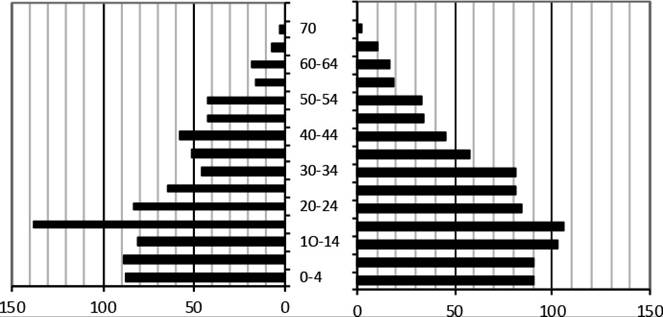
Figure 12.1 Sex-age pyramid of the population of Pereiaslav Source: tsdiauk, f. 57 op. i, kn. 278.
own aspirations. The main special aspects of the city consisted in its ability to attract the incoming population, with its specific features in terms of personality (not everyone was able to abandon their familiar village life), economic situation, and status, as well as in its ability to instill in these people its customs in marriage behavior, family life, and behavioral strategies. These aspects, even if vaguely, manifest themselves in the details of demographic coefficients and values, which, despite all their “changeability,” nevertheless make possible an attempt at painting collective portraits of the urban population of the Hetmanate.
Translated from the Ukrainian by Marta Skorupsky
NOTES
Originally published as: Ihor Serdiuk. “Polkovi mista Het'manshchyny v druhii polovyni XVIII st.: ekonomika i demohrafiia,” in Ukrains’ka derzhava druhoipolovynyXVII-XVIIIst.:polityka, suspil’stvo, kul'tura, ed. Valerii Smolii (Kyiv, 2014), 231-71. Copyright 2014 by nasu Institute of History of Ukraine. Translated and reprinted with permission.
1 U. Sowina, Woda i ludzie w miescie poznosredniowiecznym i wczesnonowozyt- nym. Ziemiepolskie z Europq w tle (Warsaw, 2009), 488.
2 M. Dolyns'ka, L'viv:prostir na tli meshkantsivXIII-XIXst. (Lviv, 2014), 8.
3 lakiv the Monk, “Satyrychna koliada,” in Slovo mnohotsinne. Khrestomatiia ukrains ’koi literatury, stvorenoi riznymy movamy v epokhu Renesansu, book 4 (Kyiv, 2006), 767.
4 T. Portnova, Mis ’ke seredovyshche i modernizatsiia: Katerynoslav seredyny XIX stolittia (Dnipropetrovsk, 2008), 29.
5 A. Putro, Levoberezhnaia Ukraina v sostave Rossiiskogo gosudarstva vo vtoroi polovine XVIIIst. (Kyiv, 1988), 78.
6 V. Diadychenko, Narysy suspil ’no-politychnoho ustroiu Livoberezhnoi Ukrainy kintsia XVII-pochatku XVIIIst. (Kyiv, 1959), 206-21.
7 A. Lazarevskii, “Opisanie Staroi Malorossii. Materialy dlia istorii zaselennia, zemlevladeniia i upravleniia. Vol. 3. Prilutskii polk,” Kievskaia starina (hereinafter - ks) 10 (1900): 92.
8 A. Shafonskii, Chernigovskogo namestnichestva topograficheskoe opisanie s kratkim geograficheskim i istoricheskim opisaniem Malyia Rossii, iz chastei koei onoe namestnichestvo sostavleno (Kyiv, 1851), 120.
9 O. Kovalenko, “Poltava XVII-XVIII st.: rozvytok mis'koi terytorii, prostorova struktura ta mis'ka zabudova” (PhD diss., National University of Kyiv- Mohyla Academy, 2009), 122.
10 Tsentral’nyi derzhavnyi istorychnyi arkhiv Ukrainy v m. Kyievi (Central State Historical Archive of Ukraine in Kyiv; hereinafter - tsdiauk), f. 57, op. 1, kn. 148a, ark. 2-4.
11 Diadychenko, Narysy suspil ’no-politychnoho ustroiu Livoberezhnoi Ukrainy, 228.
12 Ibid., 340-1.
13 V. Horobets', “Prybutkove suddivs'ke remeslo: ‘vyna pans'ka' i ‘vyna vriadova' u sudochynstvi Het'manatu,” Sotsium. Al’manakh sotsial 'noi istorii, no. 7 (2007): 191.
14 S. Taranushenko, “Uriadovi budivli na Het'manshchyni XVIII stolittia,” Ukrains’kyi istorychnyi zhurnal, no. 2 (1971): 103-7.
15 G. Miller [Gerhard Müller], “Sokrashchennoe uvedomlenie o Maloi Rossii,” Chteniia v Obshchestve istorii i drevenostei Rossiiskikh, book 4 (Moscow, 1846): 63-4.
16 tsdiauk, f. 57, op. 1, kn. 278, ark. 44zv.
17 Quoted in Kovalenko, “Poltava XVII-XVIII st.,” 124.
18 tsdiauk, f. 51, op. 3, spr. 10899, ark. 26-3ozv., 93zv.
19 Kovalenko, “Poltava XVII-XVIII st.,” 123-4.
20 Instytut rukopysu Natsional’noi biblioteky Ukrainy im. V.I. Vernads ’koho (Manuscript Institute of the National Library of Ukraine; hereinafter - ir nbu), f. 61, spr. 879, ark. i3zv.
Horobets, Prybutkove suddivs ke remeslo, 176.
O. Sokyrko, “Skil'ky koshtuie porozuminnia? ‘Poklony' ta ‘naklady v ukrain- s'kykh sudakh pershoi chverti XVIII st.,” Sotsium 7 (2007): 195-209.
lakiv the Monk, “Satyrychna koliada,” 760-7.
Lazarevskii, “Opisanie Staroi Malorossii,” 191-2.
Polnoe sobranie zakonov Rossiiskoi imperii (hereinafter - pszri), vol.io
(St Peterburg, 1830), 649-53. A sazhen equaled 2.1336 meters, thus the space for an adult measured close to 4.5m2, and 1.1 m2 for a child.
Ibid., 22:384-8.
V. Lapin, “Postoinaia povinnostv Rossii,” in Angliiskaia naberezhnaia, 4. Ezhe- godnik Sankt-Peterburgskogo nauchnogo obshchestva istorikov i arkhivistov (St Petersburg, 2000), 135-64; I. Ben'kovskii, “Utesnenie kievskikh meshchan voennym postoem v 1763-64 gg,” ks 5 (1895): 65-76.
A. Andrievskii, “Stranychka iz proshlogo g. Pereiaslava,” ks 8 (1889): 488-9.
O. Prokop'iuk, “‘Uchrezhdenie o konnoi pochte v Maloi Rossiii (do istorii funktsionuvannia kyivs'koi dukhovnoi konsystorii u XVIII st.,” Kyivs'ka starovyna 4 (2007): 129-38.
tsdiauk, f. 59, op. 1, spr. 3555, ark. 11.
P. M., “Ustav kievskogo tsiriulnicheskogo tsekha 1761 goda,” ks 11 (1883): 470-6.
Kovalenko, “Poltava XVII-XVIII st.,” 126.
Miller, “Sokrashchennoe uvedomlenie o Maloi Rossii,” 58-9.
O. Kompan, Mista Ukrainy v druhii polovyni XVII st. (Kyiv, 1963), 141.
Fernand Braudel, The Identity of France, trans. Sian Reynolds, vol. 1: History and Environment (London, 1988), 183.
Braudel, The Identity of France, 1:184.
L. Sinitskii, “Puteshestviia v Malorossiiu Akademika Gil'denshtedta i kniazia Dolgorukago,” ks 3 (1893): 417-8.
pszri, 21: 244-5.
Ibid., 246-7.
M. Kobylets'kyi, Mahdeburz’kepravo v Ukraini (XIV—pershapolovyna XIX st.): istoryko-pravove doslidzhennia (Lviv, 2008), 245.
Vossoedinenie Ukrainy s Rossiei. Dokumenty i materialy (Moscow, 1954), 3:568. Kobylets'kyi, Mahdeburz’kepravo v Ukraini, 245.
Shafonskii, Chernigovskogo namestnichestva topograficheskoe opisanie, 36.
Prava po kotorym suditsia malorossiskii narod... Izdannye pod redaktsiei i s prilozhenim issledovaniia o sem svode i o zakonakh, deistvovavshykh v Malorossii, prof. A. F. Kistiakovskogo (Kyiv, 1879), 754-70.
Kobylets'kyi, Mahdeburz’kepravo v Ukraini, 353.
46 Kovalenko, “Poltava XVII-XVIII st.,” 120.
47 tsdiauk, f. 57, op. 1, kn. 148a, ark. 9.
48 Andrievskii, “Stranychka iz proshlogo g. Pereiaslava,” 473.
49 Kovalenko, “Poltava XVII-XVIII st.,” 121.
50 Kobylets'kyi, Mahdeburz’kepravo v Ukraini, 355.
51 tsdiauk, f. 57, op. 1, kn. 148a, ark. 5.
52 Kobylets'kyi, Mahdeburz’kepravo v Ukraini, 359-61.
53 Ibid., 352.
54 H. Shvyd'ko, Dilovodchi akty kozats ’kykh orhaniv vlady iak dzherelo do istorii mistHet’manshchyny XVII-XVIIIstolit’, accessed 15 September 2021, http://www. ukrterra.com.ua/researches/23/svidko_akty.htm.
55 Andrievskii, “Stranychka iz proshlogo g. Pereiaslava,” 486-8.
56 H. Shvyd'ko, “Universaly het'maniv, iak istorychne dzherelo z istorii ukrain- s'kykh mist,” in Dnipropetrovs’kyi istoryko-arkheohrafichnyi zbirnyk, no. 1 (Dnipropetrovsk, 1991): 171.
57 V. Avseenko, Malorossiia v 1767 godu. Epizod iz istorii XVIII stoletiia. Po neizdannym istochnikam (Kyiv, 1864), 14-66.
58 Ibid., 69-193.
59 Ibid., 25-6.
60 Not counting the disbanded Poltava regiment.
61 Putro, Levoberezhnaia Ukraina, 5.
62 A. Zaiats', Urbanizatsiinyi protses na Volyni vXVI -pershii polovyni XVII st. (Lviv, 2003), 99.
63 Miller, “Sokrashchennoe uvedomlenie o Maloi Rossii,” 38.
64 Kovalenko, “Poltava XVII-XVIII st.,” 152.
65 tsdiauk, f. 57, op. 1, kn. 148a, ark. 8.
66 Shvyd'ko, Dilovodchi akty kozats ’kykh orhaniv vlady.
67 Sinitskii, “Puteshestviia v Malorossiiu Akademika Gil'denshtedta i kniazia Dolgorukago,” 433-8.
68 Fernand Braudel, Civilization and Capitalism, i$th-i8th Century, vol. 1: The Structure of Everyday Life: The Limits of the Possible (Berkeley, 1992), 482.
69 Kovalenko, “Poltava XVII-XVIII st.,” 153.
70 Shvyd'ko, Dilovodchi akty kozats ’kykh orhaniv vlady.
71 Kovalenko, “Poltava XVII-XVIII st.,” 153.
72 V. Kulakovs'kyi, “Statsionarna torhivlia v mistakh Livoberezhnoi Ukrainy u XVIII st.” in Istoriia narodnoho hospodarstva ta economichnoi nauky Ukrain- s 'koi rsr, 13 (Kyiv, 1979), 72.
73 F. Brodel', Chto takoe Frantsiia?, vol. 1, Prostranstvo i istoriia (Moscow, 1995), 140-52.
Sinitskii, Puteshestviia v Malorossiiu Akademika Gil denshtedta i kniazia Dolgorukago,” 428-41.
Putro, Levoberezhnaia Ukraina 59-62.
Kovalenko, “Poltava XVII-XVIII st.,” 133.
Sinitskii, “Puteshestviia v Malorossiiu Akademika Gil'denshtedta i kniazia Dolgorukago,” 433-8.
Brodel', Material’na tsyvilizatsiia, 420.
Sinitskii, “Puteshestviia v Malorossiiu Akademika Gil'denshtedta i kniazia Dolgorukago,” 416-39.
V. Studyns'kyi, “Papirni Chernihivshchyna u XVII - pershii polovyni XIX stolittia,” Siverians’kyi litopys, no. 2 (2002): 52-5.
Kovalenko, “Poltava XVII-XVIII st.,” 135, 167, 172.
Shvyd'ko, “Universaly het'maniv,” 174.
Shvyd'ko, Dilovodchi akty kozats ’kykh orhaniv vlady.
Kompan, Mista Ukrainy v druhiipolovyni XVII st., 190-8.
V. Kulakovs'kyi, “Klasove rozsharuvannia mis'koho naselennia Livoberezhnoi Ukrainy u XVIII st.,” Ukrains’kyi istorychnyizhurnal 9 (1980): 94.
Braudel, Civilization and Capitalism, 15 th-18 th Century, 1:487.
Braudel, The Identity of France, 1:180-8.
I. Serdiuk, “Vykhidtsi z sela sered naselennia Pereiaslava 60-ykh rr. XVIII st.,” Ukrains’kyi selianyn, no. 11 (Cherkasy, 2008): 213-15.
Kulakovs'kyi, “Klasove rozsharuvannia,” 93.
TsDIAUK, f. 57, op. 1, kn. 39, 148a, 278, 341.
Ibid., kn. 341, ark. 95zv.
Ibid., kn. 148a, ark. 64zv.-65.
Ibid., f. 763, op. 1, spr. 332.
K. Zinoviiv, Virshi. Prypovistipospolyti (Kyiv, 1971), 103-4.
A. Kamenskii, Povsednevnost' russkikh gorodskikh obyvatelei: istoricheskie anekdoty izprovintsial 'noi zhizni XVIII veka (Moscow, 2006), 62.
N. Iakovenko, Vstup do istorii (Kyiv, 2007), 246.
The objects of analysis of this study are the records of 1,708 residents of Pereiaslav, 5,086 residents of Nizhyn, and 4,210 residents of Starodub, which are located in the fair-copy books of the censuses of these cities. See tsdiauk, f. 57, op. 1, kn. 39, 148a, 278, 341.
Iu. Muromtseva, Demohrafiia: navchal'nyiposibnyk (Kyiv, 2006), 62. Maria Bogucka, Warszawa w latach 1526-1795 (Warsaw, 1984), 272-3. Sobranie Malorosiiskikh prav 1807goda (Kyiv, 1993), 21.
Iu. Voloshyn, Rozkol 'nyts ki slobody na terytorii Pivnichnoi Het’manshchyny y XVIIIst. (istoryko-demohrafichnyi aspect) (Poltava, 2005), 112.
102 According to the scale proposed by Borys Urlanis, general coefficients below 16% are regarded as low, from 16 to 24% - average, from 25 to 29% - higher than average, from 30 to 39% - high, and 40% and over - ultrahigh. See Demograficheskii entsiklopedicheskii slovar’ (Moscow, 1985), 209-10.
103 Voloshyn, Rozkol’nyts'ki slobody, 129.
104 B. Mironov, Sotsial 'naia istoriia Rossii perioda imperii. (XVIII - nach. XIX v.v.), 3rd ed. corrected and supplemented (St Petersburg, 2003), 1:159.
105 la. Kis', “Naselenie i sotsial'naia struktura L'vova v period feodalizma,” in Goroda feodal’noi Rossii (Moscow, 1966), 365-6.
106 The average birth rate coefficient in Western Europe in 1750-75 was 39%o. See B. Urlanis, Rost naseleniia v Evrope (opyt ischisleniia) (Moscow, 1941), 231.
107 Until 1793, Torun was a free city under the administration of the Polish Crown, and now it is the administrative center of the Kuyavian-Pomeranian Voivodeship in Poland.
108 K. Gorny, “Ze studiow nad stosunkami ludnosciowymi Torunia w XVIII w.” in Acta Universitatis Nicolai Copernici. Nauki Humanistyczno-Spoleczne. Historia, no. 11 (Torun, 1977): 80.
109 Mironov, Sotsial 'naia istoriia Rossii, 1: 187.
110 Brodel', Chto takoe Frantsiia? vol. 2, part 1, 170-5.
111 K. Dysa, Istoriia z vid 'mamy. Sudy pro chary v ukrains ’kykh voievodstvakh Rechi PospolytoiXVII-XVIII stolittia (Kyiv, 2008), 239-40.
112 Voloshyn, Rozkol’nyts’ki slobody, 115.
113 I. Serdiuk, Polkovykh horodov obyvateli: istoryko-demohrafichna kharak- terystyka mis’koho naselennia Het’manshchyny druhoipolovyny VIIIst. (Poltava, 2011), 144-50.
114 tsdiauk, f. 57, op. 1, kn. 278, ark. 245zv., 264zv.-65.
115 Iu. Voloshyn, “Statevo-vikova struktura naselenna mista Poltavy v druhii polovyni XVIII st.” Istorychna pam 'iat' 1 (2011): 5-24.
116 Voloshyn, Rozkol’nyts’ki slobody, 194.
117 Mironov, Sotsial 'naia istoriia Rossii, 1: 167
118 G. Khadzhnal, “Evropeiskii tip brachnosti v retrospective,” in Brachnost’, rozhdaemost’, sem 'ia za tri veka (Moscow, 1979), 14-30.
119 Kis', “Naselenie i sotsial'naia struktura L'vova,” 366.
120 tsdiauk, f. 57, op. 1, kn. 148a, ark. 9zv.
121 Ibid., ark. i27zv.
122 Ibid., ark. i28zv.
123 B. Mironov, Russkii gorod v 1740-1860-e gody: demograficheskoe, sotsial 'noe i ekonomicheskoe razvitie (Leningrad, 1990), 54.
124 tsdiauk, f. 57, op. 1, kn. 148a, ark. 68zv.
125 Ibid., ark. 69.
126 Ibid., ark. 231ZV.
127 Ibid., ark. 462ZV.
128 Ibid.
129 Gorny, “Ze studiow nad stosunkami ludnosciowymi Torunia w XVIII w.,” 93.
130 Mironov, Sotsial 'naia istoriia Rossii, 1:172.
131 I. Serdiuk, “Povtorni shliuby v Het'manshchyni u druhii polovyni XVIII st.,” Kraieznavstvo, no. 3-4 (2010): 47-55.
132 See Dilova i narodno-rozmovna mova XVIII st. (Kyiv, 1976), no. 79, 214-16.
133 Ibid., kn. 148a, ark. 23zv., ark. 3o8zv.
134 Ibid., kn. 278, ark. 2O5zv.-o6.
135 I. Koval's'kyi, “Provedennia Heneral'noho opysu v Pereiaslavs'komu polku,” Ukrains’kyi istorychnyi zhurnal 6 (i960): 132-4.
136 tsdiauk, f. 57, op. 1, kn. 39, 341.
137 Made in his lecture “Child and Empire [Rebenok i imperiia]” (as part of the project “Publichnye lektsii. Polit.ua”). For the text of the lecture, see accessed 15 September 2021, http://polit.ua/lec/402-rebenok-i-imperija.html
138 I. Serdiuk, “Vykhidtsi z sela sered naselennia Pereiaslava 60-kh rr. XVIII st.,” Ukrains’kyi selianyn, no. 11 (Cherkasy, 2008): 213-15.
More on the topic Regimental Cities of the Hetmanate in the Second Half of the Eighteenth Century: Governance, Economy, Demography:
- The Uniate Church in Right-Bank Ukraine in the First Half of the Eighteenth Century: Paradoxes of Regional Adaptation
- Colonies and the slave trade in the second half of the eighteenth century
- The second half of the eighteenth century witnessed a rise in new colonial projects and exploration.
- “Rulers of the Fatherland”: The Hetmanate's Cossack and Church Elite's Concepts of the Nature, Representation, and Obligations of Authority (Up to the Beginning of the Eighteenth Century)
- Grain, Coal, and Gas. Ukraine's Economy since the Eighteenth Century
- Population Distribution of the City of Poltava in the Second Half of the Eighteenth Century by Age, Sex, and Marital Status
- Orthodox Colleges in the Russian Empire (Second Half of the Eighteenth to the Beginning of the Nineteenth Century): Between Traditions and Innovations
- For three and a half centuries Europeans extended the bounds of their overseas possessions. In the half century that commenced in the 1770s the scope of imperial holdings shrank dramatically.
- A Tale of Four and a Half Cities, 1900–1950
- Cossack Historiography: A Vision of the Past and the Construction of Identities in the Hetmanate in the Seventeenth and Eighteenth Centuries
- PART FIVE The Hetmanate and the Right Bank in the Eighteenth Centur
- Ukrainian Cities in the Nineteenth Century
- Fatherland in Early Eighteenth-Century Ukrainian Political Culture
- For Deliveries to Tsargrad and Other Neighboring States” (Kyiv Reiters in the Eighteenth Century)
- Three Eighteenth-Century Travellers
- 24 The Right Bank and Western Ukraine in the Eighteenth Century
- Homicide in Eighteenth-Century China
- I have been working in international development for almost half a century.
- SECTION G THE ORGANS OF GOVERNMENT IN THE EIGHTEENTH CENTURY
- Ukraine on Seventeenth- and Eighteenth-Century Maps: From the “Wild Field” to the “Country of the Cossacks”