CAT 2008
1. A shop stores x kg of rice. The first customer buys half this amount plus half a kg of rice. The second customer buys half the remaining amount plus half a kg of rice. Then the third customer also buys half the remaining amount plus half a kg of rice.
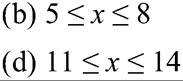
Thereafter, no rice is left in the shop. Which of the following best describes the value of x?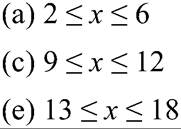
Directions for Questions 2 and 3:
Mark (a) if the question can be answered from A alone but not from B alone.
Mark (b) if the question can be answered from B alone but not from A alone.
Mark (c) if the question can be answered from A alone as well as from B alone.
Mark (d) if the question can be answered from A and B together but not from any of them alone.
Mark (e) if the question can not be answered even from A and B together.
In a single elimination tournament, any player is eliminated with a single loss. The tournament is played in multiple rounds subject to the following rule:
(a) if the number of players, say n, in any round is even, then the players are grouped into nil pairs. The players in each pair play a match against each other and the winner moves on to the next round.
(b) if the number of players, say n, in any round is odd, then one of them is given a bye, that is, he automatically moves on to the next round. The remaining (π - 1) players are grouped into (/7 - 1)/2 pairs. The players in each pair play a match against each other and the winner moves on to the next round. No player gets more than one bye in the entire tournament.
Thus, if n is even, then n/2 players move on to the next round while if n is odd, then {n +1)/2 players move on to the next round.
The process is continued till the final round, which obviously is played between two players. The winner in the final round is the champion of the tournament.2. What is the number of matches played by the champion?
(A) The entry list for the tournament consists of 83 players.
(B) The champion received one bye.
3. If the number of players, say n, in the first round was between 65 and 128, then what is the exact value of π?
(A) Exactly one player received a bye in the entire tournament.
(B) One player received a bye while moving on to the fourth round from the third round.
Directions for Questions 4 and 5:
Five horses, Red, White, Grey, Black and Spotted participated in a race. As per the rules of the race, the persons betting on the winning horse gets four times the bet amount and those betting on the horse that came in second gets thrice the bet amount. Moreover, the bet amount is returned to those betting on the horse that came in third, and the rest lose the bet amount. Raju bets ' 3000,' 2000 and ' 1000 on Red, White and Black horses respectively and ends up with no profit and no loss.
4. Which of the following can not be true?
(a) At least two horses finished before Spotted.
(b) Red finished last.
(c) There were three horses between Black and Spotted.
(d) There were three horses between White and Red.
(e) Grey came in second.
5. Suppose, in addition, it is known that Grey came in fourth. Then which of the following cannot be true?
(a) Spotted came in first.
(b) Red finished last.
(c) White came in second.
(d) Black came in second.
(e) There was one horse between Black and White.
Directions for Questions 6-10: Answer the following questions based on the information given below:
Abdul, Bikram and Chetan are three professional traders who trade in shares of a company XYZ Ltd. Abdul follows the strategy of buying at the opening of the day at 10 am and selling the whole lot at the close of the day at 3 pm.
Bikram follows the strategy ofbuying at hourly intervals: 10 am, 11 am, 12 noon, 1 pm and 2 pm, and selling the whole at the close of the day. Further he buys an equal number of shares in each purchase. Chetan follows a similar pattern as Bikram but his strategy is somewhat different. Chetan’s total investment amount is divided equally among his purchases. The profit or loss made by each investor is the difference between the sale value at the close of the day less the investment in purchase. The ‘return’ for each investor is defined as the ratio of the profit or loss to the investment amount expressed as a percentage.6. Which one of the following statements is always true?
(a) Abdul will not be the one with minimum return
(b) Return for Chetan will be higher than that of Bikram
(c) Return for Bikram will be higher than that of Chetan
(d) Return for Chetan can not be higher than that of Abdul
(e) None of the above
7. Ona ‘boom’ day the share price of XYZ Ltd. keeps rising throughout the day and peaks at the close of the day. Which trader got the minimum return on that day?
(a) Bikram (b) Chetan
(c) Abdul (d) Abdul or Chetan
(e) Cannot be determined
8. On a day of fluctuating market prices, the share price of XYZ Ltd. ends with a gain, i.e., it is higher at the close of the day compared to the opening value. Which trader got the maximum return on that day?
(a) Bikram (b) Chetan
(c) Abdul (d) Bikram or Chetan
(e) Cannot be determined
One day two other traders, Dane and Emily joined Abdul, Bikram and Chetan for trading in the shares of XYZ Ltd. Dane followed a strategy of buying equal number of shares at 10 am, 11 am, and 12 noon, and selling the same numbers at 1 pm, 2 pm and 3 pm. Emily, on the other hand, followed the strategy of buying shares using all her money at 10 am and selling all of them at 12 noon and again buying the shares for all the money at 1 pm and again selling all of them at the close of the day at 3 pm.
At the close of the day following was observed:(a) Abdul lost money in the transactions.
(b) Both Dane and Emily made profits.
(c) There was an increase in the share price during the closing hour compared to the price at 2 pm.
(d) Share price at 12 noon was lower than the opening price.
9. Which of the following is necessarily false?
(a) Share price was at its lowest at 2 pm.
(b) Share price was at its lowest at 11 am.
(c) Share price at 1 pm was higher than the share price at 2 pm
(d) Share price at 1 pm was higher than the share price at 12 noon.
(e) None of the above.
10. The share price was at its highest at
(a) 10 am (b) 11 am
(c) 12 noon (d) 1 pm
(e) Cannot be determined
Directions for Questions 11-13: Answer the following questions based on the statements given below:
(a) There are three houses on each side of the road.
(b) These six houses are labeled as P, Q, R, S, T and U.
(c) The houses are of different colours, namely, Red, Blue, Green, Orange, Yellow and White.
(d) The houses are of different heights.
(e) T, the tallest house, is exactly opposite to the Red coloured house.
(f) The shortest house is exactly opposite to the Green coloured house.
(g) U, the Orange coloured house, is located between P and S.
(h) R, the Yellow coloured house, is exactly opposite to P.
(i) Q, the Green coloured house, is exactly opposite to U.
(j) P, the white coloured house, is taller than R, but shorter than S and Q.
11. Which is the second tallest house?
(a) P (b) S
(c) Q (d) R
(e) Cannot be determined
12. What is the colour of the tallest house?
(a) Red (b) Blue
(c) Green (d) Yellow
(e) None of these
13. What is the colour of the house diagonally opposite to the Yellow colored house?
(a) White (b) Blue
(c) Green (d) Red
(e) None of these
Directions for Questions 14-17: Answer the following questions based on the information given below:
In a sports event, six teams (A, B, C, D, E and F) are competing against each other.
Matches are scheduled in two stages. Each team plays three matches in stage-1 and two matches in stage-2. No team plays against the same team more than once in the event. No ties are permitted in any of the matches. The observations after the completion of stage - 1 and stage-2 are as given below.Stage-I
• One team won all the three matches.
• Two teams lost all the matches.
• D lost to A but won against C and F.
• E lost to B but won against C and F.
• B lost at least one match.
• F did not play against the top team of stage-1.
Stage-2
√E The leader of Stage-1 lost the next two matches.
√E Of the two teams at the bottom after stage-1, one team won both matches, while the other lost both matches.
√zE One more team lost both matches in stage-2.
14. The only teams that won both the matches in stage-2 is(are):
(a) B (b) E & F
(c) A, E & F (d) B, E & F
(e) B & F
15. The teams that won exactly two matches in the event are:
(a) A, D & F (b) D & E
(c) E & F (d) D, E & F
(e) D & F
16. The team(s) with the most wins in the event is (are):
(a) A (b) A & C
(c) F (d) E
(e) B & E
17. The two teams that defeated the leader of stage-1 are:
(a) F & D (b) E & F
(c) B & D (d) E & D
(e) F & D
Directions for Questions 18-20: Answer the following questions based on the information given below:
| Sectional Cut-offMarks | Aggregate Cut-offMarks | ||||
| Section A | Section B | Section C | Section D | ||
| College 1 | 42 | 42 | 42 | 176 | |
| College 2 | 45 | 45 | 175 | ||
| College 3 | 46 | 171 | |||
| College 4 | 43 | 45 | 178 | ||
| College 5 | 45 | 43 | 180 | ||
| College 6 | 41 | 44 | 176 | ||
For admission to various affiliated colleges, a university conducts a written test with
four different sections, each with a maximum of 50 marks.
The following table gives the aggregate as well as the sectional cut-off marks fixed by six different colleges affiliated to the university. A student will get admission only if he/she gets marks greater than or equal to the cut-off marks in each of the sections and his/her aggregate marks are at least equal to the aggregate cut-off marks as specified by the college.18. Charlie got calls from two colleges. What could be the minimum marks obtained by him in a section?
(a)0 (b)21
(c) 25 (d) 35
(e)41
19. Aditya did not get a call from even a single college. What could be the maximum aggregate marks obtained by him?
(a) 181 (b) 176
(c) 184 (d) 196
(e) 190
20. Bhama got calls from all colleges. What could be the minimum aggregate marks obtained by her?
(a) 180 (b) 181
(c) 196 (d) 176
(e) 184
Directions for Questions 21-24: Each of the following questions has a paragraph from which the last sentence has been deleted. From the given options, choose the sentence that completes the paragraph in the most appropriate way.
21. Most people at their first consultation take a furtive look at the surgeon’s hands in the hope of reassurance. Prospective patients look for delicacy, sensitivity, steadiness, perhaps unblemished pallor. On this basis, Henry Perowne loses a number of cases each year. Generally, he knows it’s about to happen before the patient does: the downward glance repeated, the prepared questions beginning to falter, the Overemphatic thanks during the retreat to the door.
(a) Other people do not communicate due to their poor observation.
(b) Other patients do not like what they see but are ignorant of their right to go elsewhere.
(c) But Perowne himself is not concerned.
(d) But other will take their place, he thought.
(e) These hands are steady enough, but they are large.
22. Trade protectionism, disguised as concern for the climate, is raising its head. Citing competitiveness concerns, powerful industrialised countries are holding out threats of a levy on imports of energy-intensive products from developing countries that refuse to accept their demands. The actual sense of protectionist sentiment in the OECD countries is, of course, their current lackluster economic performance, combined with the challenges posed by rapid economic rise of China and India—in that order.
(a) Climate change is evoked to bring trade protectionism through the back door.
(b) OECD countries are taking refuge in climate change issues to erect trade barriers against these two countries.
(c) Climate change concerns have come as a convenient stick to beat the rising trade power of China and India.
(d) Defenders of global economic status quo are posing as climate change champions.
(e) Today’s climate change champions are the perpetrators of global economic inequity.
23. Mattancherry is Indian Jewry’s most famous settlement. Its pretty streets of pastel coloured houses, connected by first-floor passages and home to the last twelve saree-and-sarong-wearing, white-skinned Indian Jews are visited by thousands of tourists each year. Its synagogue, built in 1568, with a floor of blue-and-white china tiles, a carpet given by Haile Selassie and the frosty Yaheh selling tickets at the door, stands as an image of religious tolerance.
(a) Mattacherry represents, therefore, the perfect picture of peaceful coexistence.
(b) India’s Jews have almost never suffered discrimination, except from European colonisers and each other.
(c) Jews in India were always tolerant.
(d) Religious tolerance has always been only a faςade and nothing more.
(e) The pretty pastel streets are, thus, very popular with the tourists.
24. Given the cultural and intellectual interconnections, the question of what is ‘Western’ and what is ‘Eastern’ (or Indian) is often hard to decide, and the issue can be discussed only in more dialectical terms. The diagnosis of a thought as ‘purely Western’ or ‘purely Indian’ can be very illusory.
(a) Thoughts are not the kind of things that can be easily categorised.
(b) Though ‘occidentalism’ and ‘orientalism’ as dichotomous concepts
(c) ‘East is East and West is West’ has been a discredited notion for a long time now.
(d) Compartmentalising thoughts is often desirable.
(e) The origin of a thought is not the kind of thing to which ‘purity’ happens easily.
Answer Key
| l.(b) | 2. (d) | 3∙(d) | 4. (d) |
| 5. (c) | 6. (e) | 7. (a) | 8. (e) |
| 9. (e) | 10. (a) | ll.(e) | 12.(b) |
| 13. (d) | 14. (d) | 15. (e) | 16. (e) |
| 17.(b) | 18. (c) | 19. (c) | 20. (b) |
| 21. (c) | 22. (d) | 23. (a) | 24. (e) |
Solutions:
1. This question is based on odd numbers as only with an odd value of x would you keep getting integers if you halved the value of rice and took out another half a kg from the shop store.
From the options, let us start from the second option. (Note: In such questions, one should make it a rule to start from one of the middle options only as the normal realisation we would get from checking one option would have been that more than one option gets removed if we have not picked up the correct option- as we would normally know whether the correct answer needs to be increased from the value we just checked or it should be decreased.)
Thus trying for x - 7 according to the second option, you would get
417" class="lazyload" data-src="/files/uch_group76/uch_pgroup316/uch_uch7362/image/image416.jpg">
This means that 5 £ x £ 8 is a valid option for this question. Also, since the question is definitive about the correct range, there cannot be two ranges. Hence, we can conclude that option (b) is correct.
Note: The total solving time for this question should not be more than 30 seconds. Even, if you are not such an experienced solver through options, and
you had to check 2-3 options in order to reach the correct option, you would still need a maximum of 90 seconds.
EstimationofLOD: LOD 1
2. If there are 83 players in the tournament, then it is evident that there would be the following progression of number of players left in the tournament—83, 42, 21, 11, 6, 3, 2, 1. This means that there would be 7 rounds in the tournament. [Note: A logic that you should have known here perhaps is that for any number of players between 65 to 128 the number of rounds would always be 7.] However, we cannot determine the answer to the question asked only on the basis of the first statement as we do not know how many matches the champion actually played and how many byes he got. The Statement B gives us that information and hence we know the exact number of matches played by the champion by using both parts of the information.
3. If we use statement A alone, the logic here is that there should be only one digression from even numbers throughout the tournament.
Suppose, this digression happened when there were 3 players left in the tournament, then in the previous rounds there must have been 6, 12, 24, 48 and 96 players respectively.
Note that the next value which allows only one single non-even number possibility would be at 7.
In such a case, the number of players would be 14, 28, 56 and 112 respectively in the rounds prior to the round which had only 7 players.
Similarly, the next such value which would yield only one odd number in the entire series would be at 15. (You can do a trial and error for 9, 11 and 13 and eliminate these possibilities as they would lead to at least one more odd number in later rounds). Inthis case, the progression would be 15, 30, 60 and 120.
From this point, we can eliminate 17, 19, 21, 23, 25, 27 and 29 on the same basis as we eliminated 9,11 and 13, viz. they would yield at least two odd numbers in the whole series of numbers, thus giving way to at least 2 byes during the tournament. At 31, we again have a possible solution as 62 and 124.
At this point you should realise that there are multiple solutions possible if we use only statement A. However, between the multiple solutions enlisted above you should realise that if we were to add the information given in statement B, then only one possibility exists—since if the bye happens in the third to the fourth round then only 124, 62, 31, 16, 8, 4, 2, 1 can be the possible progression of number of players left after each round.
Solutions for Questions 4 and 5:
| Red | White | Grey | Black | Spotted |
| 3000 | 2000 | 1000 |
The given question gives us three types of return:
x4 (for first position), x3 (for second position), xl (For third position).
Systematic thinking at this point would give us the following possibilities for creating a return of 6000.
Possibility 1: 1000 ¥ 4 + 2000 ¥ 1 and the ' 3000 bet should get lost. (This would happen if black comes first and white comes third. Also, red should come 4th or 5 th)
Possibility 2: 1000 ¥ 3 + 3000 ¥ 1 and the ' 2000 bet should get lost. (This would happen if black comes second and red comes third. Also, white should come 4th or 5th.)
Possibility 3: 2000 ¥ 3 and the ' 1000 and the ' 3000 bet get lost. (This would happen if white comes second and Red and Black come 4th and 5th in some order.)
Note: These realisations come from the fact that- we can neither quadruple nor triple 3000 and neither can we quadruple 2000. This leaves us with the possibilities as discussed above. Like most thought patterns used in the CAT, this is also a standard thought pattern - and you can find multiple examples of this thought pattern in my book ‘QA for CAT’ as well as in ‘Data Interpretation for the CAT’. This thinking leads us to the following matrix:
| Possibility 1 | Black | GreyZspotted | White | GreyZRedZspotted | GreyZRe dZ Spotte d |
| Possibility 2 | GreyZspotted | Black | Red | GreyZ spotte dZWhite | GreyZspottedZWhite |
| Possibility 3 | GreyZspotted | White | GreyZspotted | RedZBlack | BlackZRed |
Based on this it is evident that:
4. There cannot be three horses between white and red—as for that to happen one of them should be in the first position and the other in the last position. Hence, Option (d) is correct (as it is not possible).
5. If grey came fourth, then it must be one of the first two possibilities. In both these cases, white cannot come second. Hence, option (c) is correct.
Solutions for Questions 6-10:
The following set of questions is based on your understanding of the concept of weighted averages.
The simplest one to understand is the one about Abdul. Abdul will make a profit if the price goes up and loss if the price goes down.
Further, his percentage profit /loss would be exactly the same as the percentage increase/decrease of the share price.
Before you hit the question, you need to understand clearly the difference betweenBikram& Chetan’s strategies.
Since, Chetan invests an equal amount at every hour, the no. of shares he has bought would be dependent on the price fluctuation. For example, if the prices are going down on a particular day, he would end up purchasing more shares at the lower price. In fact, his strategy of investing an equal amount every hour ensures that he buys a higher number of shares at the lower prices irrespective of the fluctuation. Thus, his average purchase price per share would be the weighted average of all prices with higher weights allocated to the lowest once during the day.
For Bikram on the other hand, his investment would always be in buying an equal no. of shares every hour. Thus, his average purchase price would always be the simple average of his five purchase prices.
Naturally, on any fluctuating prices day Bikranfs average price would be greater than Chetan’s average price, as Chetan’s average price would be the weighted average of the 5 prices @ 10, 11, 12, 1 & 2 with higher weights attached to the lower prices.
Note: What you need to have clear in your mind is that weighted average with higher weights attached to the lower prices would always have a lower value than a simple average.
However, if the prices are flat the whole day (i.e. no change in prices throughout the day) the weighted average & simple average would both be equal to that single price.
6. We can solve this by looking at and eliminating individual options. Option (a) cannot be true as Abdul would have the minimum return if the price is highest at 10 am & continuously drops till 3 pm.
Option (b) would normally ‘have been true, but is not always true because if the price remains constant at 10, 11, 12, 1 & 2, Chetanwould have the same return as Bikram.
Option (c) is also eliminated as we have seen that most of the time Chetan has a higher return than Bikram. Option (d) can be eliminated on the basis of the thought that it is easily possible that Chetan has higher return than Abdul. For example, on a day of consistently reducing prices, Abdul has the least return. Thus, option (e) is correct.
7. Abdul would get the maximum return on that day, since his purchase price (average) would be least. Also, between Chetan & Bikram, we know that Bikranfs average purchase price is higher & hence he would have the least returns.
8. The maximum return could be for Abdul or Chetan but between the two we cannot determine whose gain was more because in order to get that we would need to know the exact price at each hour starting from 10 am.
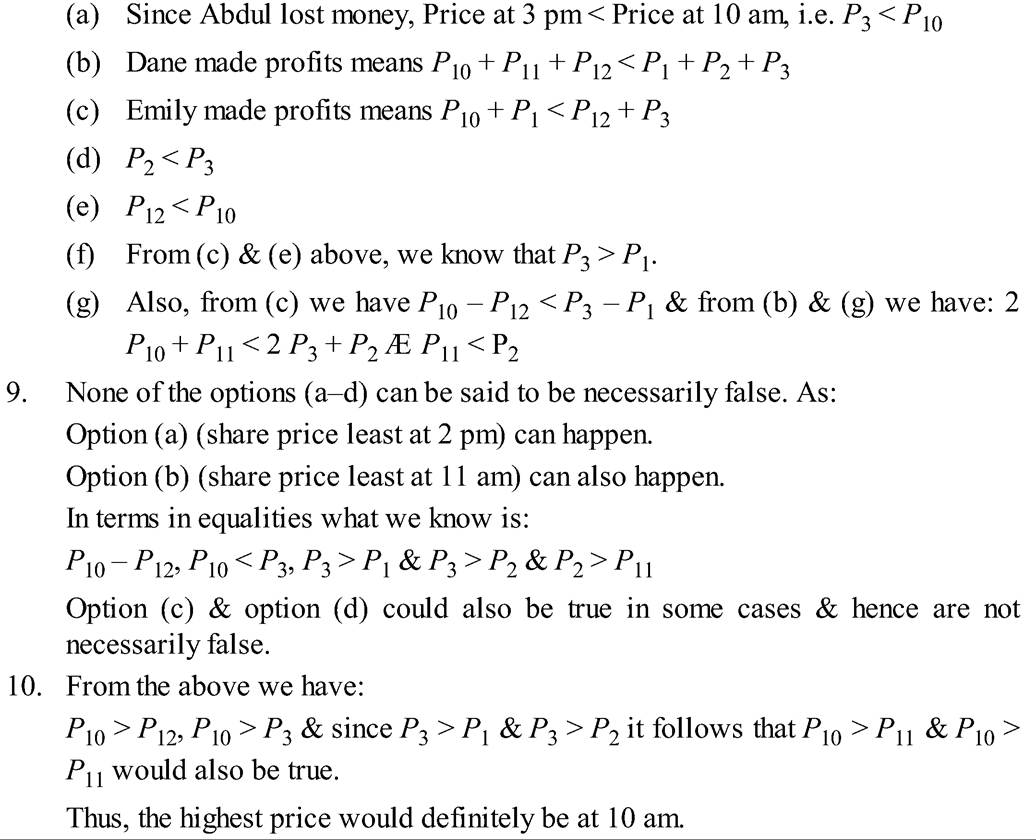
Before solving 9 & 10 we need to logically work out what happened with respect to prices on that day.
Solutions for Questions 11-13:
The following figure can be drawn based on the information provided: P/S U S/P
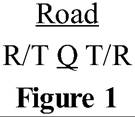
Table 1:
| Case 1 | Case 2 | |
| Tallest | TBlue | TBlue |
| 2nd Tallest | Q Green | SRed |
| 3rd Tallest | SRed | Q Green |
| 4th Tallest | P White | P White |
| 5th Tallest | R Yellow | R Yellow |
| Shortest | U Orange | U Orange |
The answers can be read off the table:
11. Can be either Q or S. Hence, we cannot determine this.
12. The Tallest house T is Blue.
13. From figure 1, it is clear S is diagonally opposite R (the yellow colored house). Thus, S being Red in color, Red is the correct answer.
* Positions have lost all three of their matches.
Solutions for Questions 14-17:
The thought Flowchart for this question set would go as follows:
Stage 1:
Fromthe first 5 clues:
| Initial possibility | Team | Team name | Match 1 Results | Match 2 Results | Match 3 Results |
| ABCDEF | 1 | Not D, Not E, Not E, Not F & Not B. Hence A | Win | Win | Win |
| ABCDEF | 2 | D | Lost A | WinC | WinF |
| ABCDEF | 3 | E | Lost B | WinC | WinF |
| ABCDEF | 4 | — | — | — | — |
| ABCDEF | 5 | Not A, D, B, E. Hence C | Lost D | Lost E | Lost |
| ABCDEF | 6 | Not A, D, B, E. Hence F | Lost D | Lost E | Lost |
Note: We have to allocate C & F to team 5 & 6 in any order as both those
(a) Once we determine that Team 1 is A we can eliminate A from the possibility list for team 2 to team 6.
(b) We also know that there would be a total of 9 matches in the first stage (18 entries in the table divided by 2). Consequently there would be 9 wins & 9 losses.
Out of the 9 wins A (3 wins) + D (2 wins) + E (2 wins) accounts for 7 wins. Thus, Team 4 (Team B) would also win 2 & lose 1.
At this stage, the table would transform to
Matches (Result & opponent)
| Team | 1 | 2 | 3 |
| A | WonD | Won | Won |
| D | Lost A | WonC | WonF |
| E | Lost B | WonC | WonF |
| B | Lost | WonE | Won |
| C | Lost D | Lost E | Lost |
| F | Lost D | Lost E | Lost |
At this stage, we still need to fix three wins & three losses. Since two of these wins were for A & A has not won against F, it is natural that A’s wins would have been against B & C. Thus, B’s win would be against F.
The final table would look like:
| Team | 1 Match Result | 2 Match Result | 3 Match Result | To play |
| A | WonD | WonB | WonC | F&E |
| D | Lost A | WonC | WonF | B&E |
| E | Lost B | WonC | WonF | A&D |
| B | Lost A | WonE | WonF | C&D |
| C | Lost D | Lost E | Lost A | B&F |
| F | Lost D | Lost E | Lost B | A&C |
We are now ready to work out the stage 2 results.
From the first 2 clues of the second stage, we know that A loses to E & E So C must have lost both its matches & F must have won both its matches.
| Stage 1 | Stage 2 | ||||
| Team | 1 | 2 | 3 | 4 | 5 |
| A | WonD | WonB | WonC | Lost E | Lost F |
| D | Lost A | WonC | WonF | E? | B ? |
| E | Lost B | WonC | WonF | WonA | D? |
| B | Lost A | WonE | WonF | WonC | D? |
| C | Lost D | Lost E | Lost A | Lost B | Lost F |
| F | Lost D | Lost E | Lost B | WonA | WonC |
To this table we add the information that more teams lost both matches and get:
| Stage 1 | Stage 2 | |||||
| Team | 1 | 2 | 3 | 4 | 5 | |
| 3 | A | WonD | WonB | WonC | Lost E | Lost F |
| 2 | D | Lost A | WonC | WonF | Lost E | Lost B |
| 4 | E | Lost B | WonC | WonF | WonA | WonD |
| 4 | B | Lost A | WonE | WonF | WonC | WonD |
| O | C | Lost D | Lost E | Lost A | Lost B | Lost F |
| 2 | F | Lost D | Lost E | Lost B | WonA | WonC |
The answer can be now read off from the table:
14. B, E&F
15. D & F won 2 matches.
16. B & E with 4 wins, won the maximum number of matches.
17. E & F defeated A.
Solutions for Questions 18-20
18. The minimum aggregate marks required to get at least 2 calls is 175 (as there are exactly 2 colleges namely college 2 & college 3 below 175).
If we allocate 50 mark each to sections A, B & C & 25 marks to sections D, a student with an aggregate of 175 marks would get 2 calls (from college 2 & 3).
19. 50 in section A + 50 in Section B + 41 in Section C + 43 in section D = 184 marks but no calls as each of the 6 colleges would reject the student.
20. To get a call from all colleges, Bhama should clear all sectional cut-offs & also aggregate cut-off Thus, 45 + 45 + 46 + 45 = 181 satisfies this condition.
Note: You cannot get calls from all colleges at 180 & 176 & while you can get calls from all colleges at 184 & 196, we are looking for the least value which is 181.
21. Option (c) best concludes the paragraph as it shows us exactly what Perowne is thinking. Hence, option (c) is the correct answer.
22. Option (d) is the most logical conclusion of the discussion of the paragraph, and also its central idea. Hence, option (d) is the correct answer.
23. Option (a) best concludes the paragraph. Hence, option (a) is correct answer.
24. Option (e) best fits the paragraph by completing the argument. Hence, option (e) is the correct answer.
More on the topic CAT 2008:
- Preface
- Introduction to an Introduction
- Article 15.8 Moody's risk alert sparks covered bond dispute
- Article 3.9 Sub-Saharan bond rush spreads east to Kenya and Tanzania
- Bibliography
- LATENT INFECTIONS (APPARENTLY HEALTHY CARRIERS)
- Article 3.10 EM bonds: are you nuts? Investors are buying bonds with ever less discrimination
- Ancient Sources Index
- OTHER ECHINOCOCCUS SPP.
- Human Rights