Article 3.9 Sub-Saharan bond rush spreads east to Kenya and Tanzania
By Javier Blas in London and Katrina Manson
Financial Times September 3, 2013
Ever since Ghana became the first sub-Saharan African country to issue a sovereign bond in 2007, the trend to tap capital markets has been confined to the west and south of the continent.
Now, east Africa is joining.Kenya and Tanzania are close to debuts in the US dollar-denominated sovereign bond market, with notes worth up to $2.5bn - joining a string of other African countries that have already raised a record $6.2bn in international debt this year, three times as much as in 2011, according to data provider Dealogic.
Until now, only Rwanda has tapped the debt market from east Africa. But the arrival of Kenya and Tanzania is set to put the region firmly on the radar of international investors - barely a decade after the region benefited from billions of dollars in debt relief.
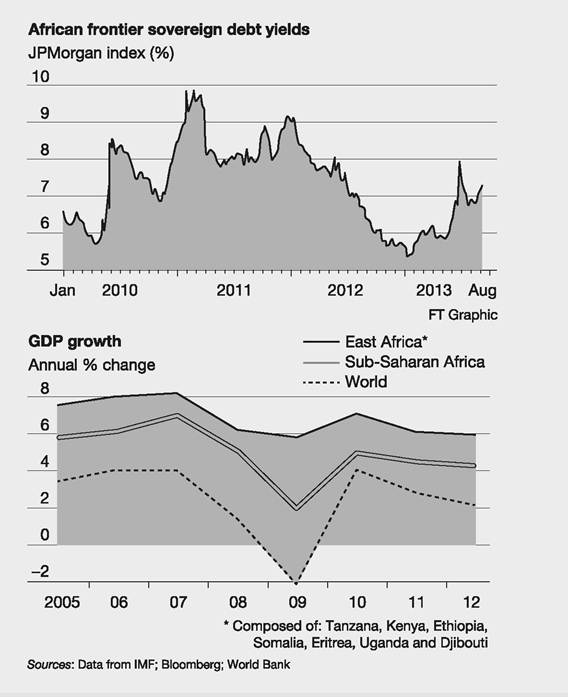
‘East Africa is the second fastest growing region in the world, only behind developing Asia,' says Ragnar Gudmundsson, head of the International Monetary Fund in Kenya. ‘That is why investors are attracted to the region.'
David Cowan, Africa economist at Citigroup, adds that east African nations would also benefit from investors' interest in diversifying their exposure from countries such as Nigeria, Ghana and Gabon. ‘There is strong appetite to diversify from the west African sovereign bond story, which is mostly linked to oil,' he says.
The JPMorgan Nexgem Africa index, which tracks the bond market in the region, is yielding 7.3%, up from a low-point in January of 5.3%. Still, interest rates for sovereign issuers in sub-Saharan Africa remain well below the most recent peak of 14% set during the global financial crisis in 2008.
Zambia's debut last year marked the top for the sub-Saharan market, raising $750m at a yield of 5.6%. But since then other countries have paid higher yields: Ghana paid an interest rate of 7.85% in June, and Nigeria paid 6.6%.
Mohammed Hanif, head of Insparo Asset Management, which manages a $160m emerging markets fixed-income fund that holds Nigerian and Zambian sovereign debt among others, says investor appetite for African debt is so strong the company will launch an Africa-only fixed-income fund later this year.
‘There is a clear lack of tradeable African debt around,' he says.
But he warns that many investors attracted by ‘a bit of euphoria in the market' but who are not familiar with Africa are easily wrong footed. Insparo did not join in the rush for Rwanda's debut $400m bond, which launched earlier this year and has already fallen significantly. He says Rwanda's small, aid-dependent economy is at too early a stage of development to warrant a bond. Still, Mr Hanif says Kenya and Tanzania instead present ‘great stories' with more mature economies that offer ‘sustainable growth' and Insparo expects to participate in both bonds.
In Dar es Salaam, the commercial capital of Tanzania, William Mgimwa, finance minister, put the example of a private placement the country launched earlier this year as a sign of the interest that investors have in east Africa.
‘In March this year I was online requesting [offers] for investors. I was looking for $500m but it was oversubscribed to $2.5bn,' he says, adding: ‘We already have very good investors who are actually waiting for [the bond] opportunity.'
Maiden sovereign bond issuances
| Country | Date issued | Amount | Yield at issue |
| Gabon | Dec 6 2007 | $1,OOOrn | 8.25% |
| Ghana | Sep 27 2007 | $750m | 8.5% |
| Kenya | Q4 2013 | $1,500m | n.a. |
| Namibia | Oct 27 2011 | $500m | 5.84% |
| Nigeria | Jan 21 2011 | $500m | 7.13% |
| Rwanda | Apr 2013 | $400m | 6.63% |
| Senegal | Dec 152009 | $2 OOrn | 9.47% |
| Seychelles | Sep 27 2006 | $2 OOrn | 9.47% |
| Tanzania | Q4 2013 | $1,OOOrn | bgcolor=white>n.a.|
| Zambia | Sep 13 2012 | $750m | 5.63% |
Source: Blas, J.
and Manson, K. (2013) Sub-Saharan bond rush spreads east to Kenya and Tanzania, Financial Times, 3 September.
FT
Clearly, many emerging markets are for the bravest of investors, but it can pay off if you buy at high yields and then the generality of investors become less afraid, start buying, pushing up the bond price and lowering yields, as they did with Irish and Belarusian debt following their crises. But there is brave and there is foolhardy - see Article 3.10.
More on the topic Article 3.9 Sub-Saharan bond rush spreads east to Kenya and Tanzania:
- Article 3.9 Sub-Saharan bond rush spreads east to Kenya and Tanzania
- Kenya
- Article 6.11 Cat bond investors show their limits
- Article 6.6 New Look launches £800m bond to grasp debt nettle
- Article 15.8 Moody's risk alert sparks covered bond dispute
- Article 7.3 Sub-Saharan market: high yields fire appetite for African Eurobonds
- Article 3.5 China bond market emerges from the shadows