Conjunction
Jason Iuliano
The Linda Problem: Linda is 31 years old, single, outspoken, and very bright. She majored in philosophy. As a student, she was deeply concerned with issues of discrimination and social justice and also participated in antinuclear demonstrations.
Which is more probable?(A) Linda is a bank teller; or
(B) Linda is a bank teller and is active in the feminist movement.
Did you pick (B)? If so, you just fell prey to the conjunction fallacy. You shouldn’t feel too bad, though. In fact, you’re in very good company. In a classic experiment, psychologists Tversky and Kahneman (1983) found that eighty-five percent of people choose (B).
Nonetheless, (B) is incorrect because it misapplies a basic rule of probability: The occurrence of two events (A and B) cannot be more likely than the occurrence of either A or B alone. As Tversky and Kahneman (1983) explain in their seminal work: “The probability of a conjunction, P(A&B), cannot exceed the probabilities of its constituents, P(A) and P(B), because the extension (or the possibility set) of the conjunction is included in the extension of its constituents” (293).
In other words, in every possible world in which both A and B occur, A has occurred and B has occurred. However, there may be possible worlds in which A occurs without B’s occurring and vice versa. Accordingly, the probability of A’s occurring is at least as great as - but may be greater than - the probability of both A’s and B’s occurring. Likewise, the probability of B’s
occurring is at least as great as - but may be greater than - the probability of both A’s and B’s occurring.
Let’s apply this concept to the Linda Problem by using a Venn diagram. In the left circle, we have the set of people who are bank tellers. Answer choice (A) places Linda somewhere in this circle. Next, in the right circle, we have the set of people who are feminists.
Finally, in the area in which the two circles overlap is the set of people who are bank tellers and feminists. Answer choice (B) places Linda somewhere in this overlapping section.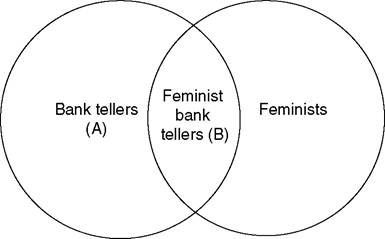
As you can see from the diagram, answer choice (A) is larger than answer choice (B). In fact, there is no part of (B) which is also not also part of (A). However, there is a large portion of (A) that does not overlap with (B). Accordingly, the probability of Linda’s falling somewhere in set (A) is greater than the probability that she is in set (B). In plain English, Linda is more likely to be a bank teller than she is to be both a bank teller and a feminist.
When you need to determine the relative probability of different scenarios, one way to prevent yourself from making the conjunction fallacy is to determine whether any of the options is a subset of any other. If so, you can conclude that the subset option is not more probable. This rule works because a specific event can never be more likely than a general event that encompasses the specific event. Consider the following example. Boston hosted the largest football parade in history to celebrate the New England Patriots. Which is more probable?
(A) The New England Patriots won the Super Bowl the day before the celebration; or
(B) The New England Patriots played a football game the day before the celebration.
(A) is the more enticing response, but (B) is the correct one. A close look at the options reveals that (A) is actually a subset of (B). Specifically, every Super Bowl is a football game, but only a small percentage of football games are Super Bowls.
When you step back and view the problem in this light, the logical flaw likely seems obvious. Given this, why are people so frequently drawn in by the conjunction fallacy?
There are two primary reasons. First, a detailed description of an event makes the event seem more probable.
Let’s see how this plays out through another example from Tversky and Kahneman (1983):(A) A massive flood will occur soon in North America, in which more than 1,000 people drown.
(B) An earthquake will occur soon in California sometime, causing a flood in which more than 1,000 people drown.
One group of participants was asked to rate the probability of (A)’s happening in the near future, and a second group of participants was asked to rate the probability of (B)’s happening in the near future. Interestingly, the (B) group provided substantially higher estimates than the (A) group. Tversky and Kahneman (1983) theorized that this error occurred because people overestimate the likelihood of “specific, coherent” events that are “representative of our mental model of the relevant worlds” (315). Think about how this idea relates to your own experience both detecting and telling lies. Chances are you more readily believe specific lies than vague ones and you are also more convincing when you tell specific lies rather than vague ones.
The second reason the conjunction fallacy tricks people is because humans are wired to seek causal explanations of events. The Super Bowl example illustrates this. Whereas the first causal explanation is consistent with our experience in the world (cities tend to have large celebrations when their team wins the Super Bowl), the second option’s causal explanation seems absurd (cities don’t have celebrations merely because their team played a football game). Nonetheless, despite its real-world absurdity, this second option is logically more probable.
Now that you know the mechanisms behind the conjunction fallacy, make sure that you don’t succumb to this probabilistic error in the future.
Reference
Tversky, Amos, and Daniel Kahneman. 1983. “Probability, Representativeness, and the Conjunction Fallacy.” Psychological Review (90): 293-315.
More on the topic Conjunction:
- SYMBOLIZING CONJUNCTIONS
- RULES OF INFERENCE FOR CONJUNCTION
- Future Directions
- Conjunction
- PROOF STRATEGIES
- Logical Consequence
- Arthur R.T.W.. An Introduction to Logic: Using Natural Deduction, Real Arguments, a Little History, and Some Humour. Broadview Press,2016. — 456 p., 2016
- Preliminary steps
- DISJUNCTION
- Contents