KEY EQUATIONS
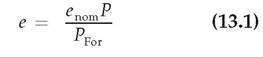
The real exchange rate, e, or the number of foreign goods that can be obtained for one domestic good, is defined in terms of the nominal exchange rate, e nom (the amount of foreign currency that can be obtained for one unit of domestic currency), the domestic price level, P, and the foreign price level, PFor.

The percentage change in the nominal exchange rate, ∆e nom∕ e nom, equals the percentage change in the real exchange rate, ∆e∕e, plus the excess of the foreign rate of inflation over the domestic rate of inflation, π For — π.
Sd — ιd = Nχ (13.4)
In an open economy, goods market equilibrium (the IS curve) requires that the excess of desired national saving over desired investment equal net exports. Equation (13.4) is equivalent to the condition that output, Y, must equal the aggregate demand for goods, Cd + Id + G + NX, Eq. (13.5).
►
More on the topic KEY EQUATIONS:
- Key Concepts
- Value and income
- SNAP 2008
- Cities and growth
- Populations can grow rapidly because they increase by multiplication
- CREDIT LOSSES
- Simple models of host-pathogen dynamicssuggest ways to control the establishment and spread of diseases
- Empire and Ideological Resources
- Metapopulations are characterized by repeated extinctions and colonizations
- Further Statistical Debate