Populations can grow rapidly because they increase by multiplication
Equations 11.1 and 11.3 show that populations increase by multiplication, not addition: at each point in time, the population changes in size according to the multiplier λ or r.
As a result, populations have the potential to add large numbers of individuals rapidly whenever λ > 1 or r > 0. The principle at work here is the same one that applies to interest on a savings account. Even when the interest rate is low, you can earn a lot of money each year if you have a large amount deposited in the bank, because savings, like populations, grow by multiplication. Similarly, the fact that populations grow by multiplication means that even a low growth rate can cause the size of a population to increase rapidly.Consider our own population. In this chapter's Case Study, we stated that the current annual growth rate of the human population was 1.0%, which is an r = 0.01. If we set the year 2022 as time t = 0, we have N0 = 7.9 billion, the size of the human population in 2022. Plugging these values of r and N0 into Equation 11.4, we calculate that the population size 1 year later should be N1 = 7.9 ? e0’01, which equals 7.98 billion people. Thus, in 2022, the human population was increasing by 80 million people per year (7.98 billion - 7.90 billion = 0.08 billion = 80 million). Since populations grow by multiplication, if r remained constant at 0.01 for an extended period of time, the yearly increments to the human population would become astronomical. For example, after 225 years, there would be 75 billion people, and our population would be increasing in size by almost a billion people each year.
Turning from humans to other species, what do field studies reveal about the growth rates of their populations? Some species, such as the woodland herb Asarum canadense (wild ginger), have maximum observed values of λ that are close to 1 (λ = 1.01 in young forests, λ = 1.1 in mature forests) (FIGURE 11.6). Similar values were observed for a population of 25 reindeer introduced to Saint Paul Island off the coast of Alaska in 1911.
After 27 years, the population had increased from 25 to 2,046 individuals, which (when we solve for λ in Equation 11.2) yields λ = 1.18.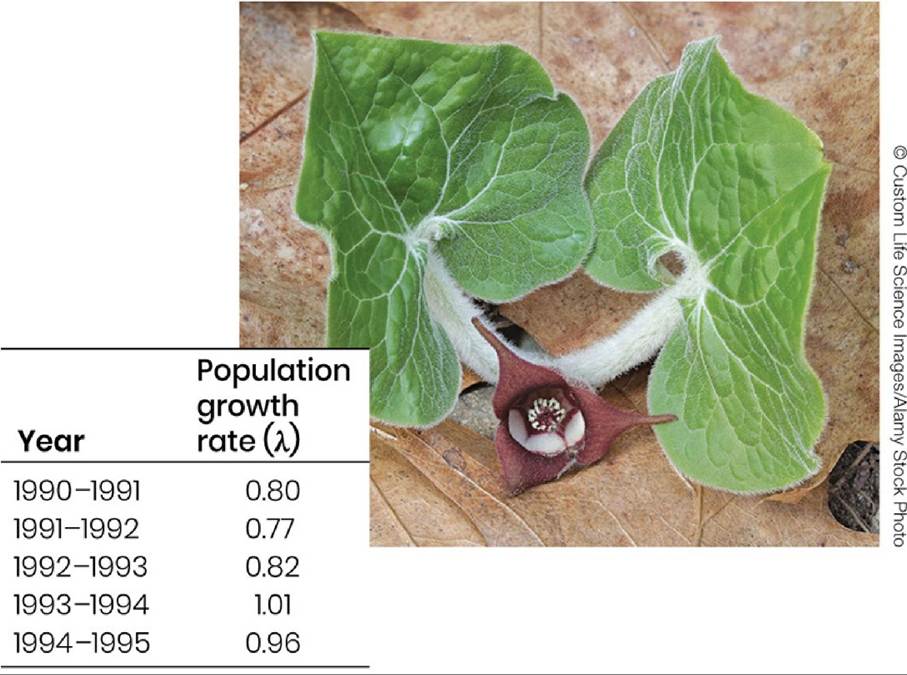
FIGURE 11.6 Some Populations Have Low Growth RatesThegrowthratesofa population of wild ginger (Asarum canadense) in a young forest vary from year to year. The maximum growth rate in this forest is 1.01. However, growth rates are often less than 1.0, suggesting that the population will decline in size unless conditions improve. (Data from H.
Damman and M. L. Cain. 1998. JEcol 86: 13-26.) View larger image
Considerably higher annual growth rates have been observed for populations of many species, including western gray kangaroos (λ = 1.9), field voles (λ = 24), and rice weevils (λ = 1017), which are insect pests of rice and other grains. Some bacteria, such as the mammalian gut inhabitant Escherichia coli, can double in number every 30 minutes, resulting in the unimaginably high annual growth rate of λ = 105’274.
Recall that when λ > 1 (or r > 0) for an extended period, populations increase exponentially in size, forming a J-shaped curve like that in Figure 11.4A. In natural populations, λ > 1 (or r > 0) when key factors in the environment are favorable for growth, survival, and reproduction. But can such favorable conditions last for long?
More on the topic Populations can grow rapidly because they increase by multiplication:
- Age or size structure influences how rapidly populations grow
- Populations grow geometrically when reproduction occurs at regular time intervals
- CONCEPT 11.1 Populations can grow exponentially when conditions are favorable, but exponential growth cannot continue indefinitely.
- Some populations exhibit logistic growth, a pattern in which abundance increases rapidly at first and then stabilizes at a population size known as the carrying capacity, the maximum population size that canbe supported indefinitely by the environment
- Small populations are at much greater risk of extinction than large populations
- CONCEPT 12.3 Predator populations can cycle with their prey populations.
- Despite growing Muslim minority populations in many Western countries, one area where there has traditionally been seen to be a legal disconnect between those populations and their new countries is the area of adoption, or the similar but distinct concept known in Islam as ‘kafala’.
- The rarest and the most rapidly declining species are priorities for protection
- Adaptive evolution can occur rapidly
- Fluctuations in population size can increase the risk of extinction
- RAPIDLY PROGRESSIVE GLOMERULONEPHRITIS
- ALL REVVED UP WITH NO PLACE TO GROW—ACTIVATION- INDUCED CELL DEATH (AICD) and peripheral deletion
- Efforts to increase intellectual humility