Age or size structure influences how rapidly populations grow
Members of a population whose ages fall within a specified range are said to be part of the same age class. Age class 1, for instance, might include all individuals who are at least 1 year old but who are not yet 2 years old.
Once individuals have been categorized in this way, a population can be described by its age structure: the proportions of the population in each age class. Imagine a population of a hypothetical organism in which all members die before they reach 3 years of age. In this population, every individual will be 0 (“newborns,” which includes all individuals less than 1 year old), 1, or 2 years old. If there are 100 individuals in the population, and if 20 are newborns, 30 are 1-year-olds, and 50 are 2-year-olds, then the age structure will be 0.2 in age class 0, 0.3 in age class 1, and 0.5 in age class 2.Age structure is a key feature of populations, in part because it influences whether a population increases or decreases in size. Consider two human populations of the same size and with the same survival and reproduction rates, but with different age structures. If one of the populations had many people older than 55, while the other had many people between ages 15 and 30, we would expect the second population to grow more rapidly than the first because it contained more individuals of reproductive age. Indeed, human populations that
are growing rapidly typically have a greater percentage of people in younger age classes than do populations that are growing slowly or are in decline (FIGURE 11.16).
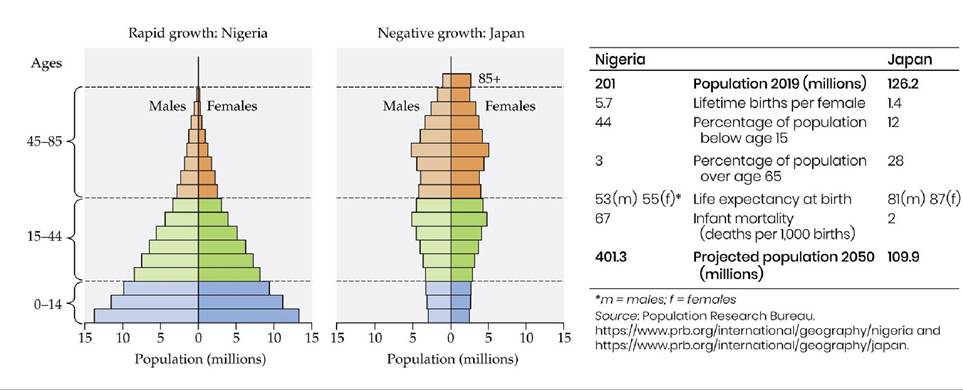
FIGURE 11.16 Age Structure Influences Growth Rate in Human Populations Population pyramids for Nigeria and Japan show age structures that are typical of human populations with rapidly growing populations (Nigeria) and with growth rates that are negative or close to zero (Japan). The main reproductive ages (15-44) are shown in green.
(After L. Roberts. 2011. Science 333: 540-543. Pyramids from United Nations, DESA, Population Division. World Population Prospects 2019/CC BY 3.0 IGO. (⅛⅝ https://population.un.org/wpp/Graphs/DemographicProfiles/Pyramid/392 and https://population.un.org/wpp/Graphs/DemographicProfiles/Pyramid/566.) View larger imageWe have emphasized the importance of age because in many species, birth and death rates differ greatly among individuals of different ages. For other kinds of organisms, age is less important. In many plant species, for example, if conditions are favorable, a seedling may grow to full size relatively rapidly and reproduce at a young age. If conditions are not favorable, however, the plant may remain small for years and reproduce little or not at all; if conditions become favorable at a later time, the plant may then grow to full size and reproduce. For such species, whether an individual reproduces or not is more closely related to size than to age. When birth and death rates correlate poorly with age, or when age is difficult to measure, life tables based on the sizes or the life cycle stages
(e.g., newborn, juvenile, adult) of individuals in the population can be constructed.
More on the topic Age or size structure influences how rapidly populations grow:
- Populations can grow rapidly because they increase by multiplication
- Some populations exhibit logistic growth, a pattern in which abundance increases rapidly at first and then stabilizes at a population size known as the carrying capacity, the maximum population size that canbe supported indefinitely by the environment
- CONCEPT 11.4 Life tables show how survival and reproduction vary with age or size structure, influencing population growth and size.
- Populations grow geometrically when reproduction occurs at regular time intervals
- All populations fluctuate in size
- CONCEPT 11.1 Populations can grow exponentially when conditions are favorable, but exponential growth cannot continue indefinitely.
- Biological structure of populations
- Ethological structure of populations
- CONCEPT 10.1 Populations are dynamic entities that vary in size over time.
- CONCEPT 10.2 The risk of extinction increases in populations that fluctuate in size and/or are small.
- CONCEPT 9.1 Populations are groups of individuals of the same species that vary in size over space and time.