Notes on transliteration
The transliteration system used in this Handbook is the one followed by International Journal of Middle East Studies.
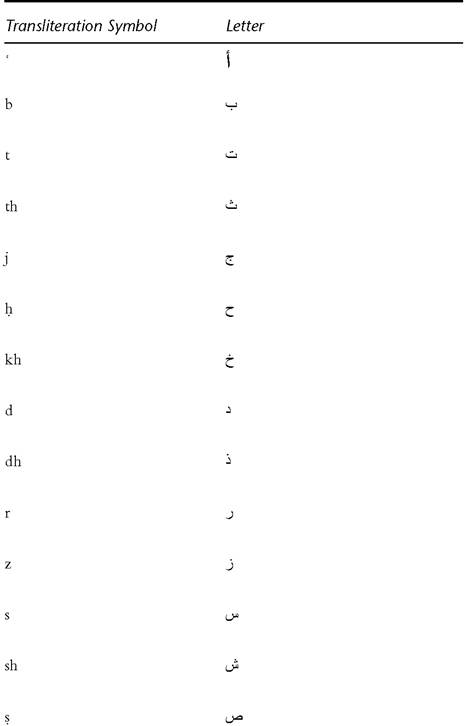
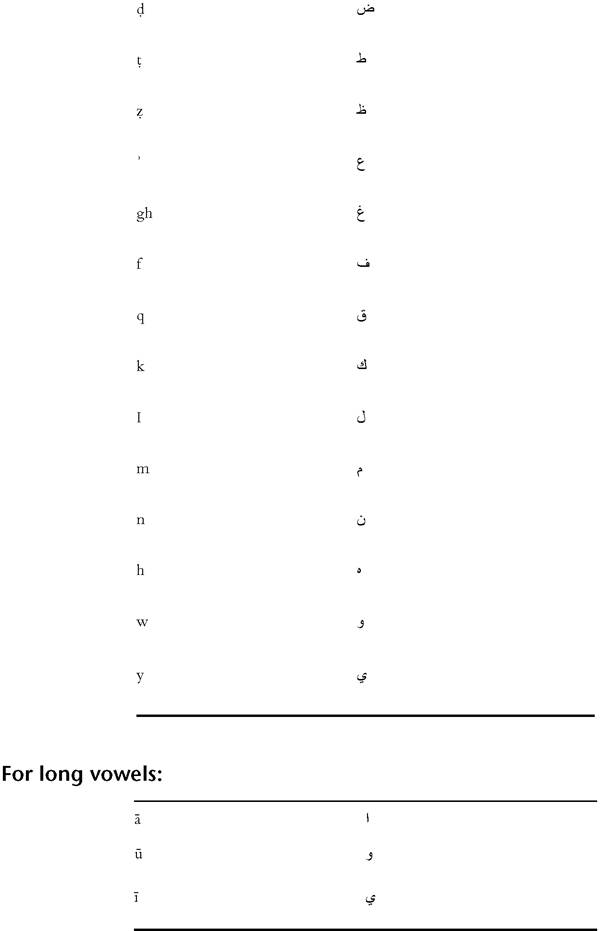
Notes
All technical terms from languages written in non-Roman alphabets must be italicized and fully transliterated with diacritical marks (macrons and dots), for example, qastda.
A technical term is defined as a word not found in Merriam-Webster’s Collegiate Dictionary or a multiword phrase, excluding titles and proper nouns.Words that are found in Merriam-Webster’s should be spelled as they appear there and not treated as technical terms. These words become common to English readers. They should have no diacritics, nor should they be italicized—for example, imam, mufti, jihad, shaykh, 'ulama.
Diacritics should not be added to personal names, place names, names of political parties and organizations, or titles of books and articles. These words should be spelled in accordance with the IJMES transliteration system but without diacritics. However, ayn and hamza should be preserved in all these cases, and should be clearly distinguished from one another.
Personal and place names with accepted English spellings should be spelled in accordance with English norms, for example, Yasir Arafat, Baalbek, Damascus. This rule applies to cities of publication in citations.
Follow English capitalization rules for transliterated titles; capitalize all major terms, but not articles, prefixes, coordinating conjunctions, or prepositions.
Use italics to indicate a book, newspaper, or periodical. Do not add diacritical marks, but do preserve 'ayn and hamza (except for initial hamza, which is dropped), for example, Faysal al-Tafriqa bayn al-Islam wa-l-Zandaqa and al-Diya ila Sabil al-Mu'minin.
“Ta marbuta” is rendered /a/not /ah/, except in Persian, where it should be /ih/. In Arabic idafa constructions, it is rendered /at/.
The feminine nisba ending is rendered /iyya/ (iyyih in Persian).
Inseparable prefixes in Arabic are connected with what follows by a hyphen: bi-, wa-, li-, and la-. When one of these prefixes is followed by al, the /a/ will elide, forming a contraction rendered as wa-l-, bi-l-, li-l-, and la-l-.
The definite article al- is lowercase everywhere, except when it appears as the first word of a sentence or endnote.
When an Arabic name is shortened to just the surname, the al- is retained; for example, Hasan al-Banna becomes al-Banna.
Connectors in names— such as bin, ben, abu, and so forth—are lowercase only when preceded by a name, e.g. Osama bin Laden, but Bin Laden, Ibn Khaldun.
Exceptions for the IJMES transliteration system due to common Arabic convention are Shariah, ayah, Sunnah, Surah, Salah, Zakah, Ummah.
More on the topic Notes on transliteration:
- A NOTE ON THE TRANSLITERATION
- Note on Transliteration
- A Note on Transliteration
- System of Transliteration and Dating
- Note on Transliteration and Dating
- A Note on Transliteration
- Note on Terminology, Orthography, and Transliteration
- EDITOR’S NOTES
- NOTES
- Notes
- Notes
- Notes