CHICKENPOX
Varicella-zoster virus (VCZ) infection presents either as a primary infection, i.e. chickenpox in reviously nonimmune child or as re-activation of earlier latent infection, i.e. herpes zoster (shingles).
Chickenpox is a common and highly contagious exanthematous illness in children, usually seen as outbreaks.Epidemiology: VCZ is a neurotropic human herpes virus, present in respiratory secretions or skin vesicles of a clinical case of chickenpox or herpes zoster (1-2 days before to 5-7 days after the rash).
Infection, transmitted via direct contact or as droplet infection, is highly contagious with secondary attack rate of 80-90% in household contacts and 30-35% in schoolmates. Transplacental fetal infection is possible in pregnant mothers with VCZ infection.
Chickenpox is most common in 5-9 year age group, though no age is immune, including newborns. Although infection confers life-long immunity, reactivation of silent infection (herpes-zoster) may occur after many years in ~ 10%, specially in immunocompromised states. Chickenpox outbreaks are more common during January to May months.
Pathogenesis: After primary infection, virus replicates locally in respiratory tract with intermittent subclinical viremia. After incubation period of 10-21 days, secondary or major viremia develops with onset of clinical disease. Gradual development of immune response limits the infection with clinical recovery within 5-7 days. However, VCZ virus invariably persists in body as a latent infection of sensory ganglion cells, which may be re-activated later to produce herpes zoster.
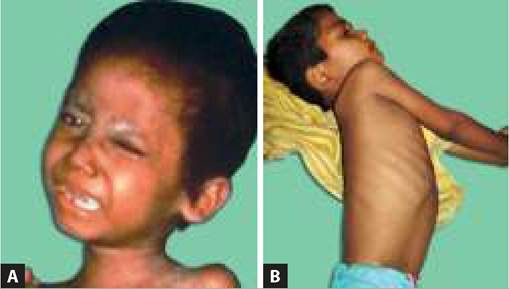
Fig. 10.9: Chickenpox.
Pathology: Typical skin vesicles containing classic giant cells with Cowdry type A eosionophilic intranuclear inclusion bodies are pathological hallmark of chickenpox.
Similar cells may also be seen in other tissues, e.g. esophagus, pancreas, liver, lungs and brain.Clinical presentation is variable, with milder disease in younger children. A typical case present after incubation period of 10-21 days, with:
• Short prodromal illness (1-2 days) with mild/ moderate fever and constitutional symptoms like malaise, anorexia, etc.
• Exanthematous phase, characterized by typical pleomorphic rash, from 2nd day of fever. Rashes appear in crops as intensely pruritic erythematous macules, which evolve rapidly into clear fluid-filled vesicles and crust within 24-48 hours (Fig. 10.9). Lesions are typically centripetal in distribution, mainly seen on trunk and back. New rashes continue to erupt for next 3-4 days, leading to pleomorphism, i.e. simultaneous presence of rashes in different stages of evolution as macules, papules, vesicles and scabs. Mucosal lesions, i.e. enanthem, may be present on oropharyngeal mucosa, airways, conjunctiva and vagina, as ulcerative lesions.
• Convalescent phase, when scabs gradually fall-off in 7-14 days, leaving behind hypopigmented scars for 4-8 weeks.
Atypical variants of chickenpox include:
• Modified varicella-like illness (MVLI), seen in lt; 5% vaccinees, presents as mild papulovesicular eruptions after 1-3 weeks, lasting for few days.
• Breakthrough varicella is defined as a clinical disease after 42 days of immunization (d/d MVLI, within 1-3 weeks), usually seen in 1-4% vaccinees within 2-5 years of vaccination. It is more common in children vaccinated lt;15 months of age with a single dose and represents inadequate immune response with waning of the immunity over time. Two doses reduce the risk of breakthrough varicella by 3.3 fold.
• Hemorrhagic chickenpox in immunocompromised host, presenting with severe, hemorrhagic skin lesions, visceral complications and longer course.
• Congenital varicella syndrome may develop in
1- 2% cases if mother is infected in before 20 weeks of gestation, characterized by limb hypoplasia, skin scarring, microcephaly and eye problems, e.g.
cataracts and microphthalmia.• Neonatal varicella is a life-threatening complication following primary maternal varicella infection 5 days prior to delivery and 2 days afterward, seen in 20-30% cases. Transplacental fetal infection may present with severe cutaneous and visceral lesions in first two weeks, with pneumonitis and fatal disseminated disease in 30% cases. Varicella zoster immunoglobulin (VZIG) at birth may reduce the severity of disease. Symptomatic newborns must be intensively treated with IV Acyclovir (10 mg/kg 8-hrly)
• Herpes zoster rarely presents in childhood, with typical unilateral dermatomal distribution of grouped vesicular lesions, which heal spontaneously within 1-2 weeks. Recurrent or multi-dermatomal herpes zoster indicates immunodeficiency state, e.g. HIV.
Complications are extremely rare in younger children, usually seen in older children, adults or immunocompromised host (Table 10.34).
Diagnosis is mainly clinical, although laboratory confirmation is possible using vesicular fluid sample for: (a) virus detection by PCR or culture, (b) serological tests, e.g. immunofluorescence or ELISA, and (c) demonstration of multinucleated giant cells on Tzanck smear.
D/D includes other causes of vesicular lesions, e.g.
(a) impetigo, (b) herpes simplex, (c) enteroviral rash, (d) drug-rash (e) insect-bites, etc. (Ch 25.6).
Treatment is symptomatic with maintenance of personal hygiene, mild antipyretic, e.g. paracetamol and topical anti-pruritic agents like zinc-calamine lotion. Aspirin is contraindicated in chickenpox due to high-riskof Reye- like syndrome.
Antiviral therapy is indicated to reduce the severity/ duration of illness in high-risk cases, i.e. (a) immunocompromised states, (b) older cases gt;12 years,
| TABLE 10.34: Complications of chickenpox | |
| • Skin | Secondary bacterial infection of rash |
| • Resp | Interstitial pneumonia |
| • Blood | Thrombocytopenia, P. fulminans, DIC |
| • CNS | Cerebellar ataxia, encephalopathy, GBS |
| • Renal | HUS, acute nephritis, nephrotic syndrome |
| • GIT | Transient hepatitis or Reye-like syndrome* |
| • Cardiac | Pericarditis, myocarditis |
| • Others | Arthritis, pancreatitis, orchitis |
HUS: Hemolytic-uremic syndrome, GBS: Guillain-Barre syndrome ^associated with use of aspirin in these cases
(c) pre-existing skin or pulmonary disorders, and (d) complications, e.g. encephalopathy, pneumonia and bleeding diathesis. It should be started within 24 hours of appearance of rash, using PO/IV Acyclovir (20 mg/ kg/dose QID) for 5-7 days or till no new lesions appear for 48 hours.
Herpes zoster may also be treated with PO acyclovir, though IV therapy is necessary in immunocompromised cases with risk of disseminated disease. Other alternatives include famciclovir or valacyclovir, though rarely used in children.
Prevention of chickenpox includes:
• Active immunization: While not included in National Immunization Schedule, IAP recommends varicella vaccine to all children with two doses-first at 15-18 months of age and second after 3-6 months. Catch-up immunization is advised till 18 years with two doses at 8-12 weeks interval.
Varicella vaccine is specially recommended in high-risk cases, e.g. close contacts of index case (within 3 days), institutionalized children or immunocompromised host (Ch 9.2.2)
• Passive prophylaxis with VZIG, i.e. specific varicellazoster immunoglobulin (IM one vial/10 kg body weight) is indicated in: (a) immunocompromised or close household contacts, (b) pregnant women and (c) newborns born to mothers who develop varicella within 5 days before or 2 days after the delivery. It is effective only if given within 48-96 hours of exposure.
• Isolation is difficult but the child should not be sent to school during infectivity period. A case is contagious from 24-48 hours before the rash to 5-7 days after rash, till all vesicles have crusted.
10.20
More on the topic CHICKENPOX:
- Immunology
- REFERENCES
- HEMORRHAGIC FEVERS (Fever with Petechiae/Purpura)
- Intra-amniotic infection, meconium staining of the amniotic fluid, and meconium aspiration syndrome: what is the link?
- Detailed contents
- HERPETIC VIRAL INFECTIONS
- 11 Perinatal Infections
- GENERAL APPROACH FOR SOLVING CRITICAL REASONING QUESTIONS
- Index
- Chapter 8 Maternal medicine and infections