Background
21.1.1 History and presence of paratuberculosis control programmes
Early programmes to control paratuberculosis were set up in France in the 1920s, followed by the UK and Iceland in the 1960s, Cyprus, the USA and Japan in the 1970s, and France and Norway in the 1980s (Benedictus et al., 2000).
In the Netherlands, first initiatives regarding test-and- cull strategies based on different diagnostic tests have been reported since 1942 (Benedictus et al., 2000). Since the 1990s, control programmes for paratuberculosis have been implemented in other high-income countries (HIC), e.g. in Australia (1996), Canada (2007) and New Zealand (2009), and middle-income countries (MIC) such as South Africa (1997). In Europe, paratuberculosis control was started in the UK (1998), Spain (2004), Denmark (2006), Belgium (2006), some regions of Germany (2003), Ireland (2013) and Italy (2014) (Bakker, 2010; Geraghty et al., 2014). A mandatory control programme for elimination of clinical cases of paratuberculosis from the food chain has been established in Austria since 2006 (Khol et al., 2007) and in Switzerland since 2015 (Whittington et al., 2019). With respect to its very low Mycobacterium avium spp. paratuberculosis (MAP) prevalence, Sweden has had mandatory regulations in force since 1998 and all adult cattle submitted for necropsy are actively monitored for the presence of MAP. Mandatory measures including elimination of the infected herd and extensive tracing of all contact herds are applied (Sternberg et al., 2007).A review presenting an overview of paratuberculosis control in cattle and other important susceptible livestock species in 48 countries was published recently (Whittington et al., 2019). In the period 2012-2018, a total of 22 of 48 countries had a control programme for paratuberculosis with more than half of the countries in Europe (Fig.
21.1). All except Ireland, Italy and Switzerland had a long-term programme that started before 2012 and will be continued after 2018. With a median starting year of 2000, these long-term programmes began as early as 1942 (the Netherlands) and 1962 (Iceland), compared with as late as 2009 (New Zealand). Control programmes changed over time in most countries. The majority of the countries without a control programme for paratuberculosis were in South and Central America, Asia and Africa. With respect to the United Nations Development Program index ranking for 2015, countries with a paratuberculosis control programme had a higher development index compared with those without a control programme (Whittington et al., 2019).‘Corresponding author: kdonat@thtsk.de
© CAB International 2020. Paratuberculosis: Organism, Disease, Control, 2nd Edition
(eds M.A. Behr et al.)
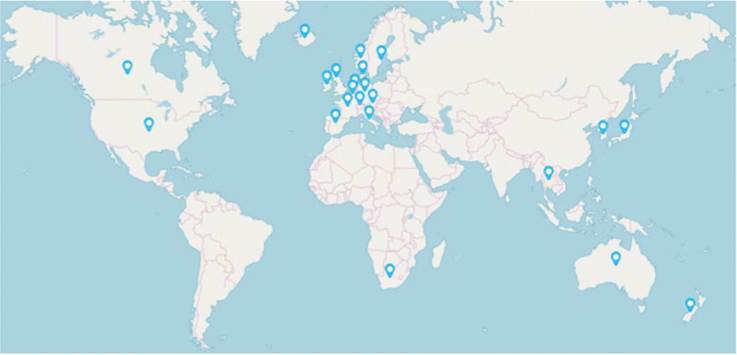
Fig. 21.1. Countries that had a control programme for paratuberculosis between 2012 and 2018. (Whittington et al., 2019, reproduced with the permission of BMC Veterinary Research.)
21.1.2 Reasons for having a control programme for paratuberculosis or not
Paratuberculosis impacts animal welfare, has direct and indirect economic costs, and arouses public health concerns. Infection leads over time to a chronic granulomatous enteritis. Animals with clinical signs suffer from weight loss, diarrhoea in some species, and death. In dairy cattle, economic losses have been extensively studied and total annual economic losses were estimated to be between US$21 and €234 depending on which costs were included and the herd's origin (Whittington et al., 2019).
Concerning the link between MAP and diseases in humans, the authors of a series of review articles concluded that human exposure exists. It was stated that ‘while the zoonotic potential of M. paratuberculosis cannot be ignored, due to important knowledge gaps in understanding its role and importance in the development or progression of human disease, its impact on public health cannot yet be quantified or described' (Waddell et al., 2015a, b, 2016).
The authors concluded that steps beyond the already existing programmes for improvement of dairy and ruminant health and reduction of economic losses could not be justified by public health authorities (Waddell et al., 2015b). In other words, a reliance of public health authorities on animal health authorities to reduce the exposure of humans to MAP by controlling paratuberculosis in livestock was identified (Whittington et al., 2019).The survey-identified reasons for having a paratuberculosis control programme or not are presented in Table 21.1 (Whittington et al., 2019). Participants in the survey stated that one of the reasons for having a paratuberculosis control programme was improvement of animal health. Reduction of economic or production losses were mentioned as a driver for 90% of the respondents whereas public health reasons were cited by Austria, Belgium, Canada, Germany, Republic of Ireland, Japan, Korea and Thailand while the UK cited the precautionary principle. The most important reasons for not having a paratuberculosis control programme were lack of economic resources and that paratuberculosis was ranked as a disease with a lower priority compared with other livestock diseases.
21.1.3 Objectives of paratuberculosis control programmes
Control of paratuberculosis can have different goals ranging from a modest objective of reducing only clinical cases, through reducing the within-herd prevalence of infected or infectious animals, right up to the eradication
| Table 21.1. Reasons for having a control programme or not (adopted from Whittington et al., 2019, modified). | ||
| Most cited reasons for having a control programme (22 countries) | Number | Percentage |
| Animal health | 22 | 100 |
| Reducing production losses | 20 | 90 |
| Maintaining trade, regional or international | 15 | 68 |
| Animal welfare | 11 | 50 |
| Public health | 8 | 36 |
| Most cited reasons for not having a control programme (26 countries) | Number | Percentage |
| Economic constraints | 12 | 46 |
| Animal health resources are currently deployed to tackle other priority diseases | 11 | 42 |
| Lack of national/regional animal health capacity, infrastructure or operational resources | 8 | 31 |
| Paratuberculosis is not prevalent at herd or individual animal levels and is not considered to be a problem relative to other animal health issues | 8 | 31 |
| Lack of laboratory diagnostic services | 6 | 23 |
| Paratuberculosis is present but is not considered to affect the animal population | 5 | 19 |
of the infectious agent from a herd or region.
In addition, limiting the entry of MAP into the human food chain via milk or meat by eliminating clinically diseased animals from the food chain is stated as an objective of programmes in Austria, Germany, Japan, New Zealand and the UK. Overall prevalence reduction in MAP- infected herds has been shown to be feasible in general (Ferrouillet et al., 2009; Collins et al., 2010) whereas eradication of MAP from the herd can be achieved only in some herds (Kalis et al., 2004; Donat, 2017). Stamping out can be a mandatory approach in countries where prevalence is low (Sternberg et al., 2007).Table 21.2 presents the survey-identified most common objectives for paratuberculosis control aggregated across types of livestock (Whittington et al., 2019). In Germany, the Netherlands and South Africa eradication at herd level was an objective that could be chosen by a farmer. National or regional eradication of paratuberculosis was described as an objective in control programmes in Belgium, Norway and Sweden. Increasing the level of knowledge about the disease and the awareness or research on paratuberculosis were not commonly expressed as objectives.
Table 21.2. Most common objectives of paratuberculosis control programmes among 22 countries (adopted from Whittington et al., 2019, modified).
| Objective | Countries n (%) |
| Reduce prevalence of MAP (equivalent term=control) | 17 (77) |
| Reduce incidence of clinical cases | 10 (45) |
| Reduce MAP contamination in the human food chain/improve consumer safety | 7 (32) |
| Reduce spread to new farms or regions | 6 (27) |
| Certification of freedom or provide information on low risk herds as a source of replacement stock | 6 (27) |
| Provide confidence or assurance to, or safeguard markets (including export) | 4 (18) |
| Reduce production/economic losses | 4 (18) |
| Risk management: determine risk in a herd; allow trade/marketing with an accredited or specified risk level; reduce within-herd spread | 4 (18) |
21.1.4 Current role of international organizations in paratuberculosis control
After decades of intensive research, paratuberculosis control is still controversially discussed among scientists, farmers, practising veterinarians and stakeholders.
Although, there is sufficient evidence on which measures contribute effectively to disease control and which strategies and tools can be effectively used, there is no consensus at international level on how to deal with the disease and little progress has been made in limiting the spread of the disease between countries. Allowing member countries to impose scientifically based sanitary measures to protect human and animal health is one of the main tasks of the World Trade Organization (WTO, 2016). The World Organisation for Animal Health (OIE), whose standards are recognized by WTO, offers little guidance on paratuberculosis (OIE, 2017). Based on a discussion of scientists at the International Colloquium for Paratuberculosis, Mexico 2018 (unpublished), a major reason that the Code chapter of the OIE has not been developed was the concern about the low accuracy of diagnostic tests in individual animals. Although these tests are useful tools to identify MAP shedders or animals at high risk of infection within a herd, they are not adequate to certify freedom of infection at individual animal level. Since no consensus has been achieved, several WTO members require freedom of MAP in traded livestock even if they themselves do not carry out activities to document such freedom. Furthermore, a proportion of official movement protocols are scientifically flawed, ineffective and therefore do not enhance control of MAP infection. In particular, certification based on recent herd history of clinical disease or on testing of the individual animals to be moved is still common but not effective. Such protocols effectively ‘reward’ farmers who are not testing. This may discourage participation in organized herd classification programmes. The latter can penalize herd owners who actively test their animals to control MAP (Kennedy et al., 2017). Therefore, the International Association for Paratuberculosis provided guidelines for movement of livestock, according to the rules laid down in the Sanitary and Phytosanitary (SPS) Agreement of WTO (Kennedy et al., 2017).These guidelines rely on herd or population level certification as has been implemented for other diseases for which negative individual animal tests provide limited assurance, such as bovine brucellosis or bovine tuberculosis.
In 2016, in context of the new Animal Health Law (AHL), the European Union (EU) decided to list and categorize animal diseases according to specific criteria (European Union, 2016). This law will be in force in all member states of the EU in 2021 with specific rules for each disease. Previously, the European Commission asked the European Food Safety Authority (EFSA) for scientific advice regarding listing and categorizing paratuberculosis among others. EFSA recommended that paratuberculosis should be listed because the disease meets all mandatory criteria laid down in article 7 of the AHL and causes or could cause significant negative economic impact on production in the EU. Furthermore, the scientists suggested categorizing paratuberculosis as a disease that is intended for optional control programmes in the member states because it meets all mandatory criteria and has significant impact on animal welfare (More et al., 2017). In the light of earlier mentioned difficulties to diagnose MAP infection at individual level and the large effort assumed to be necessary to control the disease, this scientific opinion was ignored. In the AHL, paratuberculosis will be categorized as a disease for which surveillance is necessary but trade regulations or optional control programmes are not.
21.1.5 Legal conditions for handling paratuberculosis in different countries (notifiability)
In 2018, paratuberculosis was classified as a notifiable disease in 35 of 48 countries in at least one of the susceptible farmed species (Whittington et al., 2019). Presence of MAP was notifiable in Finland, Norway and Sweden regardless of its host. In all other 32 countries only the presence of MAP in farmed animals was notifiable. However, in eight countries (Argentina, Austria, Italy, Mexico, Slovenia, South Africa, the UK, Venezuela) notification was not required for some farmed species, typically camelids and deer. MAP in dairy cattle was notifiable in all 35 countries. In beef cattle it was notifiable only in 33, in sheep and goats in 28, in farmed deer in 15 and in camelids in 12 countries. Presence of MAP in buffalo was notifiable in five and in bison in two countries.
Participants of the survey responded that paratuberculosis is underreported in 26 of the 35 countries in which it was notifiable, and 29 of all 48 respondents regardless of the geographic zone. It was stated that reasons for that phenomenon were characteristics of available tests that are known to underestimate true prevalence, lack of awareness of the signs of or knowledge about the disease, reluctance to report due to farmer concerns about the consequences, farmer's fear of the stigma of being identified as a positive herd, notification of only clinical cases or lack of surveillance. Furthermore, it is common to avoid notification, by choosing tests that are not notifiable, or to cull suspicious animals to prevent detection (Whittington et al., 2019).
Countries without notifiability were not clustered or within a particular geographic region. Paratuberculosis was not notifiable in any species in Belgium, the Czech Republic, Denmark, Ecuador, France, Greece, India, Iran, the Netherlands, New Zealand, Nigeria, the USA and Uruguay.
21.2
More on the topic Background:
- Background
- Background
- The background
- BACKGROUND
- BACKGROUND
- BACKGROUND
- BACKGROUND
- BACKGROUND
- BACKGROUND
- BACKGROUND
- BACKGROUND
- BACKGROUND
- On the Background
- Background
- Background
- Background
- Background