Background
The internal decline of the Polish-Lithuanian Commonwealth, which had already begun in the second half of the seventeenth century, and the simultaneous increase in the strength of neighboring Prussia, Austria, and Russia were factors that were to have a direct effect on the future of Galicia.
In 1772, Prussia, Austria, and Russia carried out the first of three partitions of Polish territory that less than a quarter of a century later, in 1795, were to result in the removal of Poland from the map of Europe. In 1772, the Austrian empress Maria Theresa (reigned 17401780) had laid claim, as sovereign of Hungary, to the lands of the medieval Galicia-Volhynian Kingdom, which the Hungarian royal house had, in its turn, claimed since the thirteenth century as part of its own patrimony. On the basis of this claim, Austria received territory known as the Kingdom of Galicia and Lodomeria (the Latin form of Vblhynia), which became one of the crown lands or provinces of the empire.Despite its official name, Austria’s new territorial acquisition included hardly any of Volhynia (except for a small region around Zbarazh). On the other hand, the province of Galicia did include all the former Polish palatinates of Rus’ (minus the northern half of the Chelm land), Belz, and Podolia west of the Zbruch River- that is, territory that coincided with the medieval, pre-Polish, Galician principality. Added to these core lands inhabited primarily by Ukrainians were Polish- inhabited lands father west (the Sandomierz and Cracow palatinates south of the Vistula River), which Austria also received in 1772.
The new province of Galicia comprised 83,000 sq. km and an estimated 2,797,000 inhabitants (1786). In 1787, Austria added to Galicia the province of Bukovina (75,000 inhabitants), which it had recently (1774) acquired from the Ottoman Empire; then as a result of the third partition of Poland in 1795, Austria
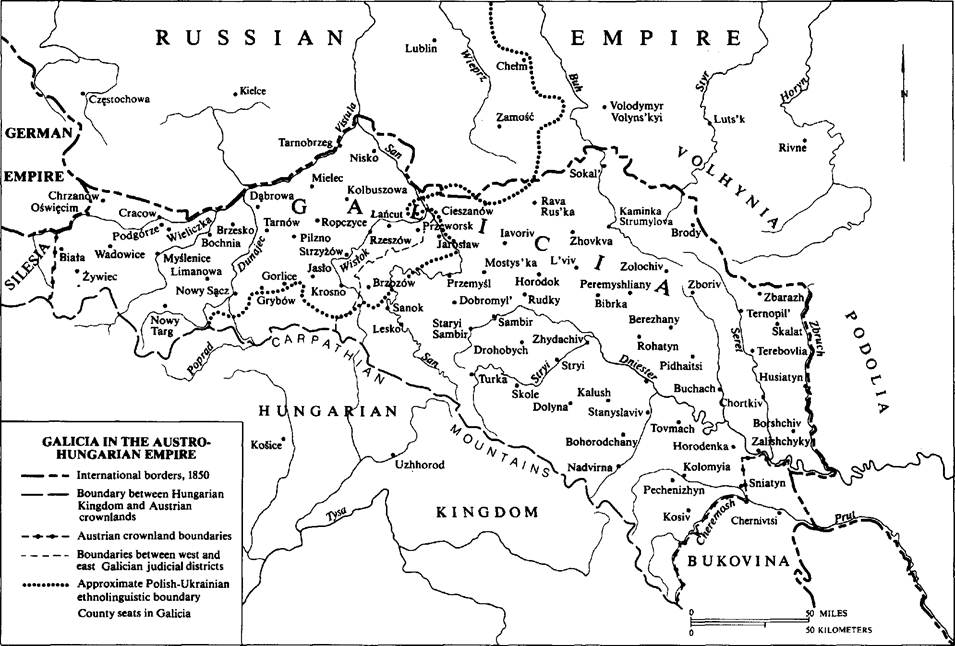
once again expanded northward, almost doubling Galicia’s size.
This last acquisition was lost in 1809 to the Duchy of Warsaw, which soon after became the Congress Kingdom of Poland within the Russian Empire. The only other territorial change came in 1847, when the Austrian administered city/state of Cracow (including the city and some territory north of the Vistula River) was made an integral part of Galicia. With the exception of this last minor acquisition, the boundaries of Austrian Galicia were more or less fixed in 1809. Thus, from the outset of the nineteenth century, Austrian Galicia included historical Galicia inhabited primarily by Ukrainians (71 percent in 1849) as well as some Polish- inhabited territory west of the San and Wislok rivers. In keeping with the principles outlined in the introduction to this study, the following two chapters on the Austrian period will deal with developments in historic, or “eastern” Galicia.Galicia entered the Austrian Empire at a time when that state was ruled by “enlightened” rulers, Maria Theresa and her son Joseph II (reigned 1780-1790), both of whom were anxious to strengthen their realm through a program of national planning and governmental centralization. By 1786, Austrian laws replaced Polish ones; the old dietines (sejmiki) were abolished; and after a while, the elected urban councils (whose privileges had been guaranteed under Magdeburg Law) were replaced by bureaucrats appointed by the imperial administration in Vienna. As in other Austrian provinces, an Assembly of Estates was set up. Located in L’viv, which under the name of Lemberg remained the administrative capital, the assembly comprised magnates, gentry, and clergy. However, it could only send petitions to the emperor; real power rested in the hands of the emperor’s appointee, the governor (gubernator/naczelnik), who ruled with his administration from L’viv. To administer the province more effectively, it was divided into nineteen regions (Kreise). The era of the enlightened, or reforming, Austrian rulers, which Galicia first experienced, had a profound effect on the province’s life.
The formerly all-powerful position of the Polish nobility (szlachta) was broken: the theoretical equality of all nobles was replaced by the creation of two separate estates-magnates and gentry; tax-exempt status for nobles was abolished; their domination of the legal system ended; and their control over the serfs was strictly defined. Emperor Joseph II even went so far as to abolish serfdom in 1781, although his social experiment ended after his death and serfdom was restored. Nontheless, despite these and other reforms from above, life for the masses of the population was unchanged. Galicia still remained an overwhelmingly agrarian society in which the vast majority of the populace was composed of enserfed peasants whose lives, especially in the economic sphere, were dependent on a small class of magnates and gentry.In one area, Austrian rule brought longer lasting change. Equality for all religions was proclaimed and backed up by concrete governmental support, especially in the realm of education. The established church for Ukrainians, now known as Greek Catholic (Uniate was dropped because the hierarchy felt the term was derogatory), received government funding to create Greek Catholic seminaries both in Galicia and in the imperial capital. Elementary education was also encouraged and the first university in Galicia was established at L’viv (1784), where before long an institute (Studium Ruthenum) to train Greek Greek Catholic Ukrainians was set up. The prestige of Ukrainian Greek Catholics was raised even further by the revival of the Galician metropolitanate in 1808.
One result of these developments was the growth of a Galician-Ukrainian intelligentsia. Though small in number and almost exclusively composed of Greek Catholic clergy, this group had become exposed to the ideas of romantic nationalism that dominated contemporary thought in Germany and east-central Europe and that placed an almost mystical faith in the supposed virtues of the Volk-unique ethnolinguistic groups. One of these groups comprised the Ukrainians of Galicia, and from educational centers in Vienna, Przemysl, and L’viv, the beginnings of a Ukrainian cultural revival took place in the first half of the nineteenth century. Of course, this was only the very embryonic stage of national development; the vast majority of the population was still composed of serfs, and the small intelligentsia was confined to struggling over issues of education and the question of formulating an acceptable literary language. Any participation by the masses in this process or any demands for political change had to await the revolution of 1848.
More on the topic Background:
- Background
- Background
- The background
- BACKGROUND
- BACKGROUND
- BACKGROUND
- BACKGROUND
- BACKGROUND
- BACKGROUND
- BACKGROUND
- BACKGROUND
- BACKGROUND
- On the Background
- Background
- Background
- Background
- Background
- Background
- Background