Escherichia coli Infection: Coliform Typhlocolitis
A syndrome resembling C. rodentium and Helicobacter spp. colonic hyperplasia in immunodeficient mice has been associated with an atypical, non-lactose-ferment- ing E. coli.
Epizootiology and Pathogenesis
Large intestinal hyperplastic lesions have been observed primarily in young adult triple-deficient N:NIH(S)III (homozygous for nu, xid, bg) and to a lesser extent double-deficient mice.
Other immunocompetent and partially deficient mice were infected without significant hyperplastic lesions. Bacteria were located in the gut lumen, attached to the surface, and within enterocytes. This syndrome has also been observed in SCID mice (Barthold, unpublished). These outbreaks are associated with an unusual non-lactose-fermenting E. coli, but its primary role as a pathogen remains to be determined. An outbreak of diarrhea and colonic mucosal hyperplasia was reported in DDY mice in Japan, which was associated with an atypical E. coli strain called mouse pathogenic E. coli (MPEC), but subsequent analysis has revealed that the MPEC agent was C. rodentium.Pathology
Mice are depressed, with perianal fecal staining. Gross necropsy findings are limited to mild to moderate segmental thickening of colon or cecum (Fig. 1.57) and
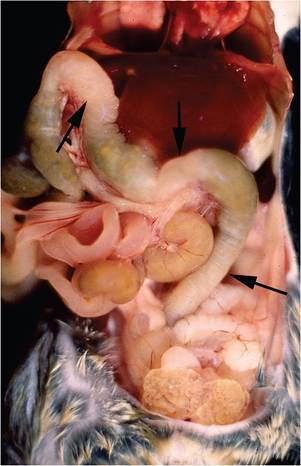
FIG. 1.57. Hyperplastic colitis due to Escherichia coli infection in a SCID mouse. Note the segmental thickening of the colon (arrows), unlike the involvement of the descending colon in mice infected with Citrobacter freundii and diffuse involvement in mice infected with Helicobacter spp.
occasional blood-tinged feces. Microscopic findings consist of mucosal hyperplasia in one or all segments of colon, with variable inflammation and erosion similar to C. freundii. Coliform bacteria are present in the gut lumen, attached to the surface, and within enterocytes of superficial mucosa of both small and large intestine.
Diagnosis
Segmental hyperplastic lesions in the colon and cecum of immunodeficient mice and isolation of atypical E. coli are required to confirm the diagnosis. The causative agent is non-lactose-fermenting, an unusual feature of E. coli. Differential diagnoses must include hyperplastic typhlocolitis caused by C. rodentium (which ferments lactose and is pathogenic in immunocompetent mice), Helicobacter spp., and enterotropic MHV in immunodeficient mice. Unlike C. rodentium, which invariably affects descending colon, E. coli lesions are segmental and usually affect other portions of the colon.
More on the topic Escherichia coli Infection: Coliform Typhlocolitis:
- Escherichia coli inhabits the large intestine and distal ileum of most vertebrate species.
- Enteropathogenic Escherichia coli
- Other Gram-Negative Bacterial Infections Bordetella hinzii Infection
- Helicobacter spp. Infections
- BACTERIAL INFECTIONS
- BIBLIOGRAPHY FOR BACTERIAL INFECTIONS