For profitable heifer rearing, the age of calving needs to be decided well in advance.
It is now common practice to calve heifers in batches and if at all possible growth rates should be adjusted to ensure that the animals in a batch are all approximately the same weight at calving.
Generally the faster-growing animal is more efficient, because a smaller proportion of its food is used for maintenance and a greater proportion for growth. It is for this reason that the two-year-old calving heifer is now very common. The age of puberty is also affected by growth rate, with well-fed animals showing their first oestrus as early as nine to twelve months old. Approximate targets for growth are given in Table 4.1.These targets are for standard crossbred heifers. pure-bred heavier.
Holstein-Friesian Clearly the larger, Holstein will be As an approximate
Table 4.1. Growth targets for Holstein-Friesian cross heifers calving at two years old.
| Target wt | Daily gain | Height at | |
| Age | (kg) | (g/day) | withers (cm) |
| Birth | 45 | 550 | |
| Weaning (6w) | 65 | 550 | |
| 4 months | 115 | 750 | bgcolor=white>100|
| Puberty (11 m) | 280 | 750 | |
| Service (15 m) | 375 | 8201 | 130 |
| Pre calving (24 m) | 580 | 7202 | 142 |
| Mature cow | 660 |
guide, the growth rate should be the mature bodyweight in grams per day, so a Holstein cow with a mature bodyweight of 700 kg needs to grow at 700 g per day to achieve two-year calving.
1Higher growth rates are sometimes recommended for the period 6 weeks before to 6 weeks after service.
2Growth rates may have to be reduced to around 600 g/day for the final 3-4 weeks before calving to avoid overfat heifers.
To achieve high growth rates such as these, a high protein diet is essential throughout the rearing period. Calves should be weaned off milk, eating 1-1.5 kg of a 20-22% crude protein concentrate, reducing to an 18-20% rearing ration, depending on the forage on offer. Even if grass silage quality is high, protein intakes need to be maintained at 17-18%, perhaps increasing to 18-20% immediately pre calving, once again to avoid excessive deposits of fat. If protein intakes are maintained at 18-20% in the total diet, then high liveweight gains can be achieved without the risk of heifers getting overfat.
Probably the worst approach is to stunt growth during the early rearing period by inadequate feeding, poor housing, poor disease control or poor pasture management, then overfeeding in later pregnancy to try to compensate. This will produce overfat heifers with an increased risk of calving problems and early lactation metabolic disorders. An increasing number of people now rear their heifers entirely indoors on a straw and concentrate regime. This certainly gives good control of growth and enables targets to be achieved. However, it does mean that the heifers have no immunity to lungworms and intestinal worms when they first join the grazing dairy herd and this can cause complications.
Another good growth target is height at the withers (Table 4.1). A well-grown Holstein-Friesian heifer will be around 130 cm withers height at the time of service, with the Friesian animals slightly less.
There are many different types of management and feeding systems for rearing. The most important factor is to decide on a policy and then adhere to it. As general guidelines, the following points are important:
• Excessive growth rates in the early rearing period, particularly prior to puberty, can be detrimental.
Overfeeding of energy may limit protein intakes and this can depress secretion of growth hormones. Excess fat is then deposited in the udder and this in turn suppresses development of the milk-producing secretory portion of the mammary gland. Concentrate intakes should be restricted after three months of age to avoid this. Reduced concentrate intakes also encourage increased forage consumption and this may make the heifer a more efficient eater and converter of roughage.• For optimum conception rates, heifers need to be above a certain minimum size (Table 4.1) and gaining weight at around 0.8 kg/day at the time of service. To achieve this, supplementary feeding with 2.0 kg concentrates will probably be necessary, particularly if conserved forage is being fed. Further details of service regimes and the advantages of batch calving heifers are given in Chapter 5.
• Underfeeding during pregnancy, leading to low maternal bodyweight at calving, will depress yields. In a survey of Holstein- Friesian heifers calving at two years old, Drew (1988) showed that heavier heifers at calving gave significantly higher yields:
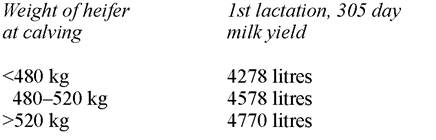
However, although the three-year-old calver may produce more milk in her first lactation, numerous trials have shown that the two-year calver is more efficient and will produce 20% more milk per day of her lifetime (see Table 8.5). Three-year calvers tend to be fatter and experience more calving problems. On the other hand, heifers calving at less than 23 months old are not sufficiently mature, may be bullied, and will give reduced yields irrespective of their bodyweight and condition.
• Weight gains in the last two to three months of pregnancy should be moderate only. Since the majority of the bodyweight of the calf is laid down in late pregnancy, some increase in feeding will be required. A high-protein, moderate energy ration, with ample access to good-quality forage, should be given to avoid laying down excess fat.
Excessive fat deposited around the inside of the pelvis can lead to serious calving problems (see Chapter 5).• When a heifer has calved at two years old she is then both a growing and a lactating animal, and feeding levels should be adjusted accordingly. If she does not reach her full mature size, total lifetime production will suffer and many of the advantages of calving at two years old will be lost.
The achievement of reasonable growth rates depends on adequate feeding, full utilisation of the feed and minimising the effects of disease. Disease contracted during rearing can have great carryover effects on longevity and total lifetime production. Problems of the young calf and the post weaning animal have been described in Chapters 2 and 3. Now we can turn our attention to the diseases which are encountered in the first grazing season, the second winter indoors and miscellaneous conditions of the second grazing season leading up to calving.
Many of the diseases affecting the growing heifer cause few symptoms apart from reduced growth rates and failure to thrive, and this means that it is even more important to be aware of the weight targets for specific ages of animal. The growing heifer is often a grazing animal, and if she receives little or no concentrate supplements she will be particularly susceptible to deficiency diseases. This is especially true during her second grazing season when she will have the requirements of pregnancy added to her needs for growth. Some of the more common causes of failure to thrive are listed below.
Some of these conditions have already been dealt with, and others (for example liver fluke and deficiency diseases) are included in later sections. In this chapter I shall be discussing ostertagia and lungworm, a number of viral conditions, eye problems and the clostridial diseases.
Common Causes of Failure to Thrive
| Parasites • Ostertagia = stomach worm • Dictyocaulus = lungworm • Fasciola hepatica = liver fluke • ticks and tick-borne disease (redwater and tick fever) | Trace element deficiencies • copper • cobalt • selenium/vitamin E Inadequate feed levels and poor housing Avery common cause of poor growth but not discussed in this section. |
There will, of course, be many other diseases affecting heifers where failure to thrive is not the main symptom.
Examples include:| Virus infections • IBR, infectious bovine rhinotracheitis • BVD, bovine viral diarrhoea • MCF, malignant catarrhal fever | Eye problems • New Forest eye • other causes of damage Conditions of the mouth |
| Clostridial diseases • tetanus • blackleg • black disease and botulism | • tooth abscesses • lumpy jaw • wooden tongue Skin conditions |
| Udder problems • summer mastitis • teat warts | • ringworm • mange • lice • photosensitisation |
More on the topic For profitable heifer rearing, the age of calving needs to be decided well in advance.:
- THE COMPONENTS OF THE CALVING INTERVAL
- OTHER POST CALVING COMPLICATIONS
- Putting Your Affairs in Order: Advance Directives
- Marriage and Child-rearing
- Chapter 4 REARING DAIRY HEIFERS
- Advance Praise for Diagnosketc
- Chapter 5 THE COW AT CALVING
- A Century of Advance, 200—303 ce
- For William Byrd II, gendered violence was part of the daily routine. Born to wealth in 1674, Byrd owned thousands of acres in Virginia and oversaw dozens of people who made his estate profitable.
- C Preliminaries to marriage: age, betrothal, and consent
- The Formative Age
- A BRONZE AGE RELIGION?
- Ideal marriage age
- Age or size structure influences how rapidly populations grow
- How Violent Was Iron Age Europe?
- The Little Ice Age
- PART I BRONZE TO IRON AGE