PART I BRONZE TO IRON AGE
The Near-Eastern “Invention” of Empire (Third Millennium to 300 bce)
Peter Fibiger Bang
Inside the fort of Allahabad the observant visitor may, in the distance, catch a glimpse of a majestic column.
2 bronze to iron age
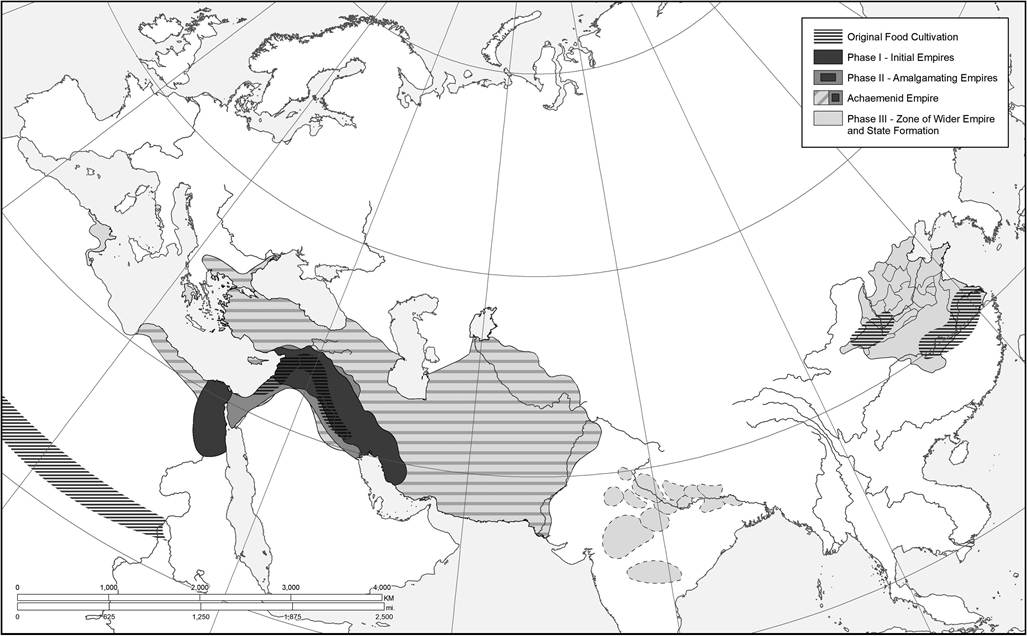
Map I. Bronze to Iron Age, the Near-Eastern “Invention” of Empire (Third Millennium to 300 bce). Copyright: Peter Fibiger Bang with Jonathan Weiland.
Standing some 10 meters tall, but half hidden behind tree tops, the monument is only just about visible from the trail that the multitudes of Hindu devotees follow on their visit to the many holy places scattered across the vast compound.[9] The mighty ramparts of the fort were erected from the 1580s CE onward, right at the confluence, the sangam, of the Ganges, Yamuna, and Sarasvati rivers on the orders of the Mughal emperor Akbar. Located at a crossroads of the great waterways of the immense floodplains of North India, the place was of obvious strategic significance. But even more, it was imbued with deep religious meaning. Allahabad serves as one of the locations for the Kumbh Mela, allegedly the biggest human gathering on the planet, where nowadays perhaps more than 100 million Hindu pilgrims assemble every twelfth year to have their sins washed away in the holy waters. A place of such numinous force has rarely failed to attract the attention of rulers.
When the British established their power in India and lodged the garrison in the fortress—from which the current local regiment and ordinance depot of the Indian army still derives its origin—the column, then lying prostrate on the ground, attracted the attention of James Prinsep. During these early decades of the nineteenth century, German and French scholars were making remarkable progress in deciphering both cuneiform and hieroglyphics, the scripts of ancient Mesopotamia and Egypt.
The English, Prinsep thought, had better not stand behind the achievements of their European rivals and so, as the secretary of the Asiatic Society of Bengal, he began a vigorous program of recording the most ancient inscriptions to be found on monuments across India.[10] On the exquisitely polished surface of the red sandstone of the Allahabad pillar, it turned out, were several groups of inscriptions. The most easily decipherable was carved in beautiful Persian letters in a belt around the central part of the pillar: “Allah Akbar! The light of the faith of Muhammad, Jahangir, badshah, gazi... son of Akbar... son of Amir Teimur, lord of the auspicious conjunction...”[11] Dated to the year 1014 of the Islamic era, the text announced the claim of Jahangir to the royal succession on the death of Akbar in 1605 ce. Jahangir had presided at the fortress as governor of the province and was now eager to accede to the throne ahead of any rival male relatives he might have. The sentences proudly inserted him into a line of rulers stretching back to the great Central Asian conqueror of the turn of the fourteenth century CE—the fabled and feared Timur Lenk.But the claim went further still. The statement of dynastic succession overwrote part of another, far longer, inscription written in the Sanskrit of a much earlier era. It is now clear that this text was written at the instigation of Samudragupta, an imperial lord projecting his power across North India in the fourth century ce: “He was without an antagonist on earth; he, by the overflowing of the multitude of (his) many good qualities adorned by hundreds of good actions, has wiped off the fame of other kings with the soles of (his) feet.”[12] In appropriating the ancient monumental pillar to underscore his own claims, Jahangir had good precedence. In Delhi, Sultan Feroz Shah had already in the fourteenth century added his own inscriptions on two similar such columns before placing them, at considerable effort, atop his new palatial complexes as proud adornments and testimonies to the achievement of his era.
Both these Muslim monarchs of the mid-second millennium ce, however, had long since been preceded by Samudragupta. When this king of the Gupta dynasty had his name and accomplishments inscribed on the Allahabad pillar to record for posterity how he had surpassed all other rulers, it had not been on a clean slate. For, above his inscription was, finally, a further set of texts recording the edicts issued by an emperor, Piyadasi, “the beloved of the gods.” In the Buddhist tradition, this ruler was known as Asoka and, based upon the inscription’s reference to some of the post-Alexander kings of the Hellenistic world as contemporaries, it was now suddenly possible for Prinsep to locate this scion of the mighty Mauryan dynasty firmly in the third century bce. From his seat at Pataliputra on the Ganges, the power of Asoka had been projected far and wide across India. To the scholarship of the colonial period, the Allahabad pillar came to serve as an anchor in its efforts to devise a firmer chronology and master the most ancient periods of Indian history. For the world history of empire, the pillar does a no less significant job. It provides an axis that opens up a dizzying vista of deep chronological reach and wide geographical expanse (see further Ray in Chap. 7).[13]When the British, convinced of the significance of the pillar, chose to raise it up from the ground again, they participated not only in the nineteenth-century rivalry of international powers to explore and record the planet and its past, they
also inscribed their own imperial project into a competition that linked conquerors across millennia from east to west (see Hilsdale, Vol. 1, Chap. 6 for a parallel example and general analysis). The history charted on the pillar, via several chronological stops from modern colonialism, over the Asian empires of the early modern world, to the great realms of deepest antiquity, had already been long in the making when Asoka put up his proclamation and arguably commences with a monarch of the Near Eastern Bronze Age, Sargon of Akkade: “Lo, the king who wants to equal me, where I have gone, let him also go.”[14] This historical summons to emulate the Akkadian ruler was penned centuries later, long after his dynasty had fallen.
Boasting conquered foes across Mesopotamia down to the Persian Gulf and in the opposite direction, all the way to the Mediterranean, Sargon became legend. Tales and myths accumulated in his name while monarchs celebrated his deeds and sought to step into the shoes of the mighty conqueror, “ruler of the universe.”Sargon, ruling in the late third millennium bce, is commonly discussed as the first empire builder in world history. In fact, precious little is known of the realm claimed by Akkade; it appears to us only as a nebulous entity, a very light structure. By this time, the pharaohs had already united the many communities strewn along the Nile Valley under their rule, combining the thrones of both Upper and Lower Egypt. Normally, however, the word “empire,” among Egyptologists, is reserved for periods when the pharaohs attempted to project their power beyond their core dominion, down into Nubia or up toward Palestine (Chap. 1). By contrast, Steinkeller includes Ur III, a geographically much more compact, but administratively firmer entity that followed the dynasty of Akkade, in his discussion of early Mesopotamian empire (Chap. 2). Where precisely to locate the beginnings of empire between these alternatives is perhaps less significant than recognizing the underlying process. State- and empire-building became possible when the agricultural population stopped being able to escape the demands of emerging military and ritual specialists. This happened first in the fertile flood valleys of the ancient Near East with the so- called Bronze Age urban revolution, during the fourth and early third millennium bce. Favorable conditions for irrigated agriculture produced grain yields well above what was possible in other locations and supported growing numbers of people on the land. These in turn constituted a ready supply of labor with which to extend irrigation works further. Irrigation agriculture and population fed on one another in an upward spiral. Soon the population had become too large to maintain itself outside the flood valleys; the peasantry was trapped and open for control.
Historically, populations have been able to resist demands for labor or taxes by moving away: nomads, for instance, or slash-and-burn agriculturalists. The great anthropologist and macro-historian Jack Goody identified a decisive rift between the parts of the Old World that had participated fully in the Bronze Age urban revolution and those that did not. In Sub-Saharan Africa, state-building elites had made little progress because land had been too plentiful and population too sparse. Confronted with their demands, people moved out of reach and on to new territories. When empire finally emerged in Sub-Saharan West Africa, with the adoption of Islam from the North, imperial formations such as the Mali and Songhay (Chap. 23) and the Sokoto Caliphate (Chap. 40) may have been geographically very extended, but in terms of imposing effective control they were capable of relatively little.[15] Not so in Mesopotamia or the Nile Valley, where priests and military men became able to extract a substantial part of the agricultural production in return for protection from the wrath of warriors and divine beings alike.
In the beginning, this resulted in small, nucleated communities organized around a temple cult and ruling elite, supported by estates, corvee labor, and slaves. But the logic governing the process was expansive and aggregate as elites quickly became locked in competition with each other; the organization of “protection” - a point elegantly established by F. C. Lane - entailed clear economies of scale. Very early on, the pharaohs managed to extend their sway over a much wider territory, enabling them for years on end to call up the labor of the several thousand peasants required in order to erect the vast and awe-inspiring pyramids. However, within the wider dominions that were forming, local elites continued to control the smaller “temple communities” or city-states (as they are called among scholars of Egypt and Mesopotamia, respectively), while mediating relations to the monarch hovering high above.
There was little alternative to local government in a world where communication and transport was by slow-moving sailboat, domesticated animal, or one's own feet. Distance, as Braudel remarked, was “the first enemy,” an obstacle to integration against which empires had to wage an “unremitting struggle.”[16] Compulsory cooperation, a term coined by Michael Mann, became a central building block of geographically more extended forms of state power. Local and regional elites took care of most of the nitty-gritty affairs of government in return for a share of the income, the tribute generated by extracting a part of the produce and labor of the subject population.Distinguishing themselves from the rest of the population, the ruling elites began to develop lifestyles and public rituals that stood out from the simplicity and largely self-sufficient modes of living found among the peasantry. The class of rulers and priests required access to strategic goods, such as the metals necessary for the production of bronze, and they coveted rare and exotic materials. All these things were necessary to the elite for the fabrication of weapons and for employment in the elaborate ceremonies that served to enhance their prestige and appearance while the steep and rigid hierarchical order of society was being enacted and ritually impressed upon the commoners. But if the flood valleys were unusually fertile, they were also uncommonly uniform environments, often lacking in the range of natural resources available. To get access to greater variety, elites had to venture outside the agricultural base. Soon expansion also began to reach out toward the control of trade routes and supply lines of the more strategic and numinous materials. Mounting expeditions to obtain cedars from Lebanon—prized for their tall tree trunks, to be used as columns in monumental building—came to rank among the deeds that every Mesopotamian king should aspire to. More generally, agrarian empire and trade are often discussed as mutually exclusive opposites; but this is a false dichotomy. Imperial elites needed access to markets to transform part of their agricultural wealth into a greater array of products and goods. Empire was a strategy to capture the world's diversity, in materials as well as in people (See Haldon, Vol. 1, Chap. 5 on the political economy of empire).
The demand of state-forming elites for distant products even fueled the rise of a thin Afro-Eurasian long-distance trade. Sometimes misleadingly referred to as the Silk Road, the series of overlapping macro-regional commercial networks that slowly came to span pre-industrial Eurasia may perhaps better be labeled as a form of “archaic globalization,” a result of elite ideologies of consumption and far-flung imperial conquest.[17] Under this rubric also belongs slavery, the capture of human labor, sometimes in possession of specialized skills that were not otherwise available to rulers and their elites. Victory in war automatically brought with it captives, and through most of history, the growth of empire often went together with the growth of slavery.[18] “His might is in all lands,” Ramesses II, the model imperialist of ancient Egypt, announced for all times on the temple at Abu Simbel, “bringing for him multitudes of workmen from the captivity of his sword in every country.”[19]
Although emphasized through the depiction of long rows of ethnically diverse captives, the claim of Ramesses was wildly hyperbolic. His own expansive ambitions had been checked in 1274 bce at the Battle of Kadesh, once a city in Syria, and soon he had had to come to terms with the ruler of the Hittites, a rival monarchy that had developed in Anatolia, recognizing him as an equal. But that was done only grudgingly. The temples of Ramesses were plastered over with triumphant depictions and verbal celebrations of the invincible military prowess of the pharaoh laying low his enemies, much to the dismay of his Hittite colleague, who complained in letters about the boastful and distorted representation of their military confrontations propagated in Egypt. Little did it help. On the temple built to worship Ramesses and keep his memory alive, an inscription portrayed the Hittites coming as supplicants to the pharaoh, asking for peace.[20] Maybe Ramesses had to lend grudging recognition to his Anatolian rival, but to the home audience he would still insist that he was the greatest and mightiest. This is a grammar that would continue to structure the competition for supremacy among monarchs and states through the centuries.
The Near Eastern world had grown and populations had become denser since the time of Sargon. Several great powers had emerged among a vast number of lesser rulers. This select family of “great kings” was pulled together in mutual recognition and rivalry.[21] The annals of ancient Near Eastern history presents a long catalogue of putative imperial powers, many more in fact than could be included for detailed treatment in the subsequent chapters of Part I. However, behind the vast parade of powers that came and went, a trend toward expansive growth and consolidation was gathering strength, but only slowly. The Bronze Age societies of the Levant still comprised only a few million people and state organizations remained brittle and vulnerable. The twelfth century bce even saw a period of widespread collapse, especially along the margins. Historians continue to struggle to explain this “dark age,” but the first adaptation of iron for the production of weaponry likely represented a serious challenge to the hold on power for existing state and warrior elites. Iron was far more easily available than bronze alloy, which in addition to copper requires tin, a metal that was only obtainable from a very restricted number of distant geographical locations. As new and old elites learned to adapt to the conditions of the iron age and managed to regain control, state-building resumed with greater strength; its repertoire of governing institutions and practices now took on firmer contours.[22] These developments culminated in the triumphant rise of Assur, a city-state in Northern Mesopotamia. From the late tenth century bce until the late seventh century bce, the Assyrians managed, bit by bit, to subject the rest of the ancient Near East to their rule and bring the old Mesopotamian process of state-formation to its logical conclusion: universal empire (Barjamovic, Chap. 3).
From near and far, people would flock to new palatial cities constructed at Kalhu, Dur Sharrukin, and Nineveh to demonstrate their loyalty or seek the favor of the great king; eventually even Egypt was reduced to vassalage. The Assyrian lord knew no equal and his writ ran to all corners of the Levantine world while his armies wrought havoc among enemies and rebels. Populations of specialist craftsmen and laborers were deported to new locations to cater to the needs of the Assyrian rulers. Large irrigation works were constructed, hunting grounds with animals and plants from all over the realm were established to symbolize the universality of the empire in microcosm, while the world of letters was served by the sponsorship of vast book collections. The main text of the epic of Gilgamesh, among the oldest literary texts in the world and a touchstone of ancient Mesopotamian court culture, was recovered during archaeological excavations of the royal library in Nineveh.[23] Then, at the height of its glory and power, the empire was riven by rebellion and civil war. A composite body, potential rival centers of power remained within its territory. One such was Babylon, a vast city-state in southern Mesopotamia and once the seat of an empire of its own; it now came to serve as a basis for a rival claimant to the throne. However, the succession struggle opened a Pandora's Box. In less than a decade Assyrian power collapsed while the Babylonians were able to capture a part of the imperial territories. In doing so, they also drew on assistance from the neighboring Iranian regions. This was a sign of things to come.
A few decades later (539 bce), Babylon would fall to an invading force led by Cyrus, a local Persian dynast. The Achaemenid or Persian Empire had been born (Waters, Chap. 4). Under Cyrus and his successors, the armies of the Achaemenid rulers would roam wider and further than anyone before. What Droysen remarked of Alexander the Great, the eventual Macedonian conqueror of the realm, could as well be said about the Achaemenids themselves: they seem both to bring an epoch in world history to its conclusion and be the initiators of a new age.[24] From one perspective, the Achaemenids stepped successfully into the shoes of the Assyrian Empire, conquering all of its former territories. However, the new empire did more than just restore and build on the foundations of the past; it broke the bounds of the old Near Eastern world, extending its hegemony across Iran and deep into Central Asia, as well as to the west, pushing out through Anatolia to reach for the growing world of Hellenic city-states around the Aegean. Empire was now sustainable outside the traditional population centers of the Levantine world. The zones of relatively dense sedentary peasantries, which required the intensification of land use and cultivation of food crops, had continued to grow bigger, and the formation of empire followed suit. The Achaemenid achievement marks a new plateau in world history that set the parameters of imperial rule for many centuries to come. In broad terms, they effectively stretched across as much territory as could be managed until the age of colonialism widened the reach of imperial power further still.[25]
As king of kings, their rule has become an emblem of imperial diversity, subjecting an almost infinite variety of ethnic groups and polities to their decentralized overlordship. Satraps were sent out from the court to govern individual regions of the empire, more in the nature of a viceroy than the civil servant of a centralizing administration. Meanwhile, the Achaemenid ruler himself traveled, taking turns residing in a number of royal residences situated around the empire. His realm was a patchwork, a composite and occasionally fissiparous body comprising many regionally distinct forms of political organization; the ruler responded in the only way possible—by conspicuously professing his respect for local customs and traditions. A loose unity, or integration, was produced not through assimilation, but through a hierarchical and ritual dialogue; the court of the ruler and his highest representatives would distribute privileges and distinctions to local elites, who were left mostly to govern themselves, in return for submissive loyalty. Only a small tier, mostly of Persian descent, constituted an empire-wide aristocracy, or “ethno-ruling class” as some prefer, on whom the very highest positions at court, in the army, and across the provinces would be bestowed. Their children would be sent to court to bond and fraternize with the royal offspring. Such a thin super-structure was enough. The demands of the Achaemenid world ruler would have been a relatively light burden to carry, at least for much of the empire. But the realm was of such gigantic proportions that even modest tax demands were sufficient to make the depth of the imperial coffers proverbial. No one could match the wealth and amount of resources available to the Great King.
The imperial monarchy of the Achaemenids set a powerful example for the next several centuries, sparking both emulation, tacit adaptation, and open rejection. Herodotus (ca. 484-420 bce), in one of the earliest extant works of history— written from the margins of the Persian world—saw the great realm as immoderate, militating against the laws of reason and proportion. Whether the Achaemenid world empire was reviled or admired, however, it produced an archetype that, bundling a set of solutions to the problem of extensive government in pre-industrial societies, would be both adapted, modified, developed, and reinvented from scratch in subsequent millennia by imperial rulers. This happened as the Achaemenid king of kings ceased to have the world to himself and found that rivals of his own caliber had appeared. The growth of peasant populations capable of supporting stateformation outpaced, so to speak, the reach of Persian arms. From the early sixth to the end of the fourth centuries bce, the central-western Mediterranean, East Asia, and North India saw the rise of state-systems and states of sufficient weight to constitute new centers around which extensive empires would begin to congeal (Scheidel, Chap. 5).
Bibliography, with Guidance
The short opening chapters for Parts I to VIII seek to identify the overarching patterns and broad trends that are characteristic of each period in world historical terms. No attempt has been made to provide detailed references for these synthetic histories. This would have been an almost meaningless exercise given the vast, not to say disorienting, amount of historical scholarship that each of these aims to distill into a relatively short statement about the main developments in the history of imperialism. However, the opening syntheses should all be seen as having been written on the basis of the individual historical narrative chapters that follow inside each part. While references have been restricted mostly to direct quotations or, minimally, to providing some literature on the specific examples that are discussed in detail, each accompanying bibliography will be prefaced by a few lines guiding readers toward some examples of scholarship. These will not always be the most recent, but will rather be works that have offered significant synthesizing overviews in the past, and that have helped shape a broader world historical understanding of the period and processes in question. Moreover Chapter 1, of volume 1, The Imperial Experience, provides an extensive theoretical survey with much guidance on the scholarship of empire.
For the beginning of imperialism and state-formation, Mann (1986) is fundamental. Eich (2015) supports our emphasis on war, military elites, and state-formation emerging out of people's lack of ability to move out of reach. On the basic character of complex or state-forming pre-industrial societies, Hall (1985) and Crone (1989) offer trenchant discussion, while Braudel (1981) remains unsurpassed, not least in his emphasis on slow, demographically driven, spatial expansion. Bang and Scheidel (2013) survey the process of state-formation in western Eurasia from the Bronze Age up to the rise of Islam. Bang and Koiodziejczyk (2012) track the spread of universal empire and its grammar of lordship across Afro- Eurasian history, from the Assyrians and Achaemenids to the eighteenth century. Alcock et al. (2001) and Bang and Bayly (2011) examine the comparative historical sociology of pre-colonial empires. Scheidel (2017) emphasizes their strength in forging steeper social hierarchies, and Burbank and Cooper (2010) explore imperial strategies of rule, the manipulation of a politics of difference, from antiquity until the twentieth century.
Bibliography
Alcock, S. et al. eds. 2001. Empires: Perspectives from Archaeology and History. Cambridge.
Allen, C. 2002. The Buddha and the Sahibs. London.
Allen, C. 2012. Ashoka: The Search for India’s Lost Emperor. London.
Bang, P. F. 2016. “Beyond capitalism - conceptualising ancient trade through friction, world historical context and bazaars.” In J. C. M. Garcia, ed., Dynamics of Production in the Ancient Near East, 75-89. Oxford.
Bang, P. F., and C. A. Bayly, eds. 2011. Tributary Empires in Global History. Basingstoke, UK.
Bang, P. F., and D. Koiodziejczyk, eds. 2012. Universal Empire: A Comparative Approach to Imperial Culture and Representation. Cambridge.
Bang, P. F., and W Scheidel, eds. 2013. The Oxford Handbook of the State in the Ancient Near East and Mediterranean. New York and Oxford.
Bayly, C. A. 2002. “ ‘Archaic’ and ‘Modern’ Globalization in the Eurasian and African Arena, c. 1750-1850.” In A. G. Hopkins, ed., Globalization in World History, 47-73. London.
Bhandarkar, D. R., B. C. Chhabra, and G. S. Gai. 1981. Corpus Inscriptionum Indicarum, Vol. III: Inscriptions of the Early Guptas, rev. ed. New Delhi.
Bradley, K. and P. A. Cartledge eds. 2011. The Cambridge World History of Slavery. Vol. 1: The ancient Mediterranean world. Cambridge.
Braudel, F. 1972. The Mediterranean and the Mediterranean World in the Age of Philip II. Translated by S. Reynolds. New York.
Braudel, F. 1981. The Structures of Everyday Life: Civilization and Capitalism, 15th- 18th Century, Vol. 1. Translated by S. Reynolds. New York.
Breasted, J. H. 1906. Ancient Records of Egypt, Historical Documents, from the Earliest Times to the Persian Conquest. Vol. 3: The Nineteenth Dynasty. Chicago.
Bryce, T 2005. Kingdom of the Hittites, New Edition. Oxford.
Bryce, T 2006. “The ‘Eternal Treaty’ from the Hittite Perspective.” British Museum Studies in Ancient Egypt and Sudan 6, no. 1-11. http://www.thebritishmuseum.ac.uk/bmsaes/issue6/bryce.html.
Burbank, J., and F. Cooper. 2010. Empires in World History: Power and the Politics of Difference. Princeton, NJ.
Burt, T. S. 1834. “A Description, with Drawings, of the Ancient Stone Pillar at Allahabad called Bhim Sen’s Gada or Club, with Accompanying Copies of Four Inscriptions Engraven in Different Characters upon Its Surface.” Journal of the Asiatic Society of Bengal 3, no. 27 (March): 105-113.
Crone, P. 1989. Pre-Industrial Societies: Anatomy of the Pre-Modern World. Oxford. Dal Lago, E. and C. Katsari eds. 2008. Slave Systems: Ancient and Modern. Cambridge.
Droysen, J. H. G. [1877] 2008. Geschichte des Hellenismus. Vol. 1: Geschichte Alexanders des Grossen. Edited by E. Bayer, introduction by H.-J. Gehrke. Darmstadt.
Eich, A. 2015. Die Sohne des Mars: Eine Geschichte des Krieges von der Steinzeit bis zum Ende der Antike. München.
Finley, M. I. 1980. Ancient Slavery and Modern Ideology. London.
George, A. 1999. The Epic of Gilgamesh: The Babylonian Epic Poem and Other Texts in Akkadian and Sumerian. London.
Goody, J. 1996. The East in the West. Cambridge.
Hall, J. A. 1985. Powers and Liberties. London.
Lane, F. C. 1958. “Economic Consequences of Organized Violence.” The Journal ofEconomic History 18, no. 4:401-417.
Mann, M. 1986. The Sources of Social Power, Vol. 1. Cambridge.
Prinsep, J. 1834. “Note on Inscription No. 1 of the Allahabad Column.” Journal of the Asiatic Society of Bengal 3, no 27, March: 114-118.
Richardson, S. 2017. “Before Things Worked: A ‘Low-Power’ Model of Early Mesopotamia.” In C. Ando and S. Richardson, eds., Ancient States and Infrastructural Power. Europe, Asia, and America, 17-62. Philadelphia.
Scheidel, W 2017. The Great Leveler. Princeton, NJ.
Scott. J. C. 2009. The Art of Not Being Governed. An Anarchist History of Upland Southeast Asia. New Haven.
Taagepera, R. 1978. “Size and Duration of Empires: Systematics of Size.” Social Science Research 7: 108-127.
Tymowski, M. 2011. “Early Imperial Formations in Africa and the Segmentation of Power.” In Bang and Bayly: 108-119.
Westenholz, J. G. 1997. Legends ofthe Kings of Akkade. Winona Lake, IN.
More on the topic PART I BRONZE TO IRON AGE:
- 17 Tin Traders
- CHAPTER IX. SIBERIA AND SURROUNDING COUNTRIES.
- Fagan Garrett G., Fibiger Linda, Hudson Mark, Trundle Matthew (eds.). The Cambridge World History of Violence. Volume 1: The Prehistoric and Ancient Worlds. Cambridge University Press,2020. — 756 p., 2020
- Bibliography
- CHAPTER FOUR Town and Country Urban devotions and rural rituals
- Transformation (Specification)
- Archaeological Evidence for Violence in the Later Stone Age