Molecular Epidemiology of BTB in Nigeria
Despite the evidence of BTB being present in Nigeria from early 1929 (Alhaji 1976), some insight into the molecular epidemiology of the disease was reported only in 2004 (Cadmus et al.
2006, 2004). Prior epidemiologic investigations were based on tuberculin tests, post-mortem examination at the abattoirs, laboratory analyses (mostly direct microscopy to detect AFBs), and on a few occasions, isolation and identification of mycobacteria using culture and biochemical tests (Alhaji 1976; Dusai and Abdullahi 1994). However, in view of the obvious existing information gap about the extent of zoonotic TB in the country, a scientific initiative initiated in 2003, by the author in collaboration with scientists from the TB Diagnostic Section, Veterinary Laboratories Agency (VLA), UK (now known as Animal and Plant Health Agency, Surrey, UK), to undertake molecular analyses of bovine and human tubercle bacilli in Nigeria (Cadmus et al. 2006). Using spoligotyping and variable-number tandem-repeat (VNTR) analyses, this work unequivocally showed that the majority of human TB in Ibadan, South-western Nigeria, was caused by a single, closely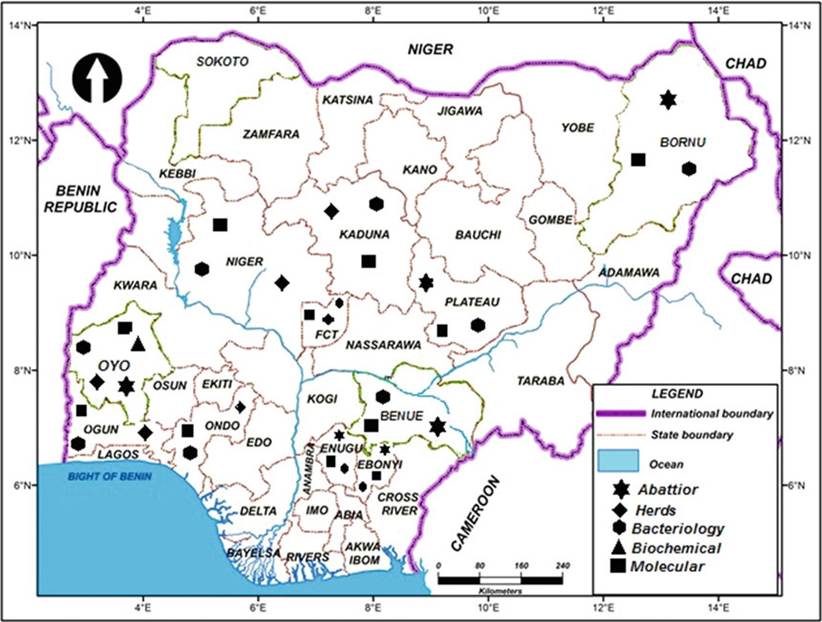
Fig. 17.1 Map of Nigeria showing the different states where BTB investigations using different diagnostic methods have been conducted
370 S. I. B. Cadmus
related group of M. tuberculosis strains. It was further shown by deletion typing that approximately 10% of the human TB cases were caused by strains of M. africanum and 5% by M. bovis.
Earlier preliminary data had shown the circulation of similar strains of M. bovis in a private cattle herd in Ibadan, South-western Nigeria (Cadmus et al. 2004), re-affirming the usefulness of molecular epidemiology as a tool to track specific strains of pathogens to understand the transmission of disease in different populations.
Recent studies conducted in different parts of Nigeria (Cadmus et al. 2006, 2011; Abubakar 2007) have shown that diverse strains of M. bovis circulate in the country (Table 17.3). These strains, also isolated from neighboring countries of West Africa, have been genotypically classified as the Af1 clonal complex (Muller et al. 2009).To date, the majority of the MTC species isolated from cattle in Nigeria have been confirmed by spoligotyping to be M. bovis (Cadmus et al. 2006, 2011; Abubakar 2007), with the SB0944 strain being the most frequent spoligotype circulating in the country. Several strains of M. africanum (lacking spacers 8, 9, and 39) have also been isolated from tuberculous cattle (Cadmus et al. 2006, 2011; Abubakar 2007). Cadmus et al. (2006) and Abubakar (2007) also detected M. tuberculosis (intact spacers 39 through 43) in slaughtered cattle in Nigeria using molecular tools like spoligotyping, VNTR (Streicher et al. 2007) and deletion typing (Cadmus et al.
2006).
Molecular epidemiology, using VNTR and MIRU-VNTR, further showed a large diversity in the strains of M. bovis in Nigeria (Cadmus et al. 2006, 2011, 2008), although most M. bovis strains isolated in Nigeria belong to the African 1 (Af1) clonal complex. The Af1 clonal complex is a group defined by a specific chromosomal deletion (RDAf1), and lacking spacer 30 using the standard spoligotype pattern (Muller et al. 2009), and its occurrence is limited to the West-Central African region compared to strains circulating in Eastern Africa and Europe (Muller et al.
2009). Though there have been several efforts to decipher the epidemiology of M. bovis in cattle and other animals in Nigeria using different molecular techniques (Cadmus et al. 2006, 2011; Abubakar 2007; Jenkins et al. 2011), there is still a huge information gap. Inadequate veterinary infrastructure, insufficient and inadequately trained personnel, and most importantly, the lack of funding to support animal health delivery are some of the factors militating against proper investigations into the molecular epidemiology of BTB in Nigeria.
17.7
More on the topic Molecular Epidemiology of BTB in Nigeria:
- Economic Losses Associated with BTB in Nigeria
- Risk Factors of BTB in Nigeria
- Historical Perspective of BTB in Nigeria
- The Use of Molecular Epidemiology in Understanding the Dynamics of M. bovis
- Molecular Epidemiology of Bovine Tuberculosis in Uganda
- Prevalence of BTB in Cattle Herds in Nigeria
- The Epidemiology of BTB in Cattle in Cameroon
- The Epidemiology of BTB in Malawi
- Prevalence and Epidemiology of BTB in Rwanda
- Molecular Epidemiology of M. bovis in Humans and Other Hosts in Africa
- Chapter 8 Molecular Epidemiology of Mycobacterium bovis in Africa
- Epidemiology of BTB Caused by M. bovis in Burkina Faso
- Nigeria
- Nigeria
- Molecular Typing for Epidemiologic Studies of Mycobacterium bovis
- Molecular Genetic Studies
- Prevalence of BTB in Cattle Slaughtered in Nigerian Abattoirs
- Nigeria: mission ahead of empire
- Post-mortal Diagnosis of BTB in Nigerian Abattoirs