Building a Grid of Analysis for Expanding the Genericness of a Past Society-Environment Model
8.5.1 Objectives for Expanding Model Genericness
One may point out that building a model that fulfils both scale & discipline categories (i. and ii. in Sect. 2) and temporal, spatial and emergence genericness criteria (1.
2 and 3. in Sect. 3.1) may be:• Very difficult to build, both humanly and technically: it needs a lot of time to build a model with many disciplines, which means managing consortiums of thematic-oriented scholars for whom the value of a model depends on the spatial and temporal adequacy with their own data. Thereby, defining altogether within the consortium the model variables to consider but also to exclude, which is far more difficult, is a harsh task[9];
• Very challenging to validate: two validation steps are to be considered: confrontation with external data and sensitivity analysis (Amblard et al. 2006). As described by the latter and Bonaudo (2005), there is no absolute validation of a model. Following Popper (1985), a theory and therefore a model is temporarily accepted until it is rejected. Field data confrontation is challenging technically but not methodologically as far as a database was kept apart of the model building for confrontation purposes. On the other hand, sensitivity analysis complexity increases dramatically with the number of variables which are to be integrated in a model;
• Useful only under specific conditions: outputs of a very multidisciplinary model are harder to interpret for a monothematic scholar, meaning that the more a model is multidisciplinary; the more the use of it may be de facto restricted socially to modellers and the more publications are harsh to be published: journals are mainly thematic-oriented and model description increases with the number of disciplines, decreasing thereby their acceptance.
We can then deduce from these points that the ultimate goal of one modeller, at least for the present-time, is not to build the ultimate model that can answer and/or explore all the combinations of a past human-environment interaction.
Whatever the variable in a spatialized model, data are never fully and perfectly available, neither for present-time data and even less so for data concerning past periods. Such a perfect source cannot exist, once we acknowledge that spatial data can be completed only through reconstructions, at least partially, based on interpolations or inferences. Thereby, lacking data can be compensated by assumptions based on inference as well; The fact that data quality varies is not per se a criterion whether to use one type of data (and the corresponding variable and discipline) and to exclude another one. The sole criterion for deciding if a phenomenon should be included is the common agreement between scholars, even without data. Therefore and following Saqalli et al. (2010), including a variable that is acknowledged as important,, is a smaller error than not considering it, even if this means to include it in a very simplistic way.
Finally, following An (2012) or Tzanopoulos et al. (2013), models where disciplines are combined but also interact may produce emergence of unexpected phenomena. More globally, one cannot always define ex ante the impact range of many variables. This applies especially for social variables, such as availability of manpower dedicated to rural activities, which may have multiplied impacts over the transformation power of humans over natural resources. We thus identify the following two desiderata:
• A methodology of model combination to answer the requirements we proposed above;
• A guideline of models according to objectives and available data.
8.5.2 Combining Four Objectives for Expanding Model Genericness
We then consider that analysing the validity of past society & environment models is performed as follows:
• Adequacy to scale and spatial genericness: simulation outputs correspond as much as possible to local data along time;
• environmental genericness: the model can be considered as reproducing correctly environmental dynamics of a broad territory;
• social genericness: the model is acceptable regarding social dynamics, including innovations' appearances, adaptations and social differentiations;
• Validity regarding emergence: It includes conjunctions, emergences, shocks, sudden events that may impact evolutions of a system.
The four types of models we described in the previous sections may be categorized along these four genericness paths, following Table 8.1:
Based on this classification, we propose a grid of pathways for expanding the genericness of the initial model one scholar may have built. Because each model is de facto a theory, i.e. a conceptualisation of a socio-ecological system (SES), it is also a methodology of test of this theory regarding scale, environment, society and emergence. Once a scholar has a model corresponding to one archetype we described in Table 8.1, different ways for expanding its genericness start from the initial model and may follow different procedures according to the genericness objective the scholar may have, itself defined by the pursued research question. The Fig. 8.3 illustrates the various patterns such pathways may follow.
These combinations of factors induces the definition of twelve pathways of genericness expansion, each one describing a methodology of model uses according to scales and drivers, each one allowing the exploration of one research question,
Table 8.1 Criteria of genericness for modelling past societies and their environments
| Model types | Scale and spatial genericness | Environmental genericness | Social genericness | Validity regarding emergence |
| TEM | Yes: it is de facto an “instantane” | No, because of the scale | No | No |
| TSM | Yes, with variations along scenarios. ex.: 1 scenario = 1 innovation | No, because of the scale | Yes, with drivers ruling innovations’ appearances or not, following theories | Yes, locally, thanks to social drivers. Environmental ones are less integrated because of scale |
| WEM | No, too broad | Yes, even with huge simplifications | Yes, with drivers ruling innovations’ appearances or not, following theories1 | No |
| WSM | No, too broad | Yes, through present time farming system inferences | No (not yet?) | Yes, socially and environmentally |
Fig.
8.3 Diagram of validity expansion paths, from one of the four model archetypes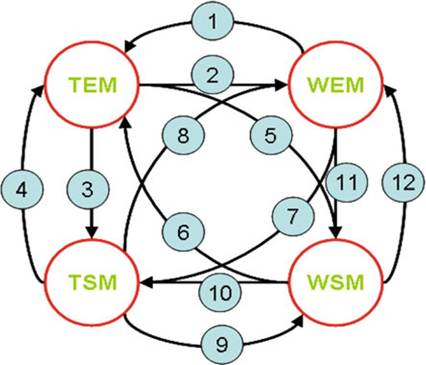
that we described in Table 8.2. As a matter of fact, establishing a selection arborescence of procedures of combination and use of models according to different criteria (scale, disciplines as inputs and drivers, consistency principles, etc.) leads to so many combinations that a full arborescence is yet to be built.
Table 8.2 Paths of genericness for modelling past societies and their environments
| Methodological procedure | Related research question | |
| 1 | TEM WEM procedure: | Integrative world models improvement approach: Step by step improving world models by including results from various local case study models |
| 2 | WEM TEM procedure: | World models testing approach: Analysing world models results for specific locations, to compare with results from local archaeologically-constrained models; Building first trials of local models, to be compared with archaeological data |
| 3 | TEM TSM procedure: | Local impacts of innovations/adaptations evaluation approach: Using a TEM model as a test-bed for analysing innovations & adaptations to shocks ‘costs/benefits’, not to compare with data |
| 4 | TSM TEM procedure: | Innovations appearance identification approach: Several TSMs are tested to see if they fit better with archaeological data and TEM data: which innovations appearance and statistically-defined chaotic events explain farming system situation, sustainability AND diachronic evolution? |
| 5 | TEM WSM procedure: | Integrative world models improvement approach, including global shocks: Step by step improving world models by including results from various local case study models AND integrating large scale variability (climate, for instance) |
| 6 | WSM TEM procedure: | World models testing approach: Analysing world models results for specific locations, to compare with results from local archaeologically-constrained models and timely constrained “snapshot models”; Building first trials of local models, to be compared with archaeological data |
| 7 | TSM WEM procedure: | Integrative world models improvement approach, smoothing local shocks: Step by step improving world models by including results from various local case study models, including local variability & innovations |
| 8 | WEM TSM procedure: | World models testing approach, including local shocks: Analysing world models results for specific locations, to compare with results from local archaeologically-constrained models, including local variability to see if it is smoothed at large scale; |
| 9 | TSM WSM procedure: | Integrative world models improvement approach, including shocks: Step by step improving world models by including results from various local case study models, transferring local variability & innovations at a global scale |
| 10 | WSM TSM procedure: | World models testing approach: Analysing world models results for specific locations, to compare with results from local archaeologically-constrained but including innovations & shocks models; Building first trials of local models, to be compared with archaeological data |
(continued)
| Table 8.2 (continued) | ||
| Methodological procedure | Related research question | |
| 11 | WEM WSM procedure: | Large scale shocks impact evaluation approach: Analysing impacts of shocks at a global scale by using a WEM model as a test-bed for analysing innovations & adaptations to shocks ‘costs/benefits’, not to compare with data |
| 12 | WSM WEM procedure: | Large scale innovations appearance identification approach: Several WSMs are tested to see if they fit better with archaeological data and WEM data (once one is settled): which innovations appearance and statistically-defined chaotic events explain farming system situations, sustainability AND diachronic evolutions? |
Usually, choosing a model procedure depends practically on the availability of data: the more a model is global, the less such a system can be built along a systemic approach and the more it relies on paleo-environmental data, which are more or less the sole available at this scale. Thereby, the more the model is global, the more it tends to follow Malthusian environmentally-determined conceptions of human-environment interactions.
We plea for avoiding this over-deterministic approach, chosen mainly for its practicability.It means also to acknowledge that it is therefore important to start from the lower scale for avoiding this pro-environment prism but also to integrate archaeological information, which is the most conditioning information on SESs:
• The possible and plausible socio-anthropological societies, with no a priori consistency in its organization but solely in its functioning at the family level (whatever the organization of this last);
• The possible and plausible farming and environmental systems coming from inference from present-time non-mechanical farming systems, as well as the constraints and assets from its socio-anthropological organization as defined above and, its possible and plausible local “terroir”-level biophysical characteristics. Agronomy and zootechny may establish the agriculture consistency at the local level along a systemic “organic” approach (Rogers et al. 2012);
• The hazards, risks, and fluctuations at the same level (epidemics, plagues, family fluctuations) but also adaptation and resilience practices in present-time non-mechanical farming societies;
Transforming such a local model towards the global level implies trying to lose as less as possible the richness of the local scale, through:
• The simple iteration and juxtaposition of many “terroir” models with inclusions of exchange procedures (goods, information, humans, etc.) between models, reconstituting the global level. However, this procedure requires huge computer capacities;
• The “smart simplification” through the introduction of “terroir” agents, each agent being built based on parameters established from a sensitivity analysis of several “terroir”-like models, each one corresponding to a combined archetype of ecosystems and cultures. However, this procedure requires strong simplifications leading to an important loss of the emergence quality of the system.
The global level, once achieved, should acquire confidence, through:
• A confrontation with paleo-environmental data such as pollen databases;
• An independent territory reconstitution, through for instance GIS, purposely built for confronting its outputs with the ones from the model;
Finally and to conclude this formalization, we plea for acknowledging that a model is no more than a formalization of representations settled as a lab of experimentations:
• Its value is solely defined by a consensus among scholars;
• It has no value in itself apart from favouring the debate among scholars, formalizing scientific questions and exploring scenarios;
• It then can be used only as a test bed, through a plan of experiences, with series of scenarios, each one corresponding to a combination of alleles of several variables.
More on the topic Building a Grid of Analysis for Expanding the Genericness of a Past Society-Environment Model:
- Modelling Past Rural Environment-Society Systems
- The Past as a Virtual Model
- Institutions for Building a Well-Functioning Society
- Building a Civil Society in Molochna
- War isnot a chess game, but a vast social phenomenon with an infinitely greater and ever-expanding number of variables, some of which elude analysis.
- Social Choice and Institutions for Building a Fair Society
- Explanatory Analysis of the Model
- Predictive Analysis Model
- Modelling Environmentally-Constrained but Adaptable Society-Environment Systems
- Model Analysis Results and Discussion
- ANALYSIS OF RESULTS: MODEL ESTIMATION AND VALUATION
- Getting history wrong is an essential factor in the formation of a nation,' wrote Ernest Renan, basing this observation on his analysis of the nation-building experience in nineteenth-century Europe.1
- Chapter 30 Multi-Agent Financial Network (MAFN) Model of US Collateralized Debt Obligations (CDO): Regulatory Capital Arbitrage, Negative CDS Carry Trade, and Systemic Risk Analysis
- Growth with expanding variety
- In the last chapter, we argued that there are two and only two plausible models of legal reasoning, the natural model and the rule model.
- If we confront sociology's most important question: what is society? we could say that we can no longer straightforwardly describe society as a thing.
- 16 EXPANDING FLORA’S EMPIRE
- Expanding Outreach to Fifty Million Group Members
- In our view, there are only two plausible methods available to judges when they decide cases as a matter of common law, the ‘natural' model of decision-making and the ‘rule' model of decision-making.
- State- and Nation-Building