CONDITIONS CONDUCIVE TO EUROPEAN GLOBAL DOMINANCE
The components of a theory of European imperialism are now ready for assembly. Causal factors listed below are considered conducive to empire formation, not its necessary or sufficient conditions.
The search for explanation is not confined to Europeans. By noting how non-Europeans contributed to their own subjugation, albeit in unintended ways, one avoids the Eurocentric fallacy. The theory is designed to pass the tests of appropriate comprehensiveness discussed earlier. Table 2.3 provides the framework for arranging the principal propositions. Part 3 offers supporting evidence from the two expansionist phases.General Characteristics of Western Europe
Geographic factors Compared with polities elsewhere in the Old World, European states with Atlantic seacoasts were in an unusually favorable location to reach other continents by sea. These states were able to take advantage of their geographical good fortune once the necessary conditions for overseas empires were met, initially by Portugal in the fifteenth century, then by other states as rulers consolidated central government power, deployed seaworthy ships, and dispatched agents with the maritime knowledge to return home from extended voyages. Arab and Chinese access to the Atlantic Ocean was both more difficult and more unlikely than west European access to the Indian and Pacific oceans. And European sailors in phase 1 were far more likely than Arab or Chinese sailors to reach the New World. That Europeans acquired and settled territories in the Americas while others did not contributed to global dominance over the long term. Resources extracted from the New World during phase 1 enhanced Europeans’ capacity to expand their Old World holdings during phase 3.
West Europeans in the modern era could seriously contemplate aggressive activity in distant lands because their own region, situated at the far western edge of Eurasia, was not threatened by invaders.
Arab-ruled polities and China did not enjoy this luxury because they were located closer to the Eurasian heartland. Mongol and Turkic armies posed threats that could not be ignored, contributing to a land- rather than sea-based conception of military power. Invasions by pastoralists posed cultural as well as strategic threats. Arab and Chinese elites looked inland with anxiety just when west Europeans started to dispatch ships across the oceans.TABLE 2.3.
EXPLAINING EUROPEAN IMPERIAL EXPANSION: A MODEL
Units of Analysis Components of Power
| Europeans | Capacity to expand | Will to expand |
| Western Europe: general features | ||
| Europe as an interstate system | ||
| Specific metropoles | ||
| Sectors within a metropole: | ||
| Public institutions | ||
| Private profit institutions | ||
| Religious institutions | ||
| Key individuals |
| Colonized Peoples | Capacity to resist | Will to resist |
| General features of many non European societies | ||
| Relations among states or societies | ||
| Sectors within a state or society | ||
| Public profit institutions | ||
| Private profit institutions | ||
| Religious institutions | ||
| Key individuals |
Regional integration and identity Western Europe was a homogeneous region in many respects, including a productive base in mixed agriculture, a limited influence of kinship on social structure, linguistic and legal legacies from Roman imperial rule, and a shared religious tradition of Roman Catholic Christianity.
Homogeneity facilitated dense networks of economic exchange and permitted rapid diffusion of new knowledge and technologies. These shared features enhanced the capacity of several European states to project influence and power abroad. They may also have increased the will to do so by giving each metropole the sense that it was engaged in more than a self-interested national project. A nobler, more comprehensive task was involved: spreading the benefits of Christian European civilization.An activist stance toward the natural world Increasingly prominent in European thought from the Renaissance onward was a worldview which assumed that what was unknown could and should become known. Closely associated with the drive to uncover what had previously been hidden was the drive to classify, possess, and put to practical use whatever was found. I term this combination of restless curiosity and self-aggrandizing manipulation the explore-control-utilize syndrome. Such a worldview was directly supportive of imperialism. Its disruptive effects on other peoples and environments were especially noticeable in areas where substantial numbers of Europeans settled.
The same inquisitive, transformative stance toward the world underlies the scientific and technical breakthroughs Europeans generated throughout five centuries of overseas expansion. Imperialism and technological advance were mutually reinforcing. The capacity of explorers, overseas soldiers and administrators, scientists, and technical specialists to advance along their respective fronts was enhanced by forward movement on other fronts.
Europe as an Interstate System
Adjusting the zoom lens enables one to see western Europe not as a unit, fairly homogeneous and integrated, but as a fragmented, decentralized collection of polities. As the region emerged from feudalism a growing proportion of its political units acquired attributes of states: territorially bounded, legally sovereign units governed through centrally controlled, functionally specialized bureaucracies.
The region’s states constituted a system in the sense that they acknowledged each other’s existence and autonomy and interacted on a sustained basis over a wide range of issues. Their relations were shaped by such shared practices as exchanges of diplomats, understandings about diplomatic immunity, limits on the scope of warfare, and international conclaves to readjust the system following major wars. Such practices were absent or far less frequently observed when states within Europe related to polities outside it.The presence of many politically autonomous units within a culturally homogeneous, intensely interactive regional system made for high levels of insecurity and competition among the units. Insecurity was endemic because no state could ensure that its sovereign right to protect its borders against invasion would not be violated by other states exercising their sovereign right to do whatever they pleased. Insecurity led some rulers to look outside the system for resources that could reduce their vulnerability to neighbors’ attacks as well as facilitate power consolidation at home. From the fifteenth century onward western Europe evolved from hundreds of tiny polities toward a far smaller number of larger, centralized states. For winners in this Darwinian process the will to reach other world regions was reinforced by an increased capacity to finance and staff overseas initiatives. The system’s competitive character made it likely that successful efforts by any one state to establish itself abroad would trigger efforts by others to do the same.
The potential of such a system to explode outward is obvious. Simultaneous drives by two or more European states to project power outside the region, fueled by concerns over possible loss of power within it, figure prominently in both expansionist phases. At times these drives became frantic scrambles for available territory.
Neither Arab-ruled Muslim polities nor China were embedded in interstate systems with the cluster of characteristics—geographical compactness, coherence, integration, fragmentation, insecurity, competition—marking modern western Europe.
This negative finding supports the argument that distinctive features of the European system were conducive to overseas aggression.Sectors Within a Metropole
When one adjusts the zoom lens to examine internal characteristics of European states, a metropole ceases to appear as a unit and becomes instead a complex network of institutions, groups, and individuals.21 Three sectors, that is, segments of a society’s life in which people specialize in a certain kind of activity, figured critically in European expansion: public, private profit, and religious (fig. 2.1). The public sector refers to a country’s central government: leaders and institutions charged with formulating and implementing, through laws and the legally sanctioned threat and use of force, policies affecting the country as a whole. In the private profit sector are people not directly and fully employed by government agencies who seek to enhance their income, wealth, and material well-being over and above basic subsistence needs. In the religious sector are those who direct collective rituals of worship within traditions that encompass cosmological reflection, theological claims, and ethical norms. Religious specialists pass on their tradition’s rituals and beliefs to young people, often through schools and colleges that convey knowledge as well as religious instruction.
In real life, of course, people associated with a sector engage in a wider range of activities than those specific to that sector. What people do may overlap and indeed compete with what specialists in other sectors do. That said, each sector can be considered functionally distinct from others by virtue of its primary stated purpose. It may also be structurally distinct from others by virtue of the institutions performing its work22
Chapter 10 argues that the public, private profit, and religious sectors of west
FIGURE 2.1
SECTORAL ACTORS IN EUROPEAN EXPANSION
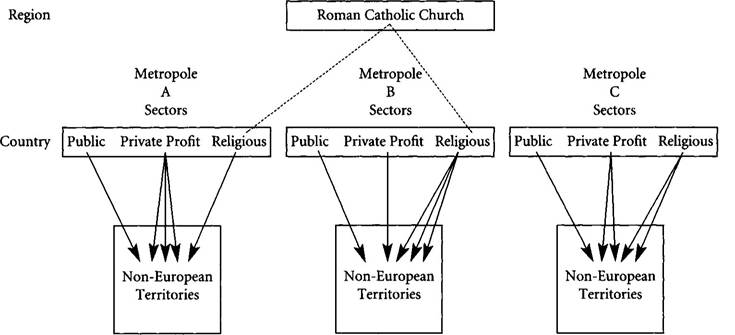
European countries have historically been highly institutionalized, autonomous, and sufficiently prestigious to recruit widely for able, suitably motivated personnel.
These qualities gave each sector the capacity to reach beyond a country’s borders. Monarchs, merchant companies, and missionary bodies were able to dispatch agents to distant lands while the structures controlling or supervising overseas activities remained on European soil.To the capacity to mount overseas initiatives was added a will to do so. The primary motivation varied by sector. But whether it was power or profit or prosely- tization, sectoral actors believed that what their agents did abroad could complement and fulfill work done in familiar home settings.
The activities and interactions of sectoral institutions constitute the most vital factor behind European global dominance. These institutions did the real work of constructing empires. Because their specialized activities, taken together, covered many functions, they could recruit agents with a wide range of backgrounds, skills, and motivations. They sustained links between agents in distant lands and power centers in Europe. By tapping diverse sources of finance they made it easier to cover initial costs of exploratory initiatives than if only one sector were involved. Their impact derived in part from the sheer number of actors involved. When each of several European states contained institutions in several sectors with the capacity and will to operate overseas, chances that someone, sometime, would establish an effective presence abroad rose. The cumulative impact of sectoral activity was enhanced by the relative autonomy each sector enjoyed. Governmental, profit-seeking, and religious institutions had leeway to operate overseas on their own. They did not have to wait for jointly sponsored ventures that might not materialize. Autonomy in turn made possible a high degree of tactical flexibility. It is not accidental that in phase i missionary orders played a major role in the Americas, where indigenous opposition to Christianity was weak, while informal influence was exercised primarily by (secular) trading companies in parts of Asia like India and the East Indies, where Islam’s prominence severely limited missionary prospects. Merchants and missionaries were able to carry on their work in societies whose rulers would quickly have repelled soldiers dispatched by a European government on a mission of conquest. Chapter 9 describes the range of tactical options available when several sectors were involved and shows how Europeans adjusted techniques for gaining footholds overseas depending on circumstances specific to the societies they encountered.
Sectoral institutions found they could usefully collaborate as well as operate on their own. Both expansionist phases featured more or less formal coalitions between institutions in the public and private profit sectors (chartered companies) and between governments and officially supported churches. In some instances—France in phases i and 3, Britain and Germany in phase 3—triple coalitions among soldier I administrators, merchants, and missionaries were formed.
When functionally specialized institutions collaborated they increased their capacity to control other people’s behavior. To the extent that the public sector relied on coercion, the private profit sector on material reward, and the religious sector on normative appeals, a cross-sector alliance meant a mix of compliance mechanisms likely to have far greater impact than if only one mechanism were at work. The cumulative effect of organized, deliberately coordinated attacks on the political structures and modes of production and religious beliefs of non-European societies made it difficult to mobilize effective popular resistance. Repelling a triple assault posed a difficult and frequently insuperable challenge.
Portugal’s conquest of Malacca illustrates the empowering effect of crosssector coalitions. Portuguese initiatives featured close collaboration between merchants and agents of the Crown, with strong support from the Catholic Church. The city’s Chinese and Arab residents, for their part, were unable or unwilling to assemble equivalent coalitions to defeat the invader. What happened in Malacca in 1511 cannot prove that the sectoral component of my theory of imperialism is valid. But because this place and time provide such a significant “laboratory” test of the theory’s spatial comprehensiveness, findings from those events offer valuable supporting evidence.
By combining levels of analysis in table 2.3 one can see the dynamic, synergistic character of Europe’s presence overseas. For instance, it is easy to see how formation of a cross-sector coalition in one expanding state could trigger formation of similar coalitions in others. Proliferation of chartered companies among several metropoles in the seventeenth century may be due to this sort of dynamic. Replication of coalitional patterns within several states increased the likelihood of struggle among them for available overseas possessions. When entrepreneurs or missionaries from one state found themselves competing with counterparts from another state for predominance in an area, an obvious response was to seek assistance from their respective home governments. Chances of a turf war between two metropoles were increased when nongovernmental actors from the two countries were waging trade wars and conversion wars on that same turf.
Colonized Peoples: General Features
The enormous diversity among peoples incorporated into overseas empires precludes generalizing about them the way one can about west Europeans. For example, many non-Europeans lived in stateless societies, others in states. It is less inaccurate to refer to them by nonpolitical expressions like “peoples” or “societies” than to employ a term like “state,” which does in fact apply to all European metropoles. Chapter 10 trains the zoom lens on colonized peoples. It notes many situations in which non-Europeans’ actions had the effect though not the intent of facilitating political subordination. Chapter 10 does not advance the obviously false claim that non-European societies were alike in all or even many respects when they encountered Europeans. The argument is rather that some attributes were present in many non-European societies at the moment of contact, and that where a specific feature was present it increased the likelihood of subordination.
Several recurring patterns are noteworthy:
States capable of defeating the first European arrivals were generally land-based and had limited control over coastal zones and little interest in defending against maritime invasion. Europeans took advantage of the surprise factor when they landed, quickly setting up fortified coastal enclaves. The physical base was thereby established for penetration inland. This could take place later when the enclave was strengthened by ships bringing the latest round of men, weapons, transport equipment, medicine, and the like. Hinterland polities were at a strategic disadvantage when confronted by aggressive seafarers.
Initial encounters with Europeans were persistently based on misunderstandings of what the newcomers wanted. Europeans were often treated hospitably as visitors when in fact they had a permanent stay in mind. When land first exchanged hands non-Europeans interpreted the transaction as a temporary, carefully qualified loan of use rights, whereas Europeans saw it as a permanent, unqualified, and full transfer of ownership rights. Such misunderstandings enabled land-hungry settlers and others to entrench themselves on foreign soil. When indigenous people realized that they had misinterpreted what was happening, it was usually too late to take back alienated land. At the moment of contact non-Europeans were able to resist Europeans but were frequently unwilling to do so because they did not believe newcomers posed a serious threat. When at a later point non-Europeans did have the will to resist they lacked the capacity to expel or exterminate outsiders who by then had become entrenched. In both situations non-Europeans lacked power, though for opposite reasons in each case.
• To the extent that non-European societies did not possess or value the explore- control-utilize syndrome, they were at a power disadvantage when encountering people who did. Where institutions and norms did not support scientific investigation and technological development, it was practically impossible to resist invaders who could call upon the latest round of advances generated by their home societies.
Relations among Societies
Empire building in both expansionist phases was made easier by competition among non-European societies. Indigenous political elites often requested Europeans to ally with them against a rival neighbor. A local pull factor thus reinforced external push factors discussed earlier. At work here was not a misreading of European capacity but, on the contrary, intense awareness of the strategic value of having well-armed foreigners on one’s side.The initiatives indigenous elites took to solicit European support were motivated more by the current threat posed by nearby enemies well known to them than by threats a few poorly understood strangers might pose in a dimly imagined future. Elites had a firm grasp of their societies’ interests. They could not have known when they tried to advance those interests by forging an alliance that Europeans would use it to advance European interests at the expense of indigenous clients. Each side attempted to use the other for its own ends. Non-Europeans understood their current condition but seriously miscalculated how they would ultimately fare in the high-stakes game of mutual manipulation.
Europeans were often asked to take sides in disputes within other societies, with similar results. To take a recurring pattern, a state lacking rules for succession to the monarchy was thrown into crisis when its ruler died. An aspirant to the throne sought support from a European to strengthen his hand against other contenders. The outsider was only too happy to oblige, using the invitation as an opportunity to play off rival parties against each other (see chapter 10).
Invitations to intervene in peoples’ affairs enabled Europeans to establish beachheads of influence and power at little expense to themselves. Their initially limited capacity to control people in distant lands was offset by unusually low costs of entry to non-European public sectors.
Sectors
Did sectoral institutions equivalent to those in Europe exist in other continents? If so, were they able to block agents of European governments, companies, and missionary agencies from penetrating their societies? Degrees of success in countering the triple assault varied greatly from one society and time period to another. What explains these variations is not clear. Fragmentary evidence suggests that a society was especially vulnerable to takeover when its sectoral activities were assigned unequal statuses. If indigenous government officials looked down on artisans and traders, for example, it would be difficult to link public and private profit sectors to resist an equivalent cross-sector coalition fashioned by European invaders. Or if political, economic, and religious tasks were assigned to castes occupying very different positions on the status hierarchy, a society was weakened because of self-imposed restrictions on recruiting people most qualified to fill various tasks.
More on the topic CONDITIONS CONDUCIVE TO EUROPEAN GLOBAL DOMINANCE:
- Abernethy David B.. The Dynamics of Global Dominance: European Overseas Empires, 1415-1980. Yale University Press,2002. — 524 p., 2002
- This chapter provides conceptual toolsto account for the rise and decline of European global dominance. Chapters 3-7 in part 2 are largely descriptive.
- 14 EUROPEAN STATE, GLOBAL NATION 1833–1974
- A. Dominance of Guardians
- The Rise of Polish and Lithuanian Dominance
- How European is the ‘European’ Legal Tradition?
- Global Fiscal Policies Implemented Within the Scope of Fight Against COVID-19, a Global Public Bad
- CONCEPT 18.2 Global patterns of species diversity and composition are influenced by geographic area and isolation, evolutionary history, and global climate.
- This chapter will explore ritual violence in the form of close combat in precolonial western Africa (and the African diaspora) during the period of European contact from the mid fifteenth century until the late nineteenth century, a period which saw an end to the slave trade and the start of European colonisation.
- FOOT CONDITIONS CAUSING LAMENESS
- 3 The Notice Conditions
- PART VII THE GLOBAL TURN
- 6 Conditions on Permitted Development Rights
- Socioeconomic Conditions
- Behaviors are determined by genes and by environmental conditions
- Autonomous survival in extreme environmental conditions